Francisco Goya
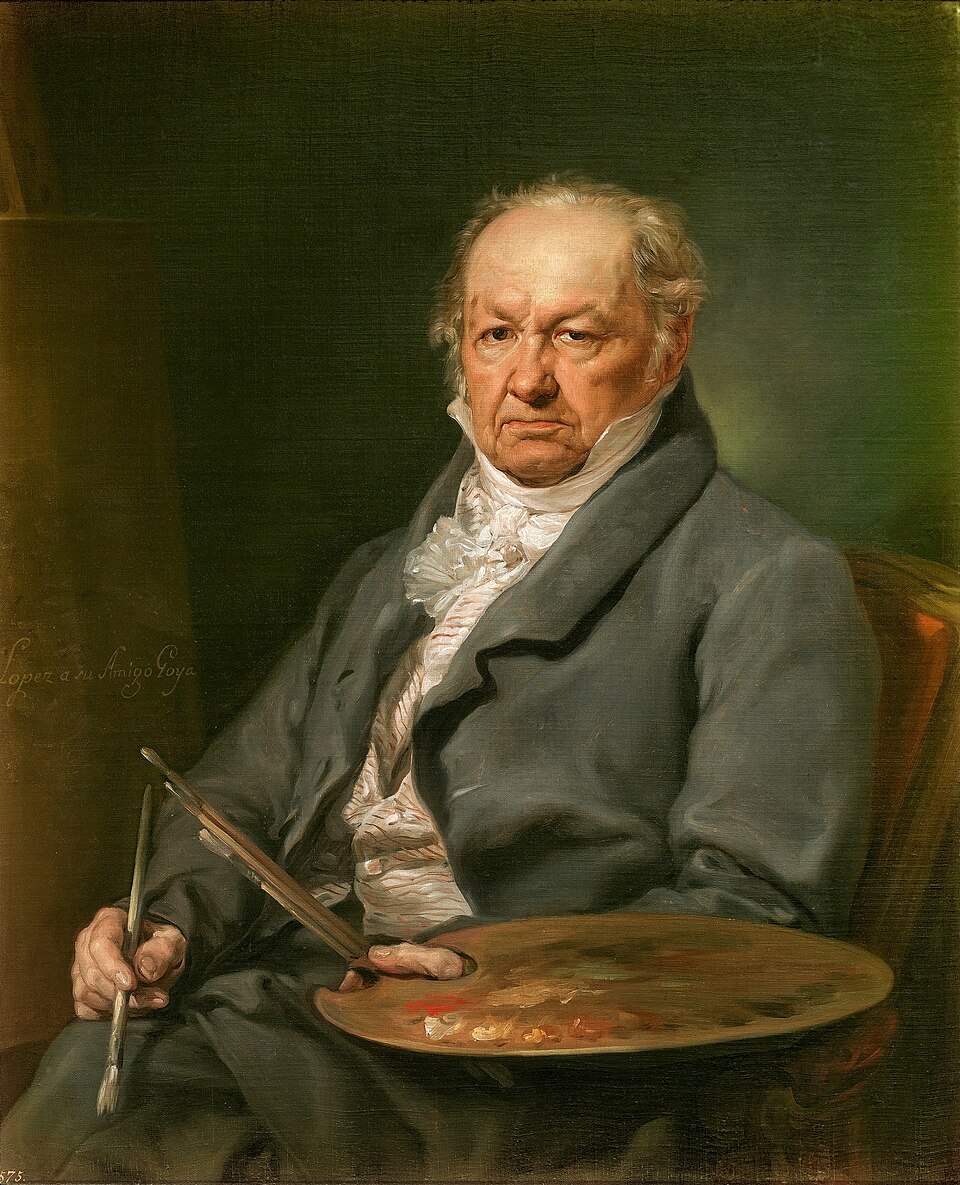
Court painter to the Spanish Crown who turned the machinery of official portraiture against power itself, producing works of political terror and psychological darkness that define the boundary between the Old Masters and modernity.
Francisco Goya spent the first half of his career producing tapestry cartoons and society portraits that satisfied the conventions of Bourbon Madrid. The second half dismantled those conventions entirely. Court painter, war witness, and recluse, he moved from decorative luminosity to images of massacre, hallucination, and dread that anticipated Romanticism, Expressionism, and Surrealism without belonging to any of them. His position as the most important Spanish painter between Velázquez and Picasso is unchallenged.
Formation and early career
Born in Fuendetodos, Aragon, on 30 March 1746, Goya was apprenticed to the painter José Luzán in Zaragoza at the age of fourteen. Two early attempts to win the Rome Prize of the Royal Academy of San Fernando in Madrid failed. He spent time in Italy independently around 1770–1771, then returned to Zaragoza to paint frescos in the Basilica del Pilar. By 1773 he had married Josefa Bayeu, sister of the court painter Francisco Bayeu, and moved to Madrid. Royal Tapestry Factory commissions followed — a long series of cartoons depicting leisure scenes in a palette of warm ochres and sky blues, technically accomplished and formally conventional.
Court painter and observer of power
Goya was appointed painter to King Charles III in 1786 and reached the apex of official recognition when Charles IV named him First Court Painter in 1799. His royal portraits are simultaneously flattering in scale and merciless in observation. The Family of Charles IV (1800–1801) arranges the royal household with Velázquezian precedent but drains the sitters of dignity; contemporaries noticed; historians have debated ever since whether the unflattering likeness was deliberate. The same period produced the paired portraits of the Majas — clothed and nude — whose subject remains disputed but whose frank eroticism was unusual for the time.
A severe illness in 1792–1793 left Goya profoundly deaf. The isolation altered his character and, visibly, his art. Cabinet paintings from this period show accident, violence, and madness rendered in rapid, summary brushwork.
War, prints, and political witness
The French invasion of Spain in 1808 and the subsequent Peninsular War gave Goya material for his most consequential work. The Second of May 1808 and The Third of May 1808 (both 1814) document the uprising against Napoleon's forces and its suppression with an urgency foreign to any previous history painting. The lantern-lit execution scene of The Third of May established a compositional template that Manet, Picasso, and others would revisit directly.
The print series The Disasters of War, made between approximately 1810 and 1820 but not published until 1863, constitutes perhaps the most sustained anti-war document in the history of Western art. Eighty-two etchings record atrocity without heroism, sentiment, or redemptive frame.
Nada. Ello dirá.
The Black Paintings and exile
After the restoration of Ferdinand VII and the suppression of liberal reforms, Goya moved to a country house outside Madrid he called the Quinta del Sordo (House of the Deaf Man). On its walls he painted directly, in oil, a series of mural-scale works now known as the Black Paintings. Executed between approximately 1819 and 1823, they include Saturn Devouring His Son, The Great He-Goat (Witches' Sabbath), and The Dog — works of raw, unmediated imagery made for no patron and apparently for no audience but himself. In 1824, fearing further political repression, he left for Bordeaux, where he remained until his death on 16 April 1828.