Frida Kahlo
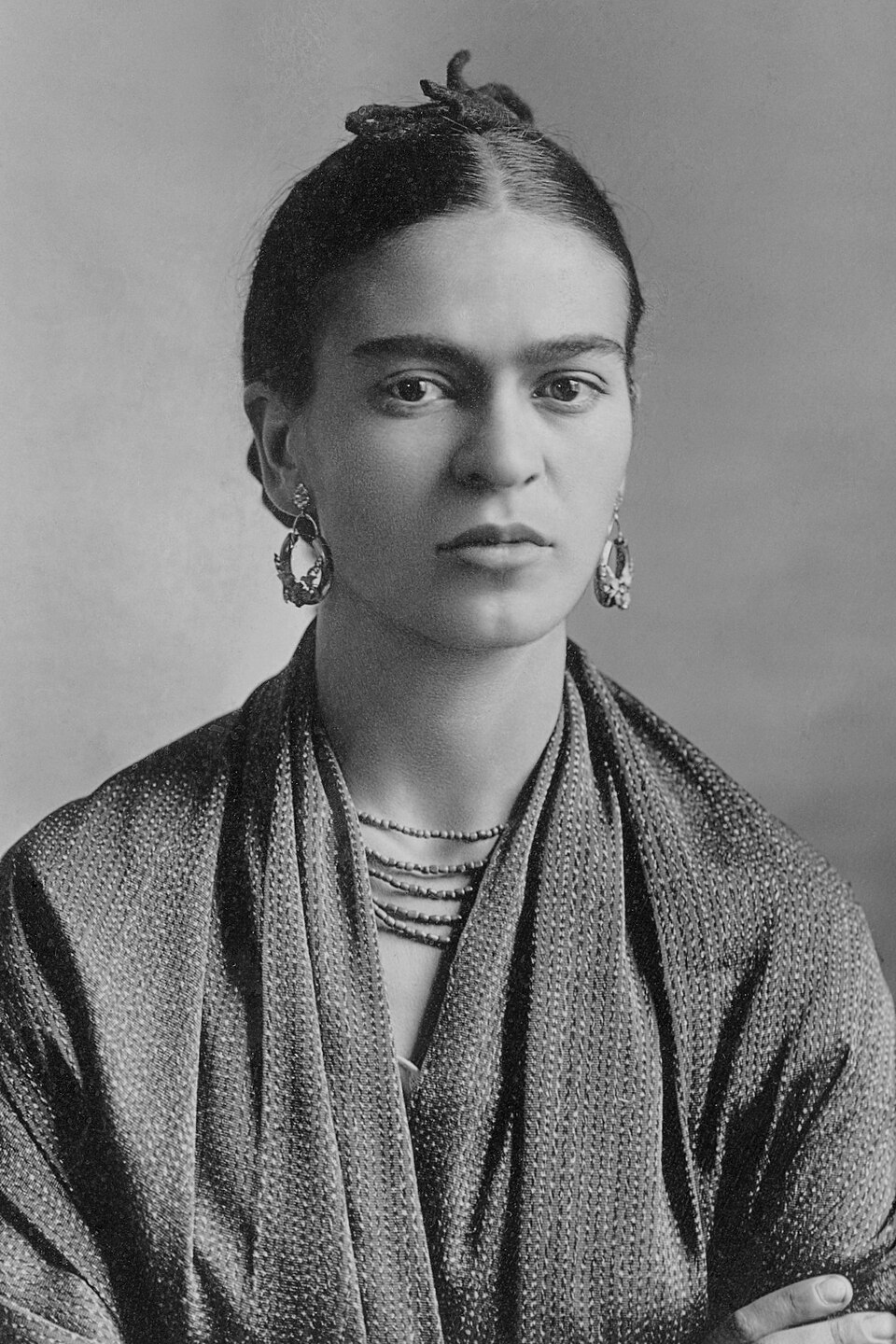
A painter who transformed physical and political pain into an iconography so precise and personal it became a universal language.
Frida Kahlo painted herself with the rigour of a clinical record and the strangeness of a dream — the broken spinal column, the Tehuana dress, the unibrow, the hummingbirds. Her body was her primary subject because her body was her primary experience: of accident, of surgery, of political identity, of desire. That she made this private catastrophe into universal art remains one of the most remarkable achievements of the twentieth century.
Early life and the accident
Kahlo was born in Coyoacán, then on the outskirts of Mexico City, in 1907. At age six she contracted polio, which left her right leg slightly thinner and shorter; she disguised this for most of her life with long skirts. She was an exceptional student and gained a place at the prestigious National Preparatory School in Mexico City, one of only thirty-five women in a class of two thousand. There she first encountered Diego Rivera, who was painting murals at the school.
In 1925, at eighteen, she was involved in a catastrophic bus accident. A steel handrail pierced her body; she suffered a broken spinal column, collarbone, ribs, and pelvis, a shattered right leg, and a crushed right foot. Surgeries and recovery consumed more than a year. During her convalescence she began to paint, using a specially designed easel that allowed her to work lying down, and a mirror mounted overhead so she could see herself. Of the roughly 143 paintings she completed over her lifetime, 55 are self-portraits.
The self-portrait as method
Kahlo refused the label Surrealist that André Breton applied to her work when he encountered it in the late 1930s. "I never painted dreams," she said. "I painted my own reality." The distinction was precise: her imagery was strange but never arbitrary. Each element — the deer shot through with arrows in The Wounded Deer (1946), the twin selves joined by a shared circulatory system in The Two Fridas (1939) — was emotionally and autobiographically specific.
Her use of Mexican popular culture — the ex-voto format, Tehuana costume, folk medicine imagery, colonial saints — was equally deliberate. She was a committed participant in the post-revolutionary Mexicayotl movement, which sought to define an indigenous Mexican identity against European cultural dominance.1
| Work | Date | Subject |
|---|---|---|
| The Two Fridas | 1939 | Dual identity; divorce from Rivera |
| Self-Portrait with Thorn Necklace and Hummingbird | 1940 | Pain and Mexican symbolism |
| The Broken Column | 1944 | Spinal surgery; bodily disintegration |
| The Wounded Deer | 1946 | Illness; self-identification with wounded animal |
Diego Rivera and political commitment
Kahlo married Rivera in 1929, divorced in 1939, and remarried in 1940. Their relationship was by all accounts turbulent — both were serially unfaithful — and its emotional content runs through much of her work. Rivera was a dominant figure in Mexican cultural politics; Kahlo was an active Communist Party member, hosting exiled Leon Trotsky in the Casa Azul in 1937.
Her political commitment was not decorative. She understood her art and her identity — indigenous ancestry, disability, bisexuality — as inseparable from questions of class, race, and colonial history.
Reception and legacy
Kahlo had her first solo exhibition in Mexico in 1953, the year before her death. Her international recognition came largely posthumously. The 1970s feminist art movement reclaimed her as a central figure; major retrospectives followed in the 1980s at institutions including the Whitechapel Gallery in London. Her self-portrait The Dream (also known as The Bed) holds the record for the most expensive work by a Latin American artist at auction. The Casa Azul in Coyoacán, where she was born and died, is now the Museo Frida Kahlo.
I never painted dreams. I painted my own reality.
Footnotes
- The Mexicayotl movement explicitly drew on pre-Columbian imagery and rejected the European academic tradition as a foreign imposition. ↩