Georges Braque
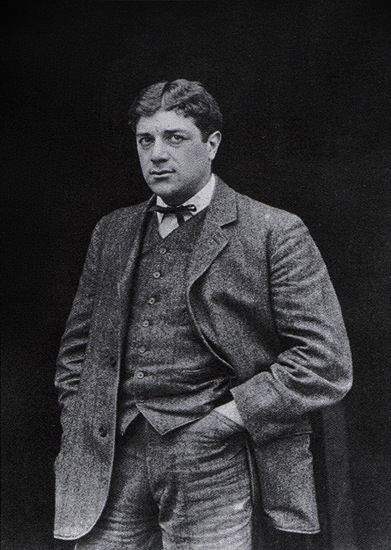
The painter who, with Picasso, invented Cubism and then quietly surpassed it — building a body of work whose still lifes and studio paintings are among the most sustained achievements in twentieth-century painting.
Georges Braque and Pablo Picasso worked in such close proximity between 1908 and 1912 that they themselves sometimes could not identify which of them had made a given canvas. That Analytic Cubist period — the most compressed and radical joint enterprise in modern art — was Braque's making; but the trajectory of his work after it was entirely his own: slower, more ruminative, returning obsessively to the studio as a subject until his death in 1963.
Formation and the Fauvist interlude
Braque was born in Argenteuil and grew up in Le Havre, where his father was a house painter and decorator. He trained as a house painter himself before moving to Paris to study painting at the École des Beaux-Arts and the Académie Humbert. In 1905 the Salon d'Automne's retrospective of Cézanne and the violent colour of the Fauves — Matisse, Derain, Vlaminck — struck him simultaneously, and his work of 1906–07 is brightly Fauvist.
The decisive shift came in the summer of 1908 when he went to L'Estaque to paint landscapes in the Cézannian manner, reducing houses and trees to geometric volumes. The dealer Daniel-Henry Kahnweiler showed the resulting pictures; Matisse, on the jury that had rejected them at the Salon d'Automne, described the forms as "little cubes." Cubism had a name.
The Picasso collaboration
From 1908 to 1914 Braque and Picasso worked in overlapping dialogue, developing the successive stages of Cubism: the faceted geometric surfaces of the Analytic phase; then, from 1912, the introduction of pasted papers and newsprint — papiers collés — that initiated Synthetic Cubism. This collage technique was Braque's invention; Picasso immediately adopted it.
The collaboration ended abruptly in August 1914 when Braque was mobilised. He was severely wounded at Carency in 1915 — a head wound requiring trepanation — and was discharged from military service in 1917. By the time he returned to painting, Picasso's public trajectory had diverged dramatically. Braque chose not to compete on celebrity.
Still life and the studio
The defining subject of Braque's mature work was the painter's studio itself — the table, the palette, easels, objects, birds in flight. He returned to the Atelier series throughout the 1940s and 1950s, producing eight large canvases of exceptional density. These are not inventories but meditations: the objects hover in ambiguous space, layered through shallow depth that still bears the memory of Analytic Cubism's simultaneous viewpoints.
His still lifes, from the interwar period onward, are among the most formally resolved works of the century — spare, tactile, occupied with the character of surfaces: the opacity of clay versus the reflectiveness of glass, the weight of a tablecloth against the lightness of a lemon.
The painting is finished when it has effaced the idea.
Legacy
Braque was made a Commander of the Legion of Honour. His ceiling for the Etruscan room of the Louvre was completed in 1953. He was given a state funeral in 1963 and buried beneath the west window of the church at Varengeville-sur-Mer, where he had often worked — a site with a Braque stained-glass window, made to his own design.