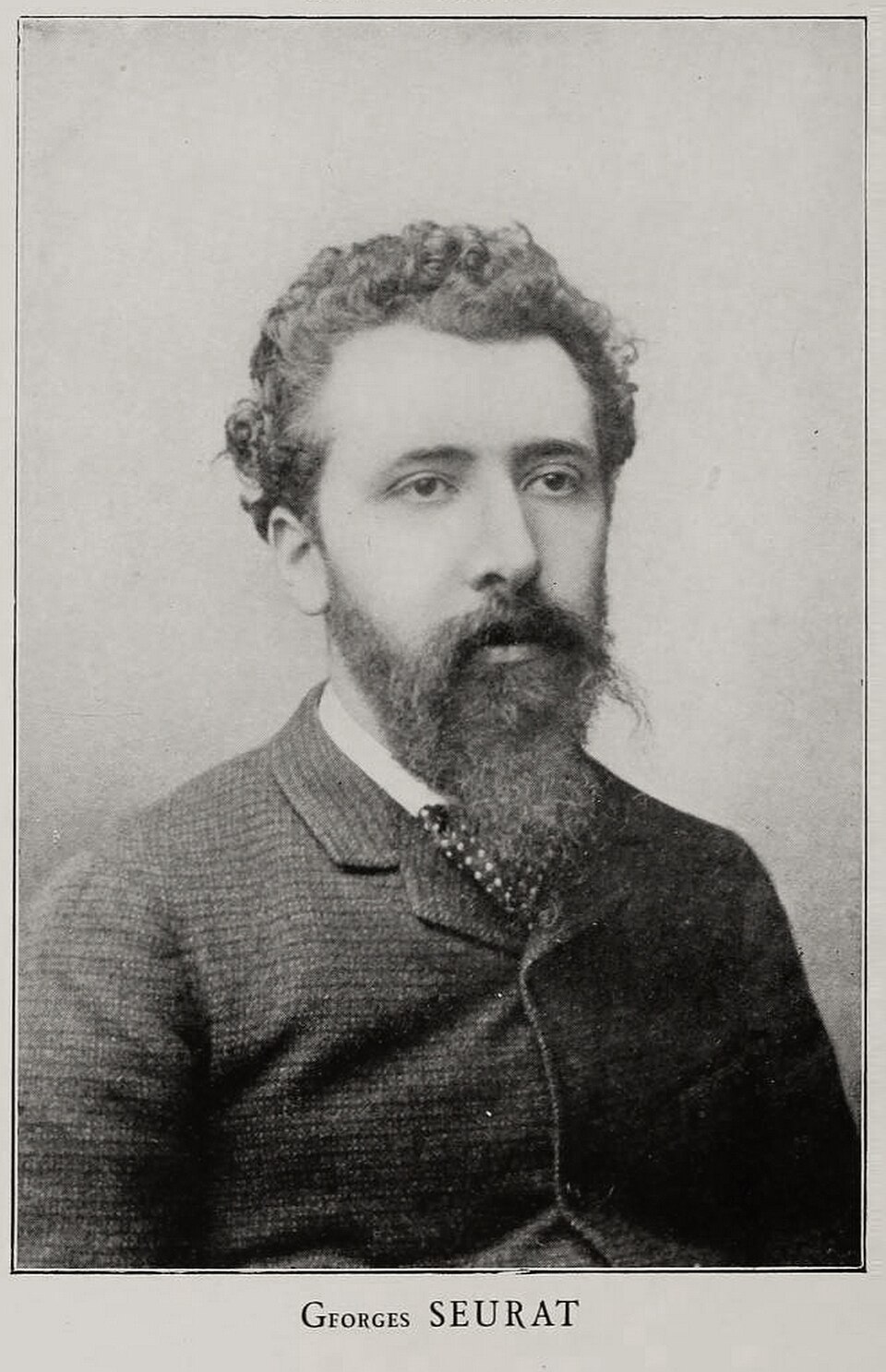
Georges Seurat
He replaced intuition with optical science and built the largest painting of his generation one dot at a time.
Georges Seurat was thirty-one when he died, yet he had already transformed the basis on which painting was made. Working from the colour theories of Eugène Chevreul and Ogden Rood, he replaced Impressionist intuition with a systematic method — chromoluminarism, later called Pointillism — in which pure pigments applied as discrete dots mix in the viewer's retina rather than on the palette. The result was painting as optical argument.
Formation
Seurat entered the École des Beaux-Arts in 1878 and completed his military service in Brest in 1879–80, where he drew constantly. Back in Paris, he studied the science of colour perception with the same rigour he applied to traditional draughtsmanship. His early drawings in conté crayon — black pigment on rough paper, figures dissolved in halftone — are independent achievements, not preparatory exercises. They demonstrate total control of tonal gradation through the texture of the medium itself.
Bathers at Asnières and La Grande Jatte
Bathers at Asnières (1884) was Seurat's first large-scale submission to public exhibition, rejected by the Salon and shown instead at the newly formed Société des Artistes Indépendants. It is painted with broad, directional strokes rather than the dots of full Pointillism — a transitional method — and depicts working-class men at rest on the Seine. The following two years Seurat spent constructing A Sunday Afternoon on the Island of La Grande Jatte (1886): a canvas roughly two by three metres, every centimetre built from small, systematic dabs of pure colour. When it appeared at the eighth and final Impressionist exhibition, it was received as a declaration against the movement it was shown alongside.
They see poetry in what I have done. No — I apply my method, and that is all.
Method and influence
Seurat codified his approach as chromoluminarism: colour contrasts, the optical fusion of complementaries, and the control of tone through dot density rather than pigment mixing. He worked out the compositional logic of each painting through numerous oil sketches (croqueton) before touching the final canvas. Paul Signac became his closest collaborator and systematiser, and Camille Pissarro briefly adopted the method. Seurat's last major works — La Parade de cirque (1888) and Le Chahut (1890) — explore how line direction and colour temperature encode emotional tone, a theory he developed with the aesthetician Charles Henry.
Legacy
Seurat died of an unidentified illness, possibly diphtheria, in March 1891. He was thirty-one. His influence on twentieth-century art is structurally deep: the logic of systematic visual decomposition runs through Neo-Impressionism, the Op art of the 1960s, and digital pixel imaging. La Grande Jatte remains one of the most studied paintings in the Western canon.