Georgia O'Keeffe
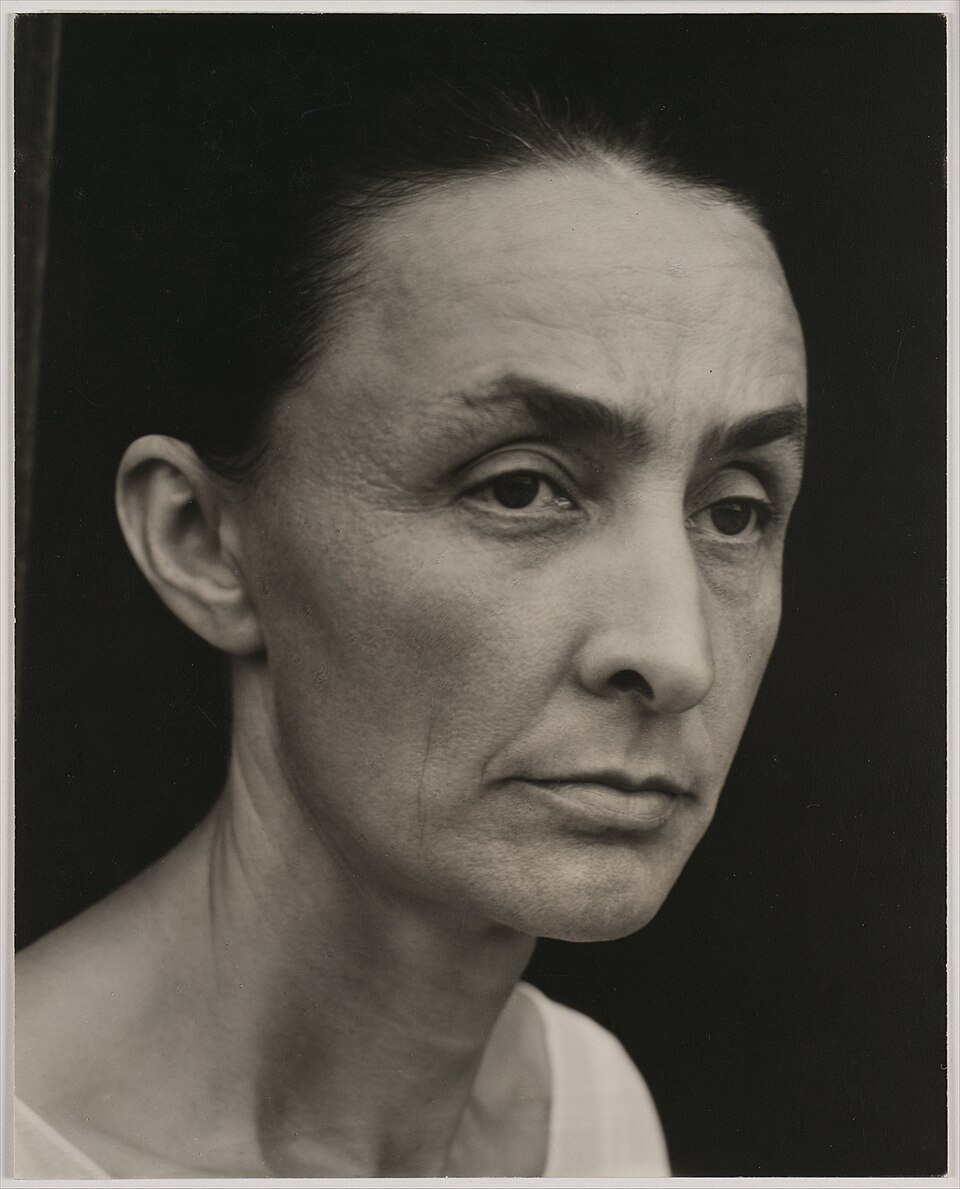
The American painter who found in the flowers and bones of the high desert a visual language both rigorously abstract and unmistakably her own.
Georgia O'Keeffe spent nearly a century building one of the most independent careers in American art, moving from the galleries of New York to the high desert of New Mexico and finding, in both, subjects that resisted every available interpretive framework. She worked until she could no longer see, and her final works were made with her hands.
Formation and New York
O'Keeffe was born in Sun Prairie, Wisconsin, in 1887, and knew from an early age that she wanted to be an artist. She studied at the Art Institute of Chicago and the Art Students League in New York before taking a position teaching art in Texas, where the flat expanse of the Panhandle landscape began shaping her sense of what a painting could address. In 1915 she sent a series of abstract charcoal drawings to a friend in New York, who showed them without permission to the photographer and gallerist Alfred Stieglitz. He exhibited them at his gallery 291 in 1916. The two began a correspondence; O'Keeffe moved to New York in 1918. She and Stieglitz eventually married in 1924.
Stieglitz photographed O'Keeffe obsessively over decades — more than three hundred photographs — and promoted her work through his galleries, but the relationship was also constraining. The psycho-sexual readings that critics attached to her large-scale flower paintings — Black Iris (1926), Jimson Weed/White Flower No. 1 (1932) — were readings she consistently rejected. She maintained that she was painting what she saw, at a scale that forced the viewer to look: the flowers were simply enlarged until they could not be ignored.1
New Mexico and the desert
O'Keeffe first visited New Mexico in 1929 and returned every summer. After Stieglitz's death in 1946 she moved there permanently, settling at Ghost Ranch near Abiquiú. The landscape reorganised her painting entirely. The bleached skulls and pelvic bones she found in the desert became recurring subjects — not symbols of death but, as she insisted, objects of pure form and colour, white against the deep blue of the New Mexico sky. Ram's Head White Hollyhock and Little Hills (1935) demonstrates her method: the skull is rendered with the same precise attention as the flower beside it, both equally strange, equally formal.
The paintings of the New Mexico years address the horizontal vastness of the Chama River valley, the mesa cliffs of Black Place, the aerial views she began painting after transcontinental air travel became common. A series of sky and cloud paintings from the 1960s shows the same rigorous attention applied to atmosphere. Her work from these decades ran consistently ahead of critical categories: it was not surrealism, not abstract expressionism, not the feminism critics tried to apply retroactively.
Independence and legacy
O'Keeffe resisted categorisation throughout her life and was in many respects not well served by the critical frameworks available to her. She was associated with the New York avant-garde through Stieglitz but lived largely outside it; she was a woman artist of extraordinary ambition at a time when the institutional structures of American art were largely hostile to women. She received the Presidential Medal of Freedom in 1977 and the National Medal of Arts in 1985. She died in Santa Fe on 6 March 1986, aged 98.
| Subject | Period | Example |
|---|---|---|
| Abstractions | 1915–1920 | Blue and Green Music |
| Flowers | 1924–1936 | Black Iris; Jimson Weed |
| New York buildings | 1925–1930 | The Shelton with Sunspots |
| Bones and desert | 1930–1950 | Ram's Head White Hollyhock |
| Skies and clouds | 1958–1965 | Sky Above Clouds series |
Nobody sees a flower, really — it is so small — we haven't time, and to see takes time, like to have a friend takes time.
Footnotes
- O'Keeffe wrote: "Nobody sees a flower, really — it is so small — we haven't time, and to see takes time, like to have a friend takes time." This documented statement is her clearest articulation of the scale strategy behind the flower paintings. ↩