Gustav Klimt
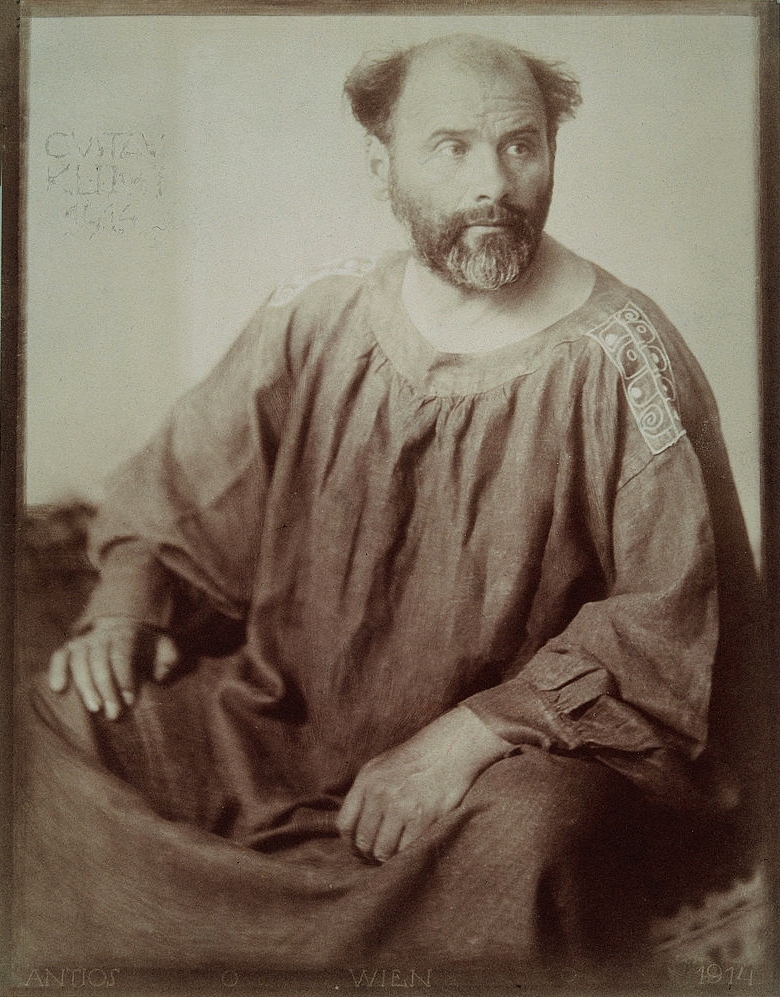
The Vienna Secession painter who dissolved the boundary between ornament and subject, wrapping the human body in gold until flesh and pattern became one.
Gustav Klimt transformed European painting by dissolving the distinction between high art and applied decoration. Working in Vienna at the turn of the twentieth century, he built surfaces of gold leaf, geometric mosaic, and Byzantine pattern around figures of frank erotic weight — an aesthetic so coherent and so unlike anything before it that it became instantly, indelibly his own.
Formation and the Vienna years
Klimt was born in Baumgarten, near Vienna, in 1862, the second of seven children of a goldsmith — an inheritance that showed. He trained at the Vienna School of Arts and Crafts and worked through the 1880s on large decorative commissions for public buildings, including ceiling paintings for the Vienna Burgtheater and the Kunsthistorisches Museum. The work was accomplished and conventional.
The break came in 1897, when Klimt co-founded the Vienna Secession with a group of artists and architects who rejected the conservative historicism of the official Künstlerhaus. The Secession's motto — Der Zeit ihre Kunst, der Kunst ihre Freiheit ("To every age its art, to art its freedom") — named the ambition exactly.
The gold phase
Around 1899, Klimt began incorporating genuine gold leaf into his paintings, moving toward a style so decorated that surface and subject become inseparable. The works from this period are simultaneously figurative and abstract: a recognisable human body anchors each composition, but the space around it — clothing, background, ground — dissolves into tessellated pattern derived from Byzantine mosaics and Japanese decorative art.
Portrait of Adele Bloch-Bauer I (1907) is the most extreme example: the sitter's face and hands are the only undecorated zones in a field of gold. The Kiss (1907–08) takes the same logic further — two figures in an embrace so consumed by gold and geometric ornament that individuality nearly disappears into pattern.
Whoever wants to know something about me — as an artist, which alone is significant — they should look attentively at my pictures.
Landscapes and late work
Alongside his figure paintings, Klimt produced a substantial body of landscape work — square-format canvases of gardens, orchards, and lakesides painted in high summer at the Attersee, where he spent his vacations. These works are pointillist in texture, built from dense touches of colour, and share none of the ornamental programme of the gold paintings. They are quieter and more surprising, and critics have increasingly placed them at the centre of his achievement.
Legacy
Klimt died in February 1918 from pneumonia following a stroke, months before the end of the First World War and the collapse of the empire whose culture he had decorated. He was fifty-five. His influence on Art Nouveau and Symbolism was immediate; his influence on subsequent generations came partly through his most famous works and partly through his role as teacher and mentor to Egon Schiele. The restitution of his work — several major paintings, including the Bloch-Bauer portrait, were looted by the Nazis and returned to heirs in the early 2000s — has kept him in public discourse.