Gustave Courbet
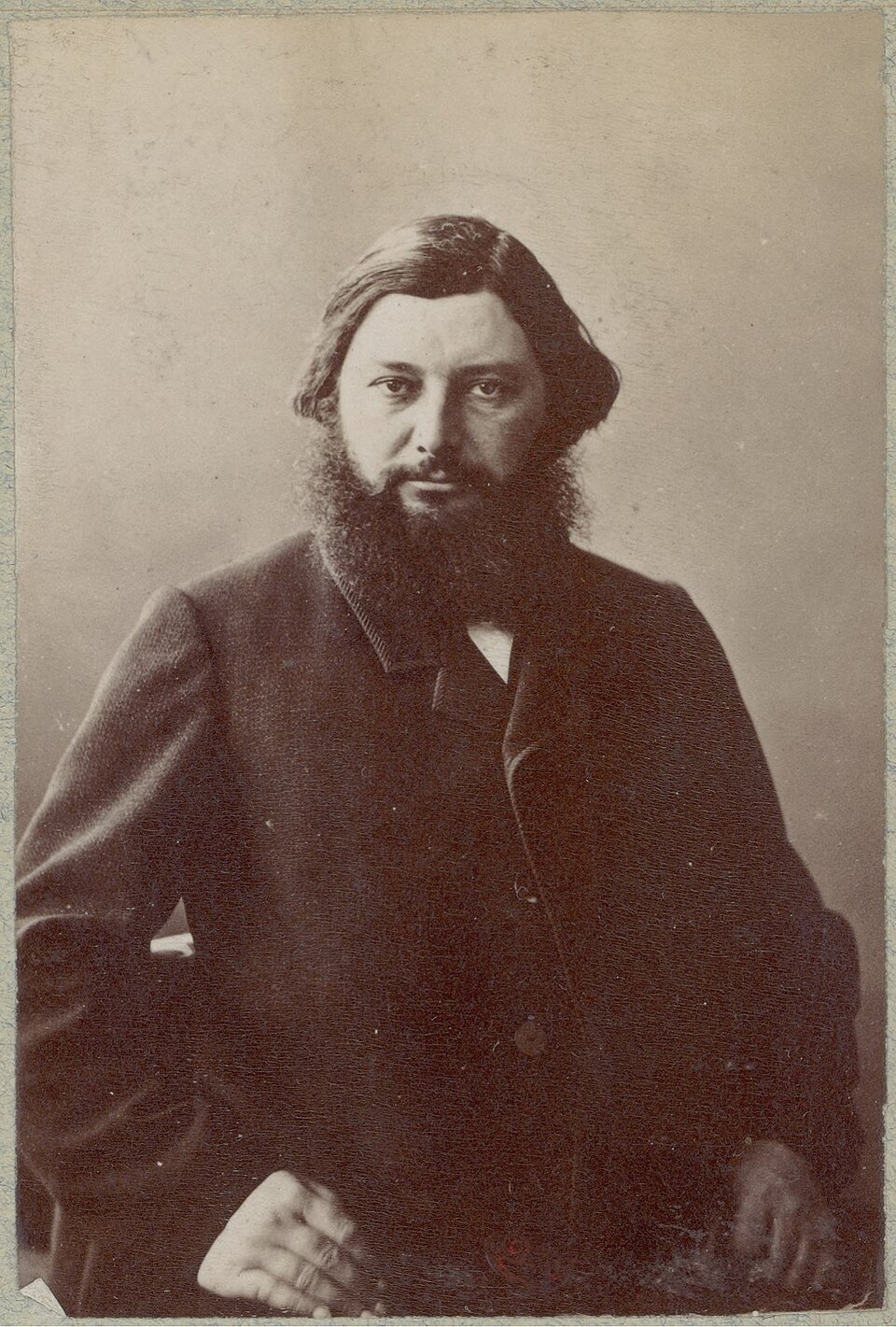
The combative founder of Realism, who insisted painting confine itself to the visible world and turned that discipline into a political act.
Jean Désiré Gustave Courbet was the founder and most forceful practitioner of Realism in nineteenth-century French painting. Rejecting both the mythological grandeur of Neoclassicism and the literary heightening of Romanticism, he committed himself to painting only what could be directly observed — laborers, funerals, nudes, landscapes, animals — at a scale and gravity previously reserved for history painting. The provocation was aesthetic, social, and political simultaneously.
Ornans and Paris
Courbet was born on 10 June 1819 in Ornans, a small town in the Franche-Comté near the Swiss border, into a prosperous farming family. His father's land and the limestone landscape of the Loue valley river remained subjects throughout his career. He moved to Paris in 1839, nominally to study law; in practice he educated himself by copying in the Louvre — Velázquez, Rembrandt, and the Dutch masters above all — and submitting repeatedly to the Salon.
After years of rejections, the Salon of 1848 accepted ten of his works. The following two years would prove the pivot of his career.
The Realist offensive
In 1849 Courbet exhibited The Stone Breakers — two labourers, an old man and a boy, breaking rock on a road — at a scale traditionally reserved for epic subjects. The painting (destroyed in 1945 during the bombing of Dresden) depicted manual work with unsparing directness and no redemptive symbolic framework. A Burial at Ornans (1849–50), nearly ten metres wide, treated a provincial funeral with the compositional weight of a Venetian altarpiece and the social observation of Dutch group portraiture. Neither painting flattered its subjects or supplied consolation to its viewers.
The critical response was fierce and divided. Courbet encouraged the controversy. He positioned himself as the anti-academic painter of modern life, coining the term Réalisme and applying it to a personal exhibition he organized outside the Exposition Universelle of 1855, where he showed The Artist's Studio — a seven-metre allegorical canvas he subtitled "a real allegory summing up seven years of my artistic and moral life."
Politics and exile
Courbet was a committed anarchist, closely associated with the theorist Pierre-Joseph Proudhon. During the Paris Commune of 1871, he served as chair of a commission of artists and was implicated in decisions regarding the cultural heritage of Paris, most notoriously in the toppling of the Vendôme Column — a monument to Napoleonic military glory — in May 1871. After the Commune's suppression, he was convicted of complicity and sentenced to pay for the column's restoration, a cost that would eventually be set at 323,091 francs.
Unable and unwilling to pay, Courbet fled to Switzerland in 1873, settling in La Tour-de-Peilz on Lake Geneva. He died there on 31 December 1877, having spent his final years painting landscapes and seascapes in relative isolation.
To know in order to do: that was my idea. To be in a position to translate the customs, the ideas, the appearance of my epoch, according to my own estimation — to be not only a painter, but a man as well; in short, to create living art — this is my goal.