Hannah Höch
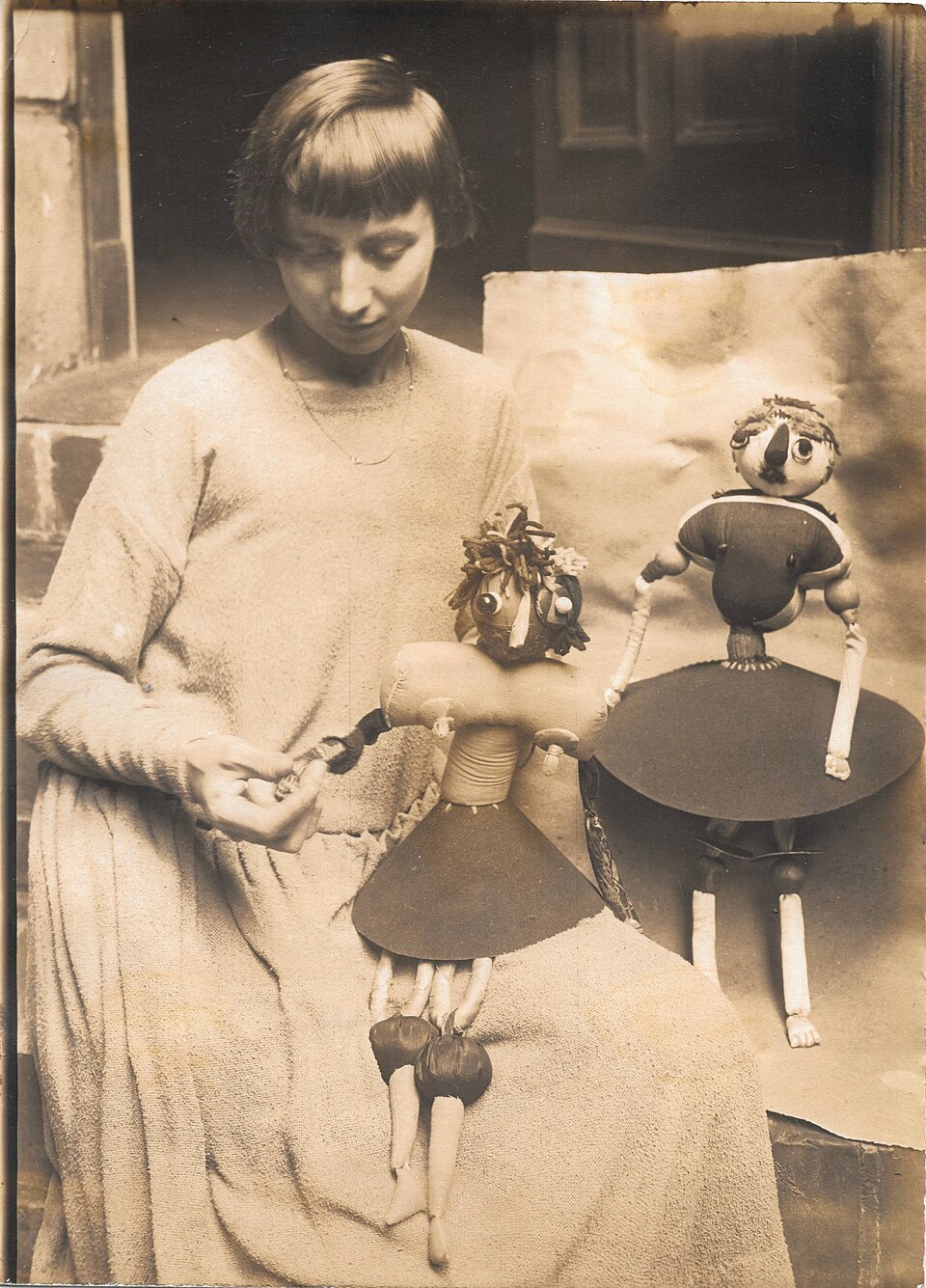
The Berlin Dadaist who invented photomontage as a political weapon and used it to dissect the contradictions of Weimar Germany's mass media with scissors and paste.
Hannah Höch was one of the originators of photomontage and the only woman in the core Berlin Dada group. She took images from the illustrated press — the mass media of the Weimar Republic — and cut and recombined them into works that exposed the contradictions of the age: the new woman of the magazines alongside the old violence of politics, the celebrity and the soldier, the advertisement and the corpse. Her masterwork Cut with the Kitchen Knife Dada through the Last Weimar Beer Belly Cultural Epoch of Germany (1919) remains one of the defining political artworks of the twentieth century.
Gotha and Berlin formation
Höch was born in 1889 in Gotha, Thuringia. She studied at the Berlin School of Applied Arts from 1912, interrupted by the war, and returned to study glassware and graphic design. From 1916 she worked for the publisher Ullstein Verlag designing embroidery and lace patterns — work that gave her access to illustrated magazines, and thus to the raw material of her photomontages.
She became involved with the Berlin Dada group around 1917 through her relationship with Raoul Hausmann. The group included Richard Huelsenbeck, George Grosz, John Heartfield, Johannes Baader, and Hannah Höch — its only female member. She was marginalised within the group and given domestic duties at meetings; she nonetheless produced some of the most significant works.
Cut with the Kitchen Knife
The photomontage Cut with the Kitchen Knife Dada through the Last Weimar Beer Belly Cultural Epoch of Germany (1919), measuring 114 by 90 centimetres, assembles dozens of images from illustrated magazines into a dense, layered field. Politicians, generals, and entertainers are rearranged and juxtaposed; captions are repurposed; the composition produces satirical meanings from the newspapers' own content.
The work was exhibited at the First International Dada Fair in Berlin in 1920, where it was hung near the ceiling — the position reserved for less important work. It is now in the Nationalgalerie, Berlin.
The Weimar Republic and its contradictions
Höch's photomontages of the 1920s repeatedly address the figure of the "New Woman" — the emancipated, professional, fashionable woman of Weimar Germany as represented in the illustrated press — with critical complexity. She neither simply celebrates nor dismisses the image; she subjects it to the same fragmentation she applies to everything else, showing how the press constructs and constrains female identity.
Her relationship with the Dutch writer Til Brugman from 1926 to 1935 was the longest of her life. She lived quietly through the Nazi period, tending a garden in Heiligensee, outside Berlin, where she buried works to protect them.
Legacy
Höch outlived most of her Dada contemporaries, dying in 1978 at the age of 88. The feminist art history of the 1970s retrieved her work from relative obscurity and established her centrality to the development of photomontage, collage, and the critique of mass media imagery. Her legacy was significant for artists working with appropriated images throughout the late twentieth century.
We took what we needed from wherever we could find it. The newspapers were full of the world.