Henri de Toulouse-Lautrec
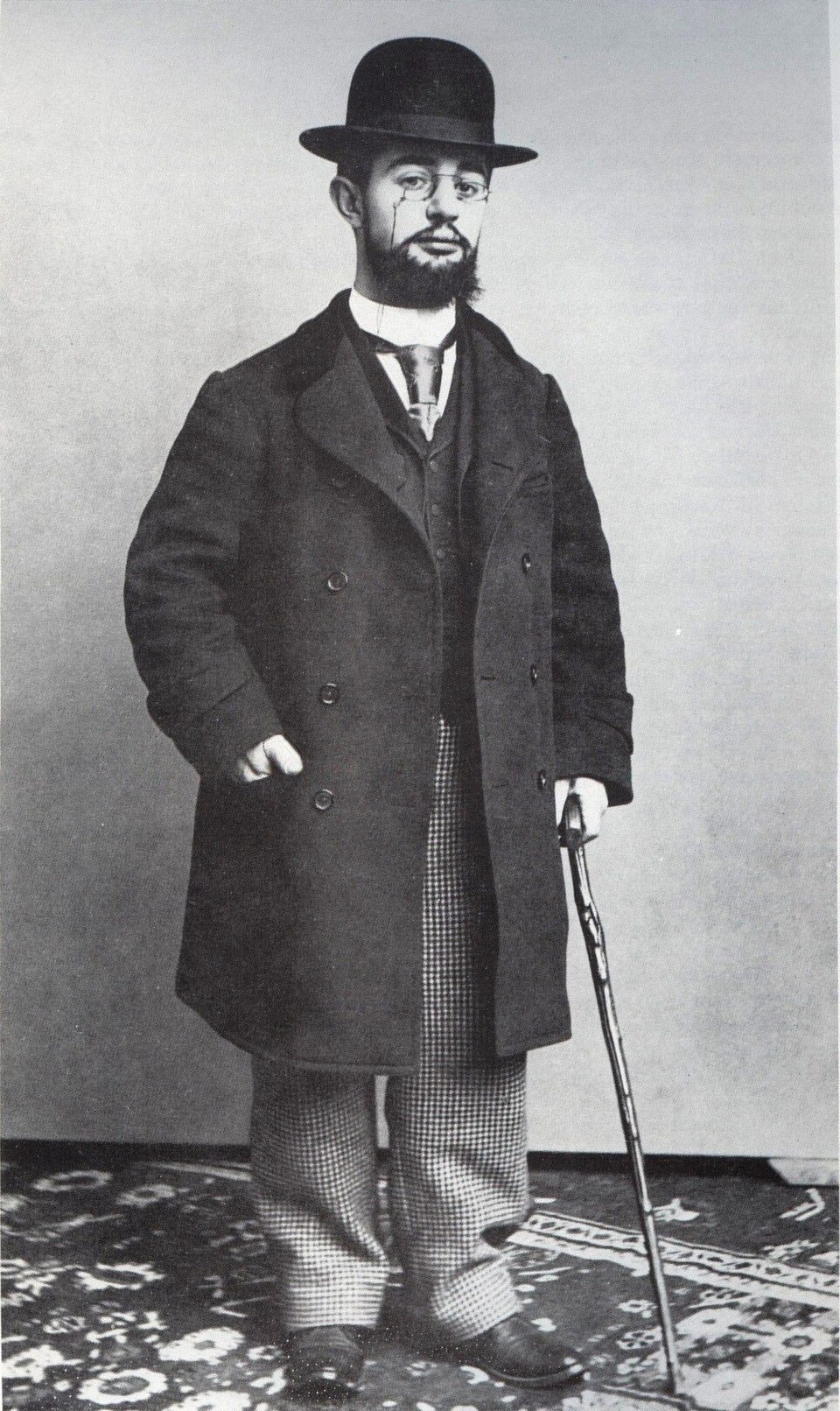
The draughtsman of Montmartre: he captured Paris's Belle Époque entertainments with an aristocrat's cool eye and a printmaker's ruthless economy of line.
Henri de Toulouse-Lautrec descended from French aristocracy and spent his short career in the cabarets, dance halls, and brothels of Montmartre, recording the performers, prostitutes, and habitués of the Belle Époque with a line of extraordinary psychological precision. His posters revolutionised the medium; his paintings and drawings constitute one of the most sustained documentary and artistic accounts of a social world that lasted barely a generation.
Origins and the accidents of biography
Toulouse-Lautrec was born into one of the oldest noble families of France in Albi in 1864. A childhood bone condition — probably pyknodysostosis, a genetic disorder associated with consanguineous unions — meant that fractures during adolescence left his legs permanently stunted while his torso continued to grow. He was 1.52 metres tall as an adult.
The injury that redirected his life toward painting was biographical not simply medical: excluded from the physical pursuits of his class, he threw himself into drawing. His early talent was recognised and he moved to Paris in 1882 to study, first under Léon Bonnat then Fernand Cormon, where he encountered Vincent van Gogh and Émile Bernard.
Montmartre and the poster revolution
By 1886 Toulouse-Lautrec had settled in Montmartre and was frequenting the Moulin Rouge, the Divan Japonais, the Folies Bergère, and the celebrity-dense world of Parisian entertainment. He drew incessantly — performers caught mid-motion, audiences in profile, dancers from below and behind.
His lithographic posters, beginning with the Moulin Rouge commission in 1891, brought Japanese woodblock economy to French commercial art: flat silhouettes, bold outlines, unusual viewpoints, minimal modelling. They worked as street graphics and as fine prints simultaneously. Jane Avril, Aristide Bruant, Yvette Guilbert — performers who became visual types in his hands — were made famous partly through his interpretations of them.
He completed roughly 30 posters, 300 lithographs, and several hundred paintings and drawings.
The draftsmanship
Toulouse-Lautrec's essential medium was line. His paintings are often more drawing than painting — colour used not to model form but to activate space around a contour. The debt to Degas in the oblique viewpoint and the cropped, candid composition is explicit. But where Degas's line is measured, Toulouse-Lautrec's is faster and more acid: it captures posture and character in three strokes.
His brothel paintings — made during extended residential stays — are among the most unsentimental depictions of working women in the history of art. There is no moral judgment, no idealization, and no voyeurism; the women are simply observed, at rest, indifferent to the painter's presence.
I paint things as they are. I do not comment.
Last years and death
Toulouse-Lautrec's health deteriorated sharply in his mid-thirties from alcoholism and the effects of syphilis. He was committed to a sanatorium in Neuilly-sur-Seine in 1899, recovered sufficiently to be released, but collapsed again the following year. He died at his family's Château Malromé on 9 September 1901, aged 36.