Henri Matisse
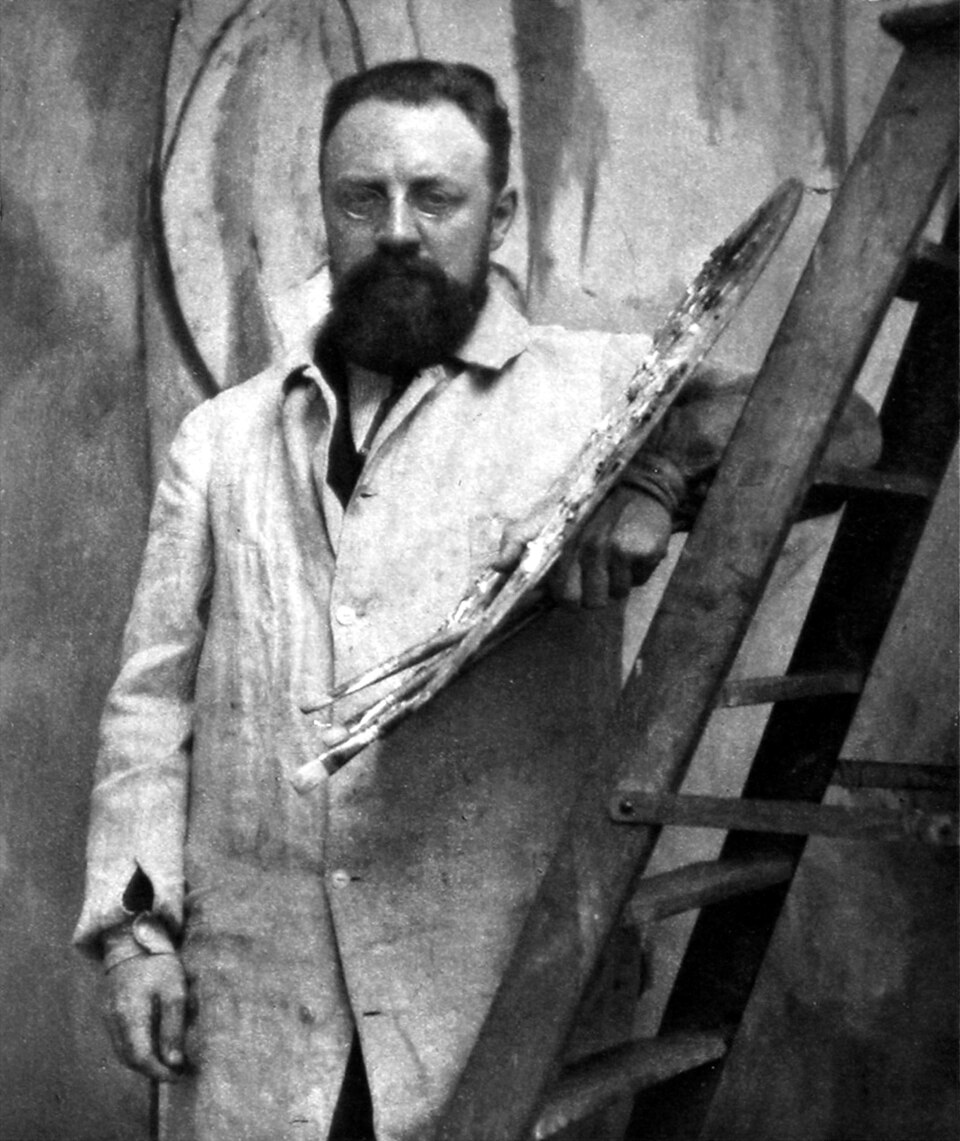
The painter who made colour a structural force — not decoration but architecture — and whose late paper cut-outs proved that a bedridden artist could still invent an entirely new medium.
Henri Matisse spent sixty years investigating colour as a structural and emotional force, and the conclusion he reached was not paint but scissors. His late cut-outs — made when illness had confined him to bed or wheelchair — are among the most original works in twentieth-century art: pure colour pressed directly into composition, without the mediation of the brush.
Origins
Matisse was born in Le Cateau-Cambrésis in northern France in 1869. He studied law and worked as a court administrator before a period of illness in 1889 led his mother to give him a paint-box. He enrolled at the Académie Julian in Paris and then studied under Gustave Moreau at the École des Beaux-Arts, where he encountered the work of the Impressionists and Post-Impressionists that would redirect everything.
Fauvism and the break
At the 1905 Salon d'Automne, Matisse exhibited work alongside André Derain, Maurice Vlaminck, and others in a room that a critic labelled the "cage of wild beasts" — les fauves. The name stuck. The paintings were not wild by the standards of what followed — Cubism, Expressionism, abstraction — but they broke with representation by using colour expressively rather than descriptively. Green shadows on a face, a red room, a blue sea: the colour answered to emotion and structure, not to observed fact.
The Joy of Life (1905–06) and The Dance (1909–10) consolidated the direction. They are flat, rhythmic, and saturated — colour used as the painter's primary organisational tool rather than as a surface property added to form.
Colour was not given to us in order to imitate Nature. It was given to us so that we can express our own emotions.
Method: the window, the interior, the figure
Matisse worked from a limited set of recurring subjects — a window view, a studio interior, a reclining or standing figure — and returned to them throughout his life, each time finding a different solution. His interiors often collapse depth into a flat orchestration of pattern: a wallpaper pattern echoing a fabric pattern echoing a tile pattern, all of equal visual weight. The represented subject almost dissolves into decoration, yet the compositions never feel arbitrary.
He was equally active as a draughtsman and sculptor, and his drawing — line of extreme economy, a single unbroken curve describing a gesture — is among the most admired in the modern tradition.
The cut-outs
After surgery in 1941 left him weakened, Matisse shifted to making large compositions from sheets of gouache-painted paper, cut into shapes by his own hand and arranged by assistants. The process removed the brush from the equation, allowing him to draw directly in colour. The works that resulted — Jazz (1947), the designs for the Chapelle du Rosaire in Vence (completed 1951), and the large cut-outs exhibited near the end of his life — are distinctive from anything in the earlier work: more abstract, more architecturally conceived, and luminous in a way that seemed to belong to a much younger artist.
Legacy
Matisse died in Nice in November 1954, aged eighty-four, having worked almost until the end. His influence on subsequent abstraction, pattern painting, and the use of colour in decorative and graphic design is pervasive and not always acknowledged. The paper cut-outs were a direct influence on mid-century graphic design and have been revisited by artists working with flat colour ever since.