Henry Moore
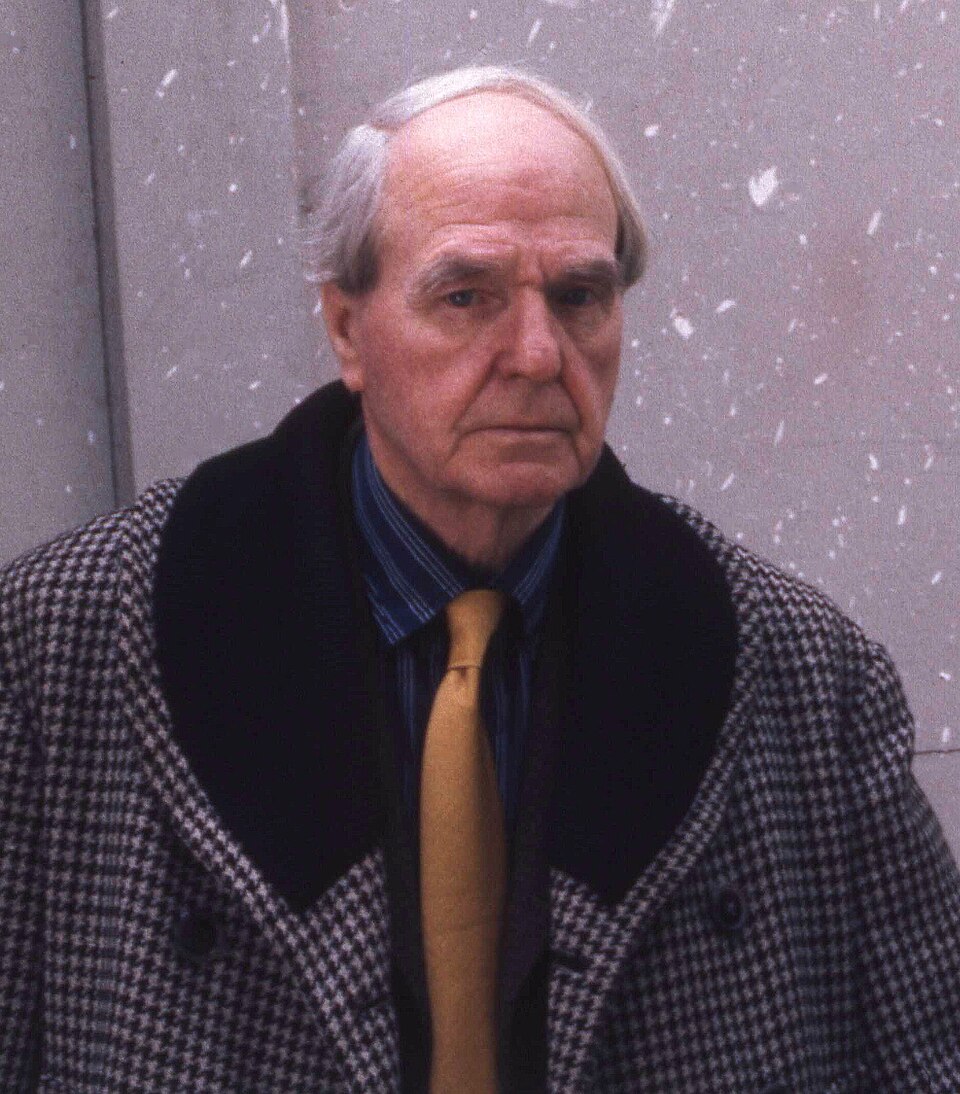
The Yorkshire sculptor who found in the reclining human figure an inexhaustible form, scaling it from intimate bronze to monumental public presence and placing it in dialogue with landscape.
Henry Moore gave the reclining human body a new life in stone and bronze, enlarging and abstracting it until holes opened through its mass and landscape could pass through. His sculptures, sited in parks, civic squares, and museum gardens worldwide, established the idea of public art as a permanent conversation between a made object and its outdoor setting.
Castleford and formation
Moore was born in Castleford, Yorkshire, in 1898, the seventh of eight children of a coal miner. He showed early aptitude and won a scholarship to study at Leeds School of Art, then at the Royal College of Art in London from 1921. His early influences were not the European classical tradition but pre-Columbian Mexican sculpture and the carved figures he encountered in the British Museum — particularly the Chacmool reclining figures that would become the template for his own.
He taught at the Royal College of Art and later the Chelsea School of Art through the 1920s and 1930s, and during this period his mature direction became clear: the human figure, primarily female, abstracted and simplified, with formal interest concentrated in mass, weight, and the relation between solid and void.
Holes and forms
Moore's innovation within sculpture was to treat negative space — the hole, the void — as structurally equivalent to mass. His figures are pierced, their interiors opened to air and light. The effect is to make visible the relationship between the form and the space it displaces: the hole is not an absence but an active element, shaped as deliberately as the surrounding bronze.
He worked in plaster for maquettes, transferring to stone (Horton stone, Hornton stone, marble) and later predominantly to bronze as his practice scaled up. His studio in Perry Green, Hertfordshire, where he moved in 1940, became the working environment for an output of exceptional scale and range.
The hole connects one side to the other, making it immediately more three-dimensional.
The shelter drawings and wartime
During the Second World War, Moore served as an official war artist and produced a series of drawings of Londoners sheltering in the Underground during the Blitz. The figures, wrapped in cloth and pressed against the tunnel walls, are among the most powerful drawings of the twentieth century — and they show that Moore's interest in enclosed, protective form had a directly human dimension that his abstract sculpture sometimes obscures.
Public work
From the 1950s onwards Moore received major international commissions: a reclining figure for the UNESCO headquarters in Paris (1958), another for Lincoln Center in New York, and many others for banks, universities, and civic institutions across North America and Europe. His work became associated with a certain international post-war cultural confidence — civic in scale, humanist in subject, modernist in form.
The Henry Moore Foundation, established in 1977, continues to manage his estate and supports sculpture and its study internationally.
Legacy
Moore died in Perry Green in August 1986 at eighty-eight. The reclining figure he developed is now so identified with him that it is difficult to see it fresh; but the quality of his best bronzes — the interplay of organic surface and composed form, the presence these objects carry outdoors — repays attention on its own terms.