Herbert Bayer
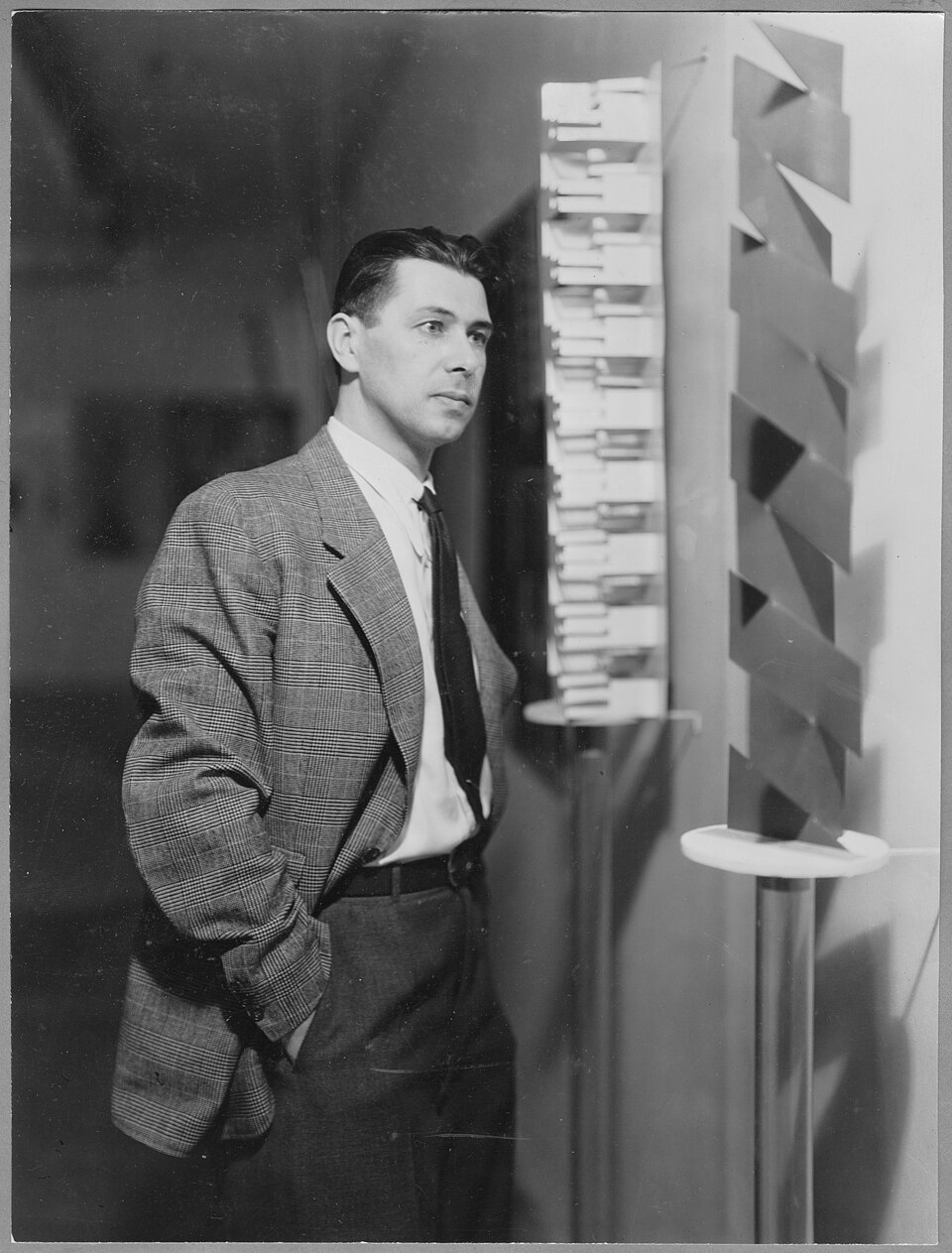
Bauhaus master turned American modernist who fused typography, exhibition design, and earthwork into a single restless practice.
Herbert Bayer arrived at the Bauhaus as a student and left as one of its defining voices — a designer who believed that letterforms, exhibition halls, and the contour of a hillside were all subject to the same visual logic. His six decades of work, spanning the workshops of Dessau and the open terrain of Aspen, Colorado, made him a singular figure in the translation of European modernism into American institutional culture.
From Haag to Dessau
Bayer was born in 1900 in Haag am Hausruck, Upper Austria, and trained as an architectural draftsman before enrolling at the Bauhaus in Weimar in 1921. He studied under Wassily Kandinsky and László Moholy-Nagy, absorbing the school's conviction that fine art and applied design were not separate disciplines. When Walter Gropius relocated the school to Dessau in 1925, Bayer was appointed Master of the Printing and Advertising Workshop — one of the youngest masters the Bauhaus ever appointed, at twenty-five.
In the same year he designed his most enduring typographic contribution: the universal typeface, an all-lowercase, geometrically constructed alphabet that eliminated capital letters on the grounds that speech used only one case and type should follow suit. The idea was polemical as much as practical, but it crystallised the Bauhaus argument that design should be stripped of historical ornament and rebuilt from rational first principles.
Berlin and emigration
Bayer resigned from the Bauhaus in 1928 and moved to Berlin, where he worked as art director at the Dorland advertising agency, applying Bauhaus typography and photography to commercial campaigns with considerable success. The period sharpened his understanding of communication design as persuasion — an understanding he would later put to very different use.
When the political situation in Germany made remaining untenable, Bayer emigrated to the United States in 1938. That year he co-designed the landmark exhibition Bauhaus 1919–1928 at the Museum of Modern Art, New York — a show that introduced the school's ideas to an American public and helped establish the Bauhaus as the central myth of modern design. The exhibition's spatial and typographic organisation was itself a demonstration of Bauhaus principles in action.
The total field of vision, a 360-degree panorama, should be the designer's canvas.
Aspen and the American chapter
In 1946 Bayer relocated to Aspen, Colorado, at the invitation of Walter Paepcke, chairman of the Container Corporation of America. He served as design consultant and eventually Chairman of the Department of Design at the Container Corporation, helping shape a corporate identity programme that was among the first to treat design as a sustained institutional commitment rather than a series of commissions.
Aspen became his permanent base and the site of his most ambitious environmental work. The earthwork Grass Mound (1955) at the Aspen Institute — a low, circular berm sculpted from the landscape — is considered a precursor of land art, predating by more than a decade the movement's canonical works. He also contributed to the planning of the Aspen Institute campus, bringing the same integrating impulse to architecture and landscape that he had applied to the printed page.
In his final years he worked as a design consultant to the Atlantic Richfield Company, building a corporate art collection until his death in 1985.