Hilma af Klint
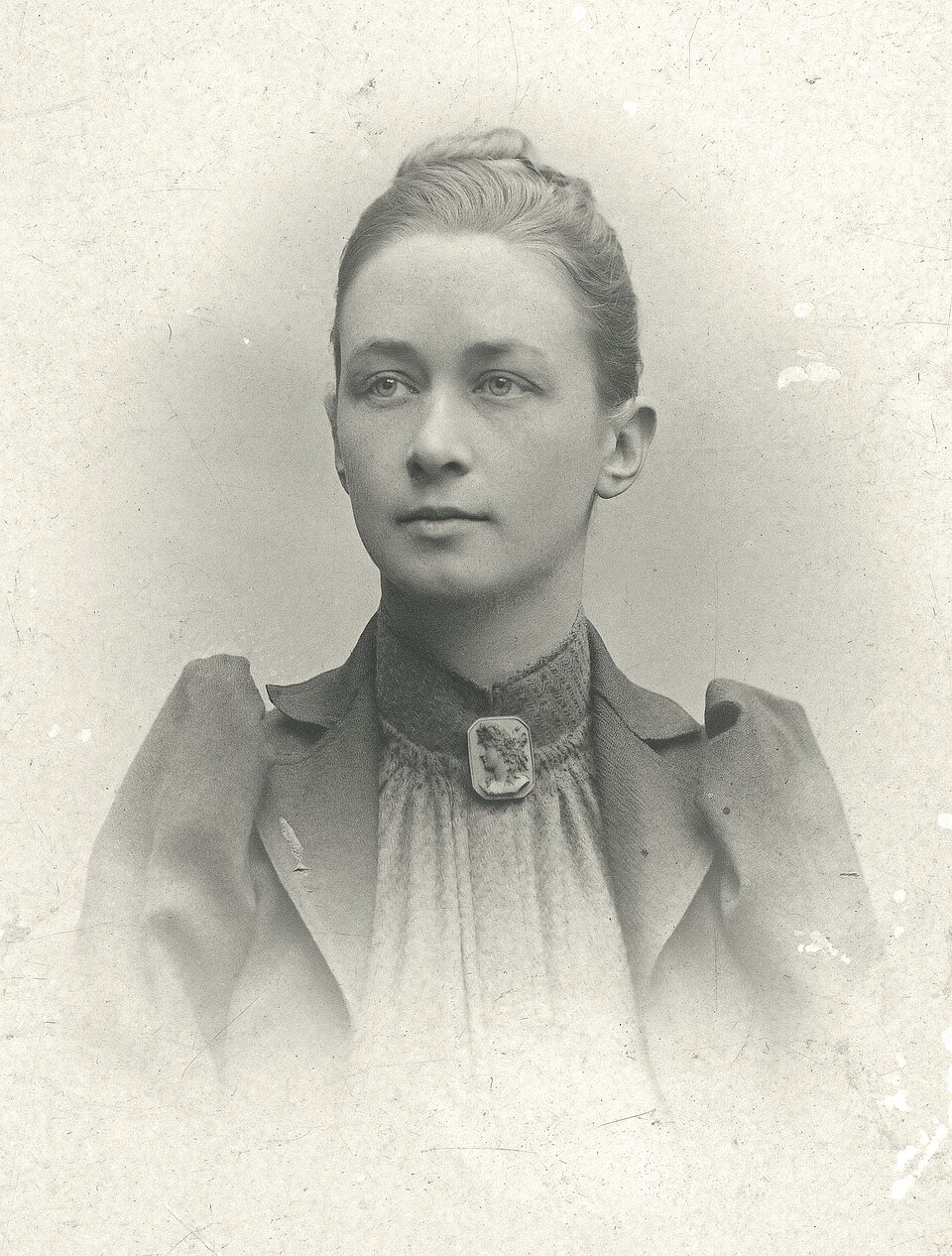
The Swedish painter who made fully abstract large-scale canvases years before Kandinsky, keeping them hidden until after her death because the world was not yet ready.
Hilma af Klint completed more than two hundred large abstract paintings before 1920, in deliberate secrecy, convinced that public exhibition would precede understanding by too many decades — a judgement that proved accurate: her work remained almost entirely unknown until the 1980s and was not broadly exhibited until after 2010.
Training and early practice
Af Klint was born in 1862 near Stockholm. She trained at the Royal Academy of Fine Arts in Stockholm, graduating in 1887 with distinction and establishing herself as a competent portraitist and botanical illustrator. Her professional work — precise, conventional, academically accomplished — gave no public indication of what she was pursuing privately.
From the early 1900s she was part of a group of five women called The Five (De Fem), who shared an interest in Theosophy and held séances in which they believed they received messages from spiritual entities they called the High Masters. Af Klint's diaries record that commissions to create a body of visual work for a spiritual temple came through these sessions — whether taken literally or as a psychological framework for artistic decision, the effect was the same: a sustained, systematic, and entirely unprecedented body of abstract painting.
The Paintings for the Temple
Between 1906 and 1915 af Klint completed The Paintings for the Temple, a series of 193 works of varying scale, some reaching nearly three metres in height. The largest group, The Swan, presents biomorphic forms in symmetrical arrangements — curling, spiralling shapes in blue, white, and gold that predate analogous forms in European modernism. The Atom series uses geometric circles and diagrams to model invisible natural forces.
The works are not purely decorative or spiritual; they draw on contemporary natural science — cellular biology, atomic theory — synthesised with Theosophical symbolism into a pictorial language with no direct precedent.
I had no idea what the paintings were supposed to depict; nevertheless I worked swiftly and surely, without changing a single brush stroke.
Secrecy and posthumous terms
Af Klint left instructions that The Paintings for the Temple should not be exhibited until at least twenty years after her death. She died in 1944 following injuries sustained in a traffic accident. Her nephew inherited the work and the foundation she had established, honouring the moratorium. The first significant exhibition did not occur until 1986, at a symposium in Los Angeles.
The Guggenheim Museum's retrospective in 2018 — Hilma af Klint: Paintings for the Future — brought her to mass international attention, becoming one of the museum's most visited exhibitions. The show forced a reassessment of abstraction's origins: not solely Kandinsky's Composition V (1911) or Malevich's Black Square (1915), but af Klint's large canvases from 1906 onward.