Isamu Noguchi
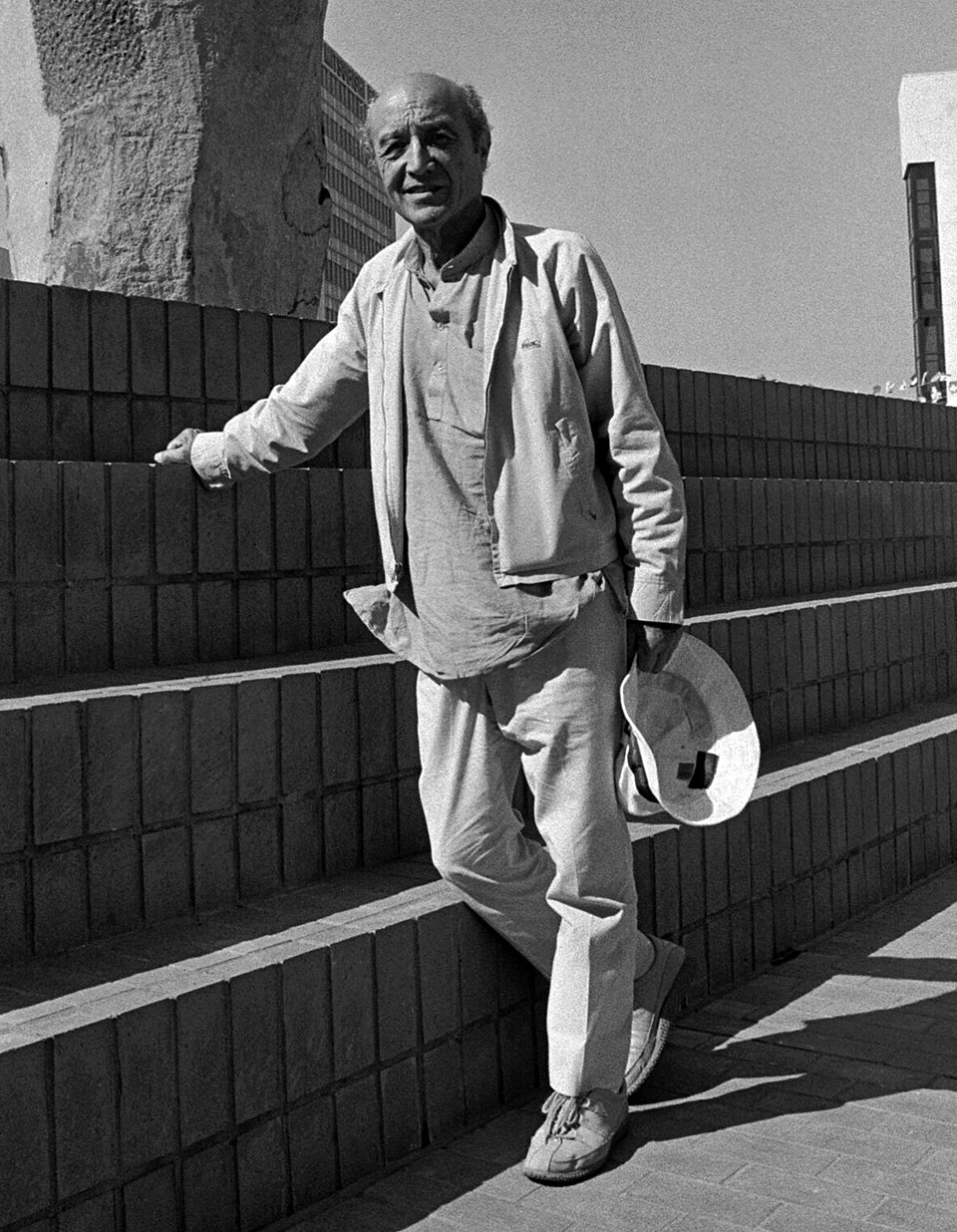
The sculptor and designer who refused to separate art from use, making gardens, stage sets, furniture, and public plazas with the same sculptural intelligence he brought to stone.
Isamu Noguchi's career was a sustained argument against the hierarchy that places fine art above craft and design: he made large abstract sculptures, designed theatre sets and public parks, created furniture still in production today, and considered all of it the same practice — the shaping of space by a sculptor's intelligence.
Between two worlds
Noguchi was born in Los Angeles in 1904 to a Japanese poet father and an American writer mother. The family moved to Japan when he was two; he was sent back to the United States for schooling at thirteen. This early fracture between cultures — never quite Japanese to Japan, never quite American in America — became constitutive rather than merely biographical.
He trained as a sculptor in New York, was accepted as an assistant by Constantin Brâncuși in Paris in 1927 — a formative year spent absorbing the Romanian sculptor's radical reduction of form. He also worked briefly in portrait painting to fund travel, and studied the traditional Japanese crafts of ceramics and bronze-casting during time in Japan in the 1930s. Both experiences fed directly into his mature work.
Sculpture, theatre, and the public realm
Noguchi's collaboration with choreographer Martha Graham began in the 1930s and continued for decades, producing stage sets for many of her most celebrated works — Appalachian Spring (1944), Cave of the Heart (1946), Clytemnestra (1958). The sets were abstract sculptural environments, not backdrops: forms that the dancers moved among and around, extending the dance into three-dimensional space.
His public commissions developed a related approach at urban scale. The Dodge Fountain in Detroit (1978) and California Scenario in Costa Mesa (1982) treated the public plaza as a landscape of sculptural forms — bridges, cascades, rocks, and planted elements arranged with the compositional rigour of his gallery work. He called this approach "sculptured earth."
Everything is sculpture. Any material, any idea without hindrance born into space, I consider sculpture.
The Akari and the table
Two designs became objects with independent cultural lives. The Akari light sculptures — lanterns made from washi paper over bamboo frames, begun in 1951 after a visit to Gifu — were created as an explicit fusion of Japanese craft tradition with contemporary form. They remain in production and have been continuously available since their introduction. Their organic forms and warm diffused light became central to a particular mid-century domestic aesthetic.
The IN-50 coffee table (1947), designed for Herman Miller and still manufactured by the company, consists of two interlocking biomorphic wood legs supporting a free-form glass top. It is among the most recognisable pieces of postwar American furniture design, present in museum collections and homes across six decades.