Jan van Eyck
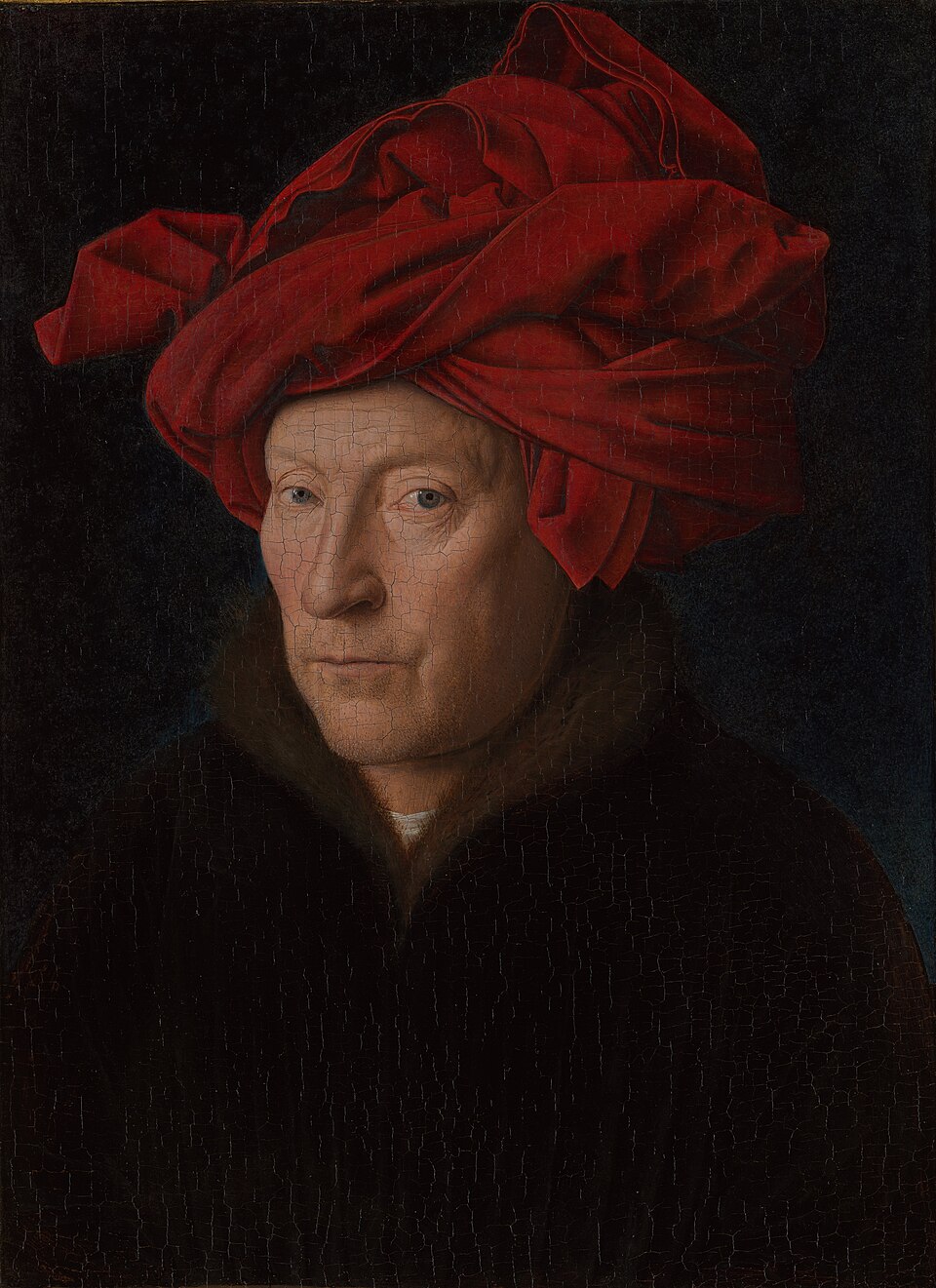
The Flemish painter who brought oil glazing to a level of refinement that made the visible world—texture, light, reflected space—available to art for the first time.
Jan van Eyck is the supreme figure of early Netherlandish painting and one of the most significant innovators in the history of Western art. His mastery of oil glazing — building up translucent layers of pigment suspended in linseed oil — gave him a command of surface texture, reflected light, and spatial depth that no painter before him had achieved, and his portraits in particular created a standard of psychological directness that the tradition has never abandoned.
Liège and the Burgundian court
Jan van Eyck's early life is poorly documented. He was born around 1390, probably in or near Maaseik in the Prince-Bishopric of Liège, and is first recorded in 1422 as a court painter to John of Bavaria, Count of Holland. After John's death in 1425 he entered the service of Philip the Good, Duke of Burgundy — the most powerful ruler in the Low Countries — and remained there for the rest of his life. Philip used him not only as a painter but as a trusted diplomatic envoy, sending him on at least two missions to Portugal in the late 1420s.
The Burgundian court at Bruges was the richest and most culturally sophisticated north of the Alps, and Van Eyck worked at the centre of it, in close contact with the best craftsmen, the most ambitious patrons, and the largest collection of Flemish luxury goods — textiles, metalwork, glass — that the world contained.
The Ghent Altarpiece
The Ghent Altarpiece (completed 1432, St Bavo's Cathedral, Ghent) is the masterwork of early Netherlandish painting and one of the most complex and influential paintings in existence. Commissioned by a wealthy Ghent merchant and his wife, it comprises twelve panels — the outer wings showing the donors, John the Baptist, and an Annunciation; the inner wings, opened on feast days, revealing the Adoration of the Mystic Lamb, surrounded by ranks of angels, saints, and prophets. The altarpiece was the work of both Jan and his elder brother Hubert van Eyck, who died before its completion; the inscription on the frame names both, with Hubert as the initiator and Jan as the completer.
The refinement of the oil technique across its panels — the skin of the Ghent saints, the individual blades of grass in the meadow, the depth of the sky — went beyond anything previously attempted in Northern European painting.
The Arnolfini Portrait
The Arnolfini Portrait (1434, National Gallery, London) depicts a prosperous Flemish merchant and his wife in a domestic interior, with a convex mirror behind them reflecting the room — and, in it, the painter himself. The mirror is a technical tour de force; the entire reflected scene is painted in miniature with the same attention to light and colour as the main figures. The painting also carries a Latin inscription above the mirror: Johannes de Eyck fuit hic — Jan van Eyck was here — the most explicit artist's signature of the medieval period, and an assertion of the painter's presence as witness.
He had been called the inventor of oil-painting by Vasari and others, though this is an oversimplification — what he invented was a level of refinement in its use that amounted to a new medium.
Legacy
Vasari's claim that Van Eyck invented oil painting is not literally true — oil had been used as a vehicle before him — but his development of the glazing technique was so decisive that the claim is understandable. Within decades of his death his method had spread across the Netherlands and into Italy; Antonello da Messina brought it to Venice, where it became the basis of the Venetian tradition. The resolution of surface detail he achieved — a velvet collar, a crystal goblet, a convex mirror — set a standard that painters have used as a benchmark of technical achievement for six centuries.