J. M. W. Turner
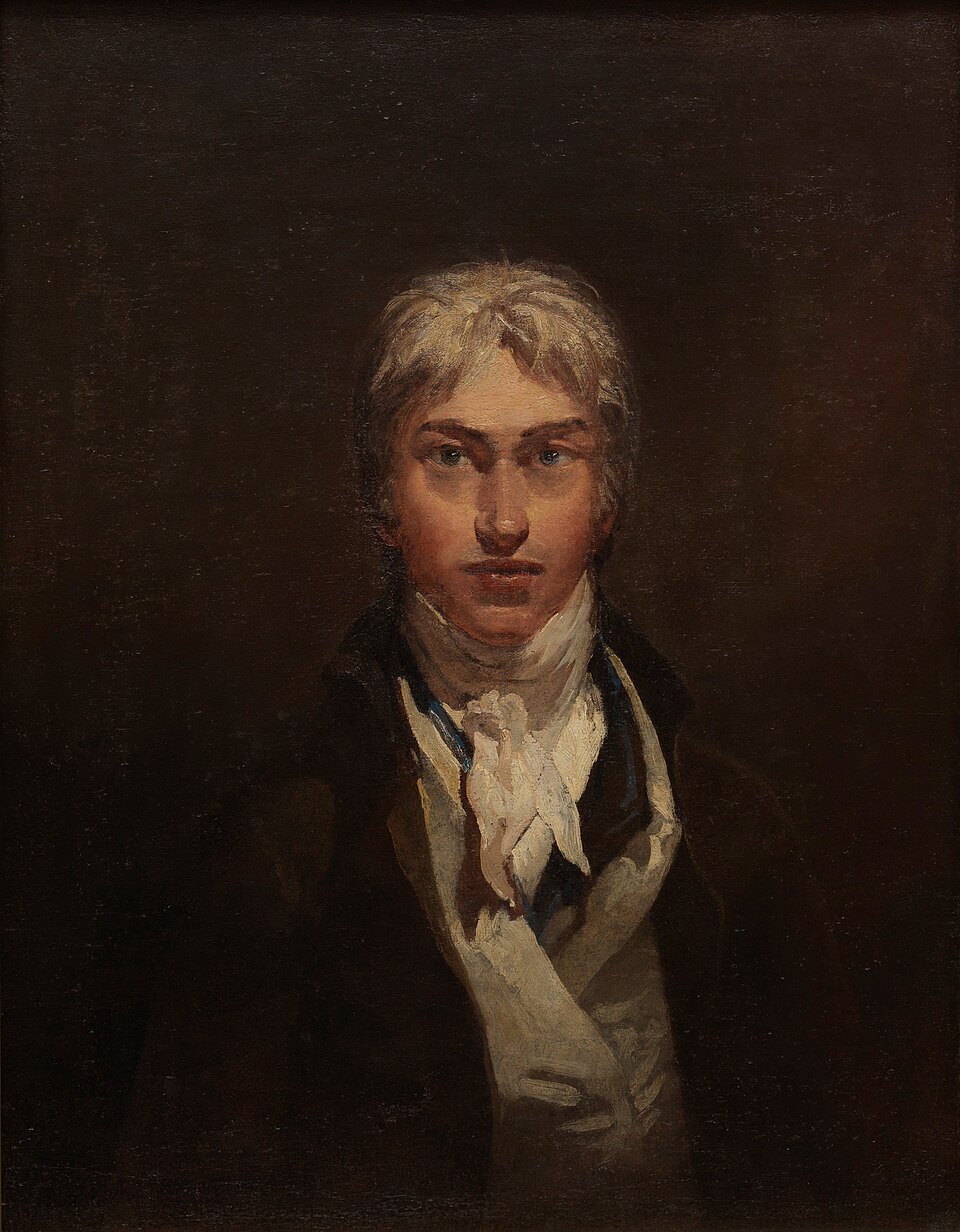
The English painter who dissolved solid form into atmosphere and light, elevating landscape to the highest ambitions of history painting and opening a path that led directly to Impressionism.
Joseph Mallord William Turner entered the Royal Academy Schools at fourteen and spent the next six decades dismantling the landscape conventions he had mastered. His mature canvases subordinate topography, narrative, and defined form to the rendering of light and atmospheric effect — a project radical enough that some contemporaries dismissed his later work as unfinished. The Impressionists studied him seriously; he is now regarded as the most important British painter and one of the foundational figures of European modernism.
Prodigious beginnings
Turner was born in Maiden Lane, Covent Garden, London, on 23 April 1775, the son of a barber and wigmaker. He entered the Royal Academy Schools in 1789 and exhibited his first watercolour at the Academy the following year, aged fifteen. He was elected an Associate of the Royal Academy in 1799 and a full Academician in 1802 — among the youngest ever at that rank. His early reputation rested on topographical watercolours of architecture and landscape rendered with meticulous draughtsmanship, and on oil paintings that demonstrated thorough command of Dutch marine painting and the classical landscapes of Claude Lorrain, whose luminous treatment of distance Turner admired and consciously competed with.
Expanding ambition
From the early 1800s Turner began pushing landscape painting toward the territory traditionally reserved for history painting — depicting events of moral or epic weight. The Shipwreck (1805), Snow Storm: Hannibal and His Army Crossing the Alps (1812), and The Battle of Trafalgar (1822) use natural phenomena — storm, avalanche, sea — as the active subject, reducing human figures to elements within a larger atmospheric drama. He travelled extensively in Britain and continental Europe, particularly in France, Switzerland, and Italy, making thousands of preparatory sketches. Venice, first visited in 1819, became a recurring subject; its quality of light over water matched his developing painterly concerns almost perfectly.
He was appointed Professor of Perspective at the Royal Academy in 1807, a post he held — though with increasingly irregular lectures — until 1838.
Late style and dissolution of form
Turner's work from the 1830s and 1840s moved toward an increasing abstraction of atmospheric effect. Rain, Steam and Speed (1844) uses a Great Western Railway locomotive as the nominal subject but reduces it to a dark streak within a vortex of mist and motion. Snow Storm — Steam-Boat off a Harbour's Mouth (1842) was accompanied by a note in the exhibition catalogue claiming Turner had himself lashed to a mast to observe the storm — a claim not verified but consistent with his documented practice of direct observation. These late works attracted critical derision from some quarters and intense admiration from John Ruskin, who became his most influential champion.
He is the only painter who has ever given an entire transcript of the fulness of God's works.
Legacy and the Turner Bequest
Turner never married and lived frugally in later years; he died in Chelsea on 19 December 1851 under an assumed name. His will, after protracted legal challenges, directed that his finished oil paintings be kept together and displayed to the public. The resulting collection — the Turner Bequest — forms the core of the Tate Britain collection, including the Clore Gallery purpose-built to house it. The annual Turner Prize, established in 1984, takes his name as shorthand for ambition in contemporary British art.