Joan Miró
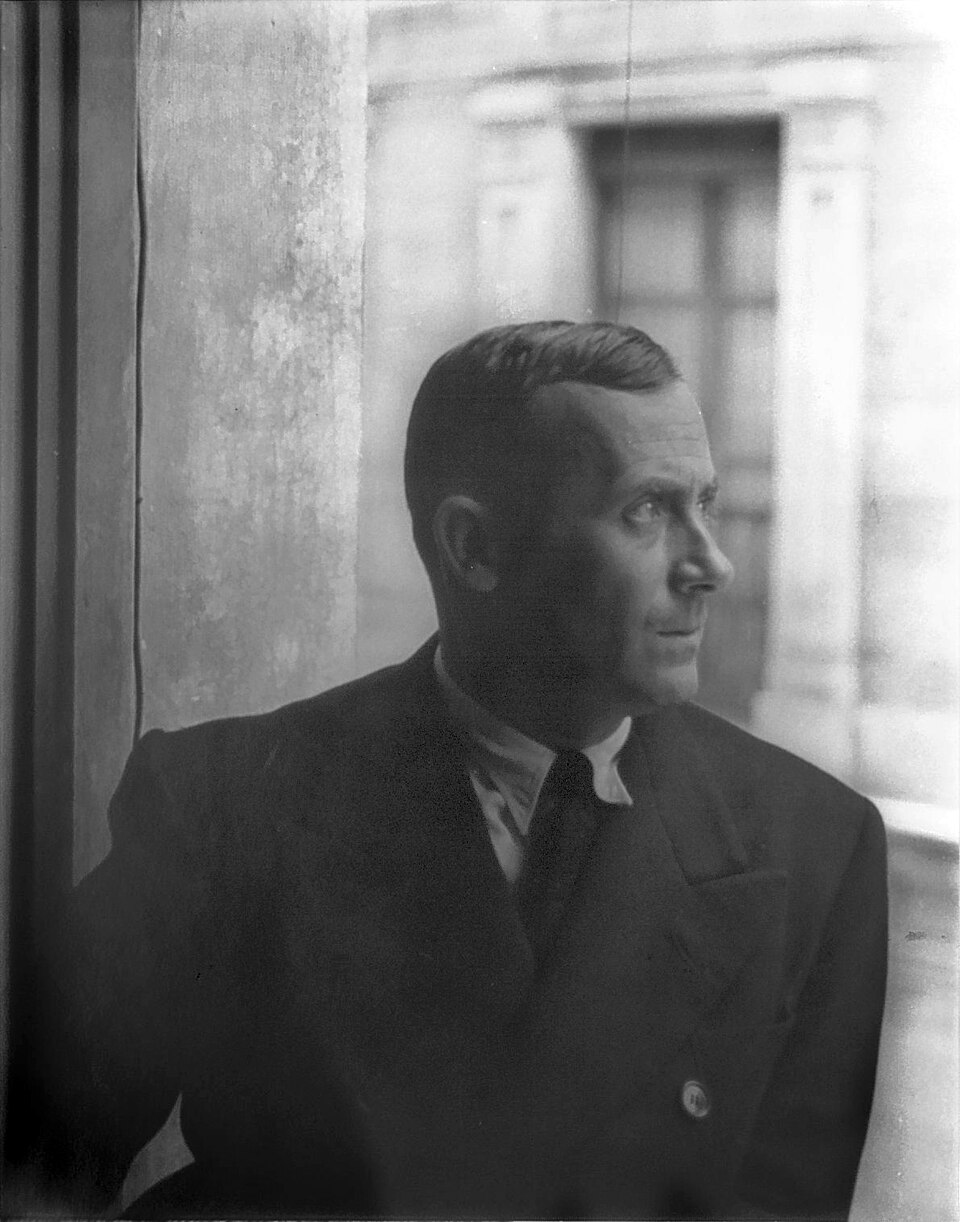
The Catalan painter who built a private universe of signs and stars and biomorphic creatures, holding surrealism at arm's length to remain entirely himself.
Joan Miró is the painter of a world that does not exist but feels completely true: a flat cosmos of primary colours, black lines, and biomorphic shapes — eyes, stars, crescents, birds — arranged with a compositional intelligence so refined that the work looks effortless while being extraordinarily controlled.
Formation in Barcelona and Paris
Miró was born in Barcelona in 1893, the son of a goldsmith and watchmaker from Cornudella. He showed artistic aptitude early and studied at the Escola de Belles Arts de la Llotja in Barcelona and subsequently at the Cercle Artístic de Sant Lluc. After a breakdown attributed to overwork, he turned to painting full time.
His early painting, particularly The Farm (1921–22), is painstakingly detailed — an accumulation of observed objects at his family's property at Montroig del Camp, rendered with a hallucinatory specificity. Ernest Hemingway, who acquired the painting, later said it told him more about Spain than anything he had read. Miró exhibited in Paris from 1921, becoming associated with the Surrealists — André Breton claimed him — though he resisted full membership in any movement.
The pictographic language
By the late 1920s Miró had reduced his visual vocabulary to a set of recurring signs: stars, eyes, women, birds, crescent moons, and abstract lines that carry both aggression and tenderness. The surface became increasingly flat; colour — red, blue, yellow, black, green on white — became more saturated. The paintings of the 1930s and 1940s, made partly in response to the Spanish Civil War, include some of his most unsettling work: the Constellations series (1940–41), twenty-three gouaches painted in France while Miró fled the German advance, compressed this private iconography into jewelled surfaces dense with incident.
The Constellations were shown in New York after the war and had a decisive impact on the Abstract Expressionists; Gorky, Pollock, and de Kooning cited them.
I try to apply colors like words that shape poems, like notes that shape music.
Sculpture and ceramics
From the 1940s onwards Miró expanded aggressively into sculpture, ceramics, and large-scale public work. His collaborations with the ceramicist Josep Llorens Artigas produced two monumental ceramic murals for the UNESCO headquarters in Paris (1958) and the Harvard University Graduate School of Design (1960). He cast found-object sculptures in bronze and produced large-scale outdoor works that carry the same vocabulary of his paintings into three dimensions.
The Fundació Joan Miró, designed by Josep Lluís Sert and opened in Barcelona in 1975, houses the largest collection of his work and serves as a centre for contemporary art — a late act of institutional commitment to his home city.
Late work and legacy
Miró continued working at extraordinary productivity into his late eighties. His final paintings, made at the studio in Palma de Mallorca that he occupied from 1956, are among his most radical — gestural, minimal, sometimes approaching pure abstraction. He died on Christmas Day 1983 in Palma, aged ninety.
His influence is pervasive and not always acknowledged: the graphic language he developed — primary shapes, bold outline, flat colour — has entered commercial and typographic design so thoroughly that it appears as a natural visual vocabulary rather than an invented one.