John Constable
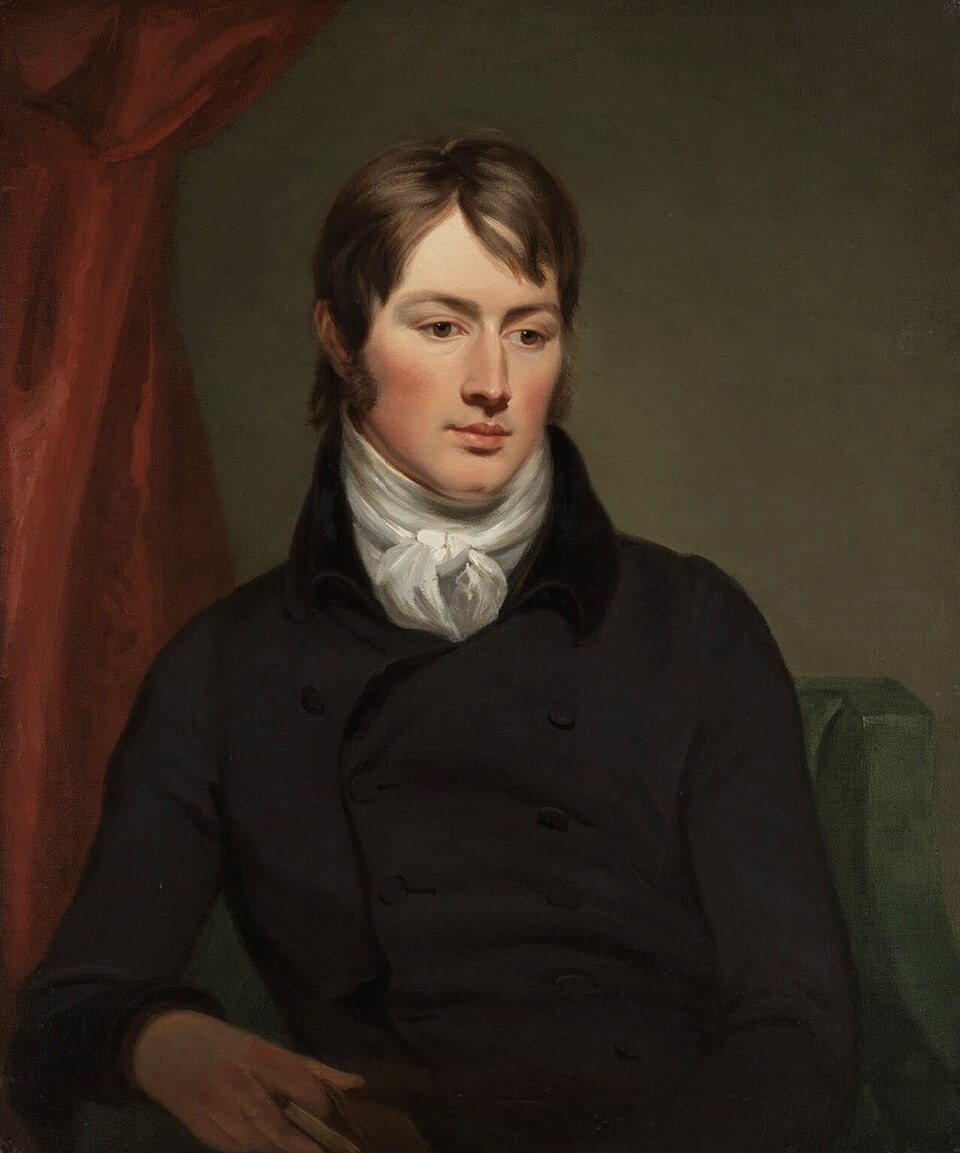
The Suffolk painter who refused historical subjects and foreign scenery, insisting that the lanes, skies, and water meadows of his childhood contained everything landscape painting needed to say.
John Constable spent most of his life within thirty miles of the Suffolk village where he was born, and made that constraint the foundation of a radical artistic programme. Rejecting the elevated subjects and Italianate conventions expected of serious painters, he built a career on direct observation of the Stour Valley — its mills, clouds, and light — and in doing so redefined what landscape painting could honestly depict. His large exhibition canvases shocked French critics at the 1824 Paris Salon; the English establishment recognised him with reluctant slowness.
Formation in Suffolk
Constable was born in East Bergholt, Suffolk, on 11 June 1776, the son of a prosperous corn merchant who owned Flatford Mill and Dedham Mill on the River Stour. The working river landscape of his childhood — barges, locks, horses, reed banks — became the primary subject of his mature work. He drew from an early age but entered the Royal Academy Schools only in 1799, at twenty-two, relatively late. His early oils show command of the academic conventions of landscape; his early oil sketches, made directly from nature, show something else: rapid, unfinished notation of atmospheric conditions with no precedent in English painting.
The programme of direct observation
Constable's critical position, repeated across his letters and his lectures, was that landscape painting must be grounded in direct observation rather than convention. He made systematic cloud studies between 1821 and 1822 — annotating each with date, time, wind direction, and weather conditions — producing a body of sky sketches now valued as documents of both meteorological observation and painterly research. He studied the optical physics of colour and light, and corresponded with the scientist George Field on pigment science.
His working method involved producing a full-scale oil sketch for each major exhibition canvas — a practice with no real precedent. These sketches were kept private during his lifetime and were only gradually recognised as independent achievements.
I should paint my own places best — painting is but another word for feeling.
Exhibition canvases and French recognition
From 1819, Constable began exhibiting large canvases — roughly six feet wide — at the Royal Academy. The White Horse (1819), The Hay Wain (1821), View on the Stour near Dedham (1822), and The Leaping Horse (1825) constitute the core of this series. The Royal Academy received them respectfully but without great enthusiasm; election as a full Academician came only in 1829, when Constable was fifty-two.
In France the reception was sharper. The Hay Wain and two other works were shown at the Paris Salon of 1824 and awarded a gold medal. Eugène Delacroix, on seeing them, reportedly repainted sections of his own Massacre at Chios to achieve similar freshness of colour. The Barbizon painters — Théodore Rousseau, Charles-François Daubigny — absorbed his practice of outdoor observation and carried it toward Impressionism.
Later work and legacy
Constable's wife Maria died of tuberculosis in 1828, leaving him with seven children. The loss shadowed his later paintings; works such as Hadleigh Castle (1829) and Salisbury Cathedral from the Meadows (1831) carry a turbulence absent from the earlier Suffolk scenes. He began delivering lectures on the history of landscape painting at the Royal Institution in 1833, developing a cogent theoretical account of direct observation as the proper foundation of the genre. He died in London on 31 March 1837.