Joseph Beuys
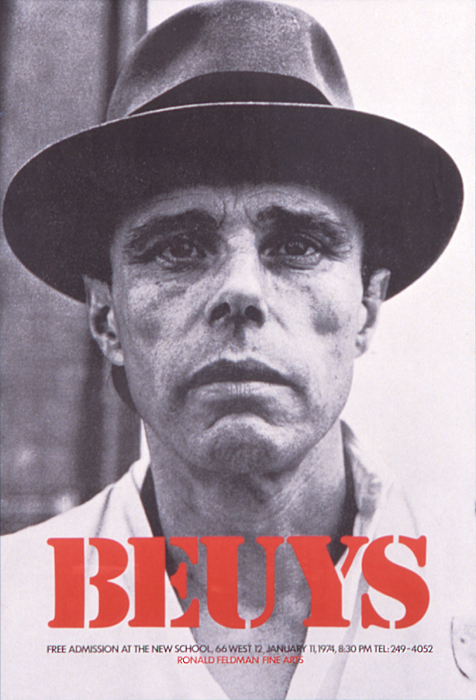
The German artist who made felt and fat into philosophy and argued that every human being capable of thought is, in the act of thinking, already an artist.
Joseph Beuys made art from materials no one else thought to use — felt, fat, copper, dead hares — and performance actions no institution knew how to classify, while insisting that the real medium was the social field itself. His concept of "social sculpture" reframed the question of what art is for: not an object to be looked at, but a transformation of the way human beings organise their shared life.
Krefeld, war, and a founding myth
Beuys was born in Krefeld on 12 May 1921. He trained as a Stuka pilot and served on the Eastern Front during World War II. He was shot down over Crimea in 1944; the circumstances of his rescue became central to his personal mythology, which he elaborated across decades of interviews and performances: Tartar nomads covered his body with fat and felt to keep him alive. Historians have questioned whether the account is literal or mythologised, but Beuys integrated it into his art consistently, deploying fat and felt as both material and symbolic residue of that survival.
After the war he studied art in Düsseldorf and became increasingly central to the postwar German avant-garde.
Fluxus, performance, and the Kunstakademie
In the early 1960s Beuys participated in the Fluxus movement — an international network of artists committed to dissolving the boundary between art and everyday life. His actions became more elaborate and more demanding of their audiences: The Chief (1963–64), performed in Copenhagen and Berlin, involved Beuys lying motionless, rolled in felt, for nine hours while producing occasional sounds. How to Explain Pictures to a Dead Hare (1965) was performed at Galerie Schmela, Düsseldorf: Beuys, his head covered in honey and gold leaf, cradled a dead hare and whispered to it — a meditation on the limits of rational communication.
From 1961 he taught at the Kunstakademie Düsseldorf, where he became the most influential and controversial teacher in German art education. He rejected the numerus clausus — the student admission limit — and allowed anyone to attend his classes, which brought him into open conflict with the administration. He was dismissed in 1972.
Every human being is an artist, a freedom being, called to participate in transforming and reshaping the conditions, thinking, and structures that shape and inform our lives.
7000 Oaks and social sculpture
Beuys developed the concept of social sculpture — the idea that art's proper medium is the transformation of society, that politics, economics, pedagogy, and environmental action are all sculptural acts when conducted creatively. The 1982 project 7000 Oaks at Documenta 7 in Kassel was the most direct embodiment: he planted 7,000 oak trees, each paired with a basalt stone, across the city. The project extended beyond his death, completed by others. The paired objects — organic and geological, living and inert — remain in Kassel.
He co-founded the Free International University for Creativity and Interdisciplinary Research with Heinrich Böll and others, and ran as a candidate for the German Green Party.