Katsushika Hokusai
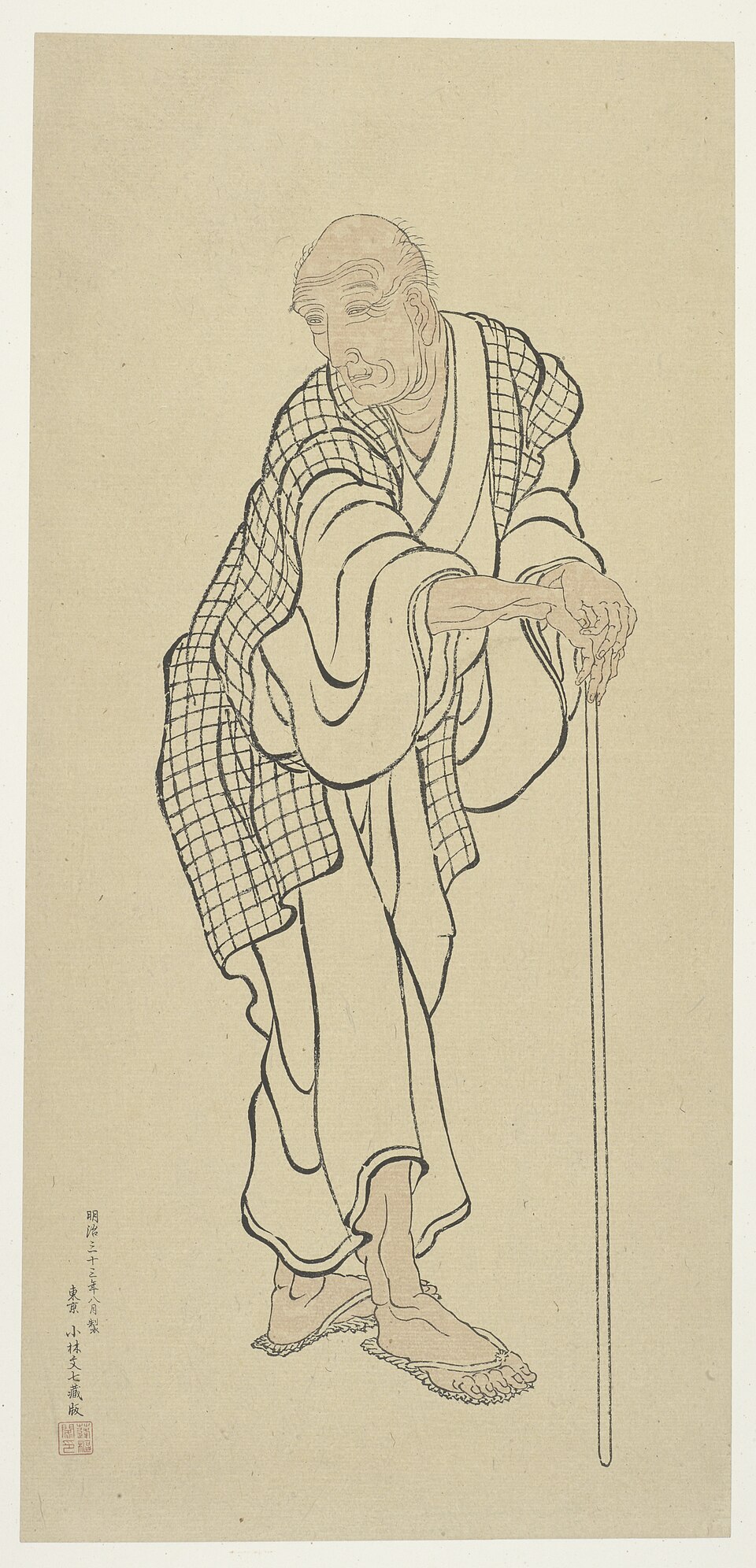
The Edo-period printmaker who spent nine decades relentlessly refining his art, producing images of nature and motion that reshaped how the world pictured Japan.
Katsushika Hokusai worked for nearly seventy years before producing the images for which he is remembered, then spent his final decades convinced he had not yet arrived at mastery. The discipline and longevity of his practice generated one of the largest and most varied bodies of work in the history of printmaking, culminating in a wave so perfectly rendered it remains the most recognised Japanese image in the world.
Early life and training
Hokusai was born in the Honjo district of Edo (present-day Tokyo) in 1760. At fourteen he was apprenticed to a wood-engraver, and at eighteen he entered the studio of the ukiyo-e master Katsukawa Shunshō. For the next decade he worked within the conventions of the genre — primarily portraits of actors and wrestlers — before beginning to break from the school and experiment with landscape and natural subjects. He adopted a succession of pseudonyms throughout his career, using more than thirty names in all; the name Hokusai, meaning "north studio," dates from around 1798.
The Thirty-Six Views of Mount Fuji
The series that secured his enduring reputation, Thirty-Six Views of Mount Fuji, was produced between approximately 1830 and 1832, when Hokusai was already in his seventies. Each print situates the sacred mountain in a different context — from different distances, seasons, and human activities — but the mountain's stable geometry anchors every composition against the dynamic elements of weather, wave, and labour.
The Great Wave off Kanagawa, the first print in the series, shows three fishing boats cresting a towering wave whose claw-like foam reaches toward a small, distant Fuji. Its combination of Prussian blue (a pigment newly available from Europe) with the mathematical precision of the wave's curve produced an image of force and containment simultaneously. It was reproduced across Europe from the 1860s onward, becoming a touchstone of Japonisme and directly influencing the visual vocabulary of Art Nouveau.
From the age of six I had a mania for drawing the forms of things. By the time I was fifty I had published an infinity of designs. But all I produced before the age of seventy is not worth taking into account.
Range and output
Hokusai's output extended far beyond the Fuji series. His Manga — sketchbooks published from 1814 onward across fifteen volumes — documented thousands of figures, animals, plants, and scenes from daily life in a rapid, encyclopaedic style. The One Hundred Ghost Stories and One Hundred Poems Explained by the Nurse are among his many other series. He also produced painted hanging scrolls and detailed illustrated books. The total number of his works runs to tens of thousands.
He broadened ukiyo-e away from its origins in portraiture of actors and courtesans toward landscape and natural subjects, establishing a template that influenced Hiroshige and subsequent generations of Japanese printmakers.