Louise Bourgeois
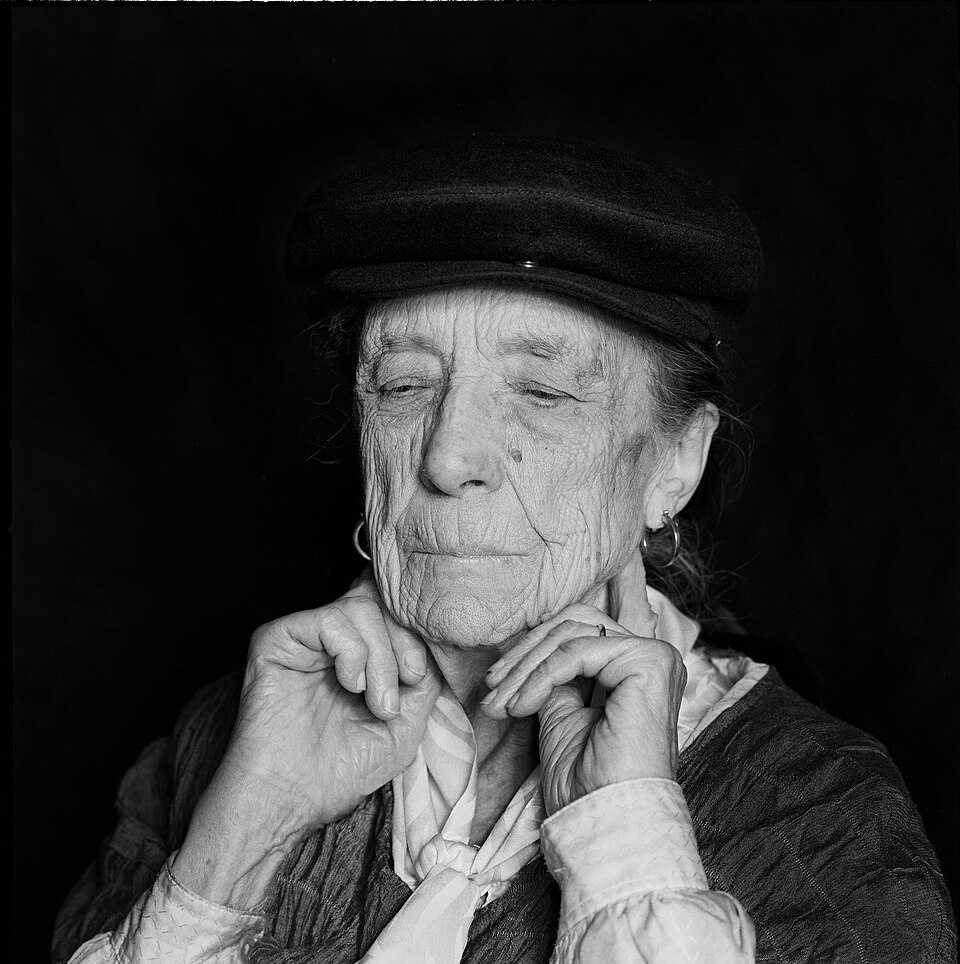
A Franco-American sculptor who spent seven decades turning childhood trauma — betrayal, desire, dependency — into monumental forms that redefined what sculpture could hold.
Louise Bourgeois made art from the materials of memory — family, the body, fear, and the slow work of repair — across a career that spanned the Great Depression, the rise of Abstract Expressionism, and the emergence of installation art, without ever quite belonging to any of those movements. She was in her seventies when the art world finally caught up with her, and she worked until the last years of her life.
Childhood and formation
Bourgeois was born in Paris on Christmas Day 1911. Her parents ran a tapestry restoration workshop, and she grew up drawing the missing sections of damaged tapestries — an early training in attention to the fragmented, the incomplete, and what must be reconstructed. Her father's decade-long affair with her English governess, Sadie Gordon Richmond, became the emotional fault line her work returned to repeatedly across sixty years. She studied mathematics at the Sorbonne before turning to art, attending the École des Beaux-Arts and studying under Fernand Léger, among others. In 1938 she married the American art historian Robert Goldwater and moved to New York, where she would remain.
The major work
Her early New York years produced painted wooden sculptures — the Personnages series, tall vertical forms recalling the isolated figures of absent people — shown at the Peridot Gallery in the late 1940s. Recognition was slow; for decades she showed infrequently, raised three sons, and worked without consistent critical support. The 1982 retrospective at the Museum of Modern Art, New York — the first the institution devoted to a living woman artist — changed her public standing entirely.
The Cells series, begun in the late 1980s, enclosed objects of domestic and bodily significance within wire-mesh or glass chambers: bones, mirrors, clothing, perfume bottles, suspended in states of barely contained anxiety. Maman (1999), the giant steel-and-marble spider first shown in 2000 in Tate Modern's Turbine Hall, became the most widely seen sculpture of her late career — a predatory-yet-nurturing figure she identified explicitly with her mother, who was, she wrote, "deliberate, clever, patient, soothing, reasonable, dainty, subtle, indispensable, neat and as useful as a spider."1
Method and psychological territory
Bourgeois worked across media — latex, marble, bronze, fabric, found objects — refusing specialisation. Her printmaking practice ran parallel to her sculpture for decades; her notebooks and diaries, known as the Journals, are dense with drawings and text. She considered art-making therapeutic in the precise sense: a practice of returning to and metabolising the past rather than escaping it. Themes of domesticity, sexuality, the maternal body, and psychological power recur without resolution, since resolution, for Bourgeois, was not the point.
| Material | Representative works |
|---|---|
| Wood | Personnages series, 1940s–50s |
| Latex and rubber | Fillette, 1968; Janus Fleuri, 1968 |
| Marble and steel | Maman, 1999 |
| Fabric | The Fabric Works series, 2000s |
Influence and late recognition
The scale of her retrospective shows — at the Guggenheim Bilbao, the Tate Modern, and the Centre Pompidou — confirmed a late-career status that matched the ambition she had sustained privately for decades. Younger artists working with autobiography, the body, and domestic space — Tracey Emin, Kiki Smith, Mike Kelley — have acknowledged her as a primary precedent. She died in New York in 2010 at ninety-eight, having worked almost to the end.
Art is a guarantee of sanity.
Footnotes
- The quoted passage is from Bourgeois's own writing on Maman, widely reproduced in exhibition catalogues; the exact phrasing appears in documentation from the Louise Bourgeois Studio. ↩