Marc Chagall
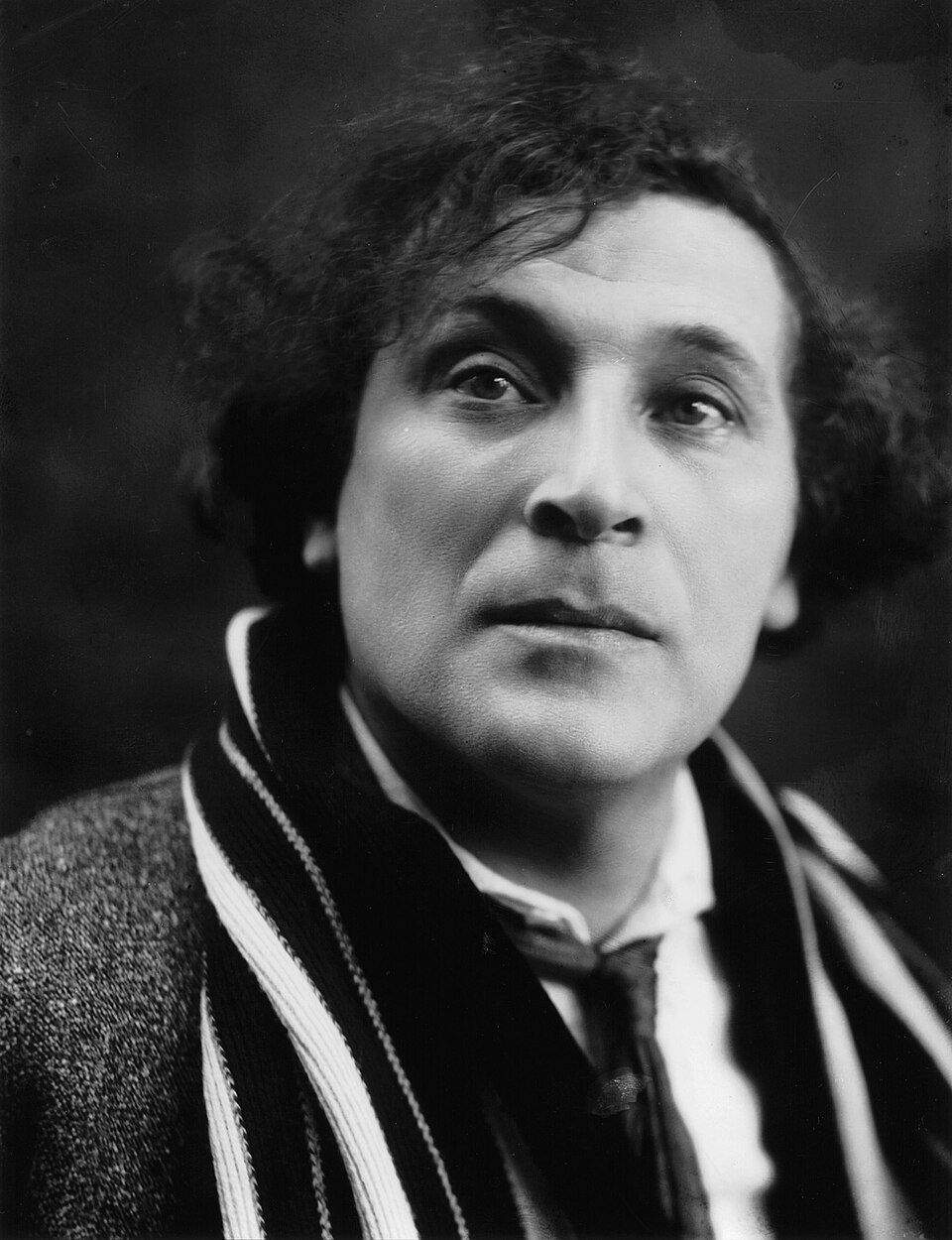
A Russian-French artist who drew on Jewish folk tradition and personal mythology to create an imagery of floating figures, animals, and lovers that is unlike anything else in modernism.
Marc Chagall arrived in Paris from the Pale of Settlement in 1910 carrying an imagery entirely his own — Vitebsk's rooftops and fiddlers, wedding ceremonies and flying lovers — and never discarded it, however many modernist movements swept past. Working across painting, stained glass, ceramics, theatre design, and book illustration across a career of nearly seven decades, he produced an art of extraordinary persistence: the same few images, endlessly reinvented, charged with the memory of a world that was later destroyed.
Vitebsk and Russian formation
Chagall was born in 1887 in Vitebsk, then part of the Russian Empire, into a Hasidic Jewish family. He studied at a local art school, then in 1907 moved to St Petersburg — a city Jews could inhabit only with difficulty — to train at the school of the Society for the Encouragement of the Arts and, briefly, in the studio of Léon Bakst.
The imagery of his childhood — the shtetl, its animals and rituals, the blue-green light of a Belarusian winter — became the permanent repertoire of his work. He neither idealised it sentimentally nor abandoned it for modernist abstraction. It was simply the world he painted.
Paris and the School of Paris
In 1910 Chagall moved to Paris, living in the artists' colony La Ruche and encountering Cubism, Fauvism, and the range of avant-garde practice. He absorbed these formally without becoming a convert to any programme: Cubist fragmentation appears in his spatial construction; Fauve colour in his palette; but neither dissolves his figurative imagery.
He was associated with the loose grouping known as the École de Paris — the diverse community of foreign artists working in Paris between the wars — and exhibited at the Salon des Indépendants. The dealer and critic Guillaume Apollinaire was among his early supporters.
Return, revolution, and exile
In 1914 Chagall returned to Vitebsk for his wedding and was stranded there by the outbreak of war. After the Russian Revolution he was appointed Commissar for Art in Vitebsk and founded the Vitebsk People's Art School in 1919 — a position that ended when Kazimir Malevich arrived, converted the school to Suprematism, and Chagall's figurative approach was displaced.
He left Russia permanently in 1922, spending years in Berlin and Paris before fleeing the Nazi occupation to the United States in 1941. He returned to France in 1948 and settled eventually in Saint-Paul-de-Vence.
Stained glass and monumental work
From the 1950s Chagall took on large-scale commissions that amplified his imagery into architectural scale. His stained-glass windows — for the Hadassah Hebrew University Medical Center in Jerusalem (1962), for Reims Cathedral (1974), for the Art Institute of Chicago — are considered among the finest of the twentieth century. The ceiling of the Paris Opéra, commissioned by André Malraux and unveiled in 1964, covers 220 square metres with a vision of world music history in Chagall's palette.
He worked until his death in 1985 at the age of 97.
In our life there is a single colour, as on an artist's palette, which provides the meaning of life and art. It is the colour of love.