Mary Cassatt
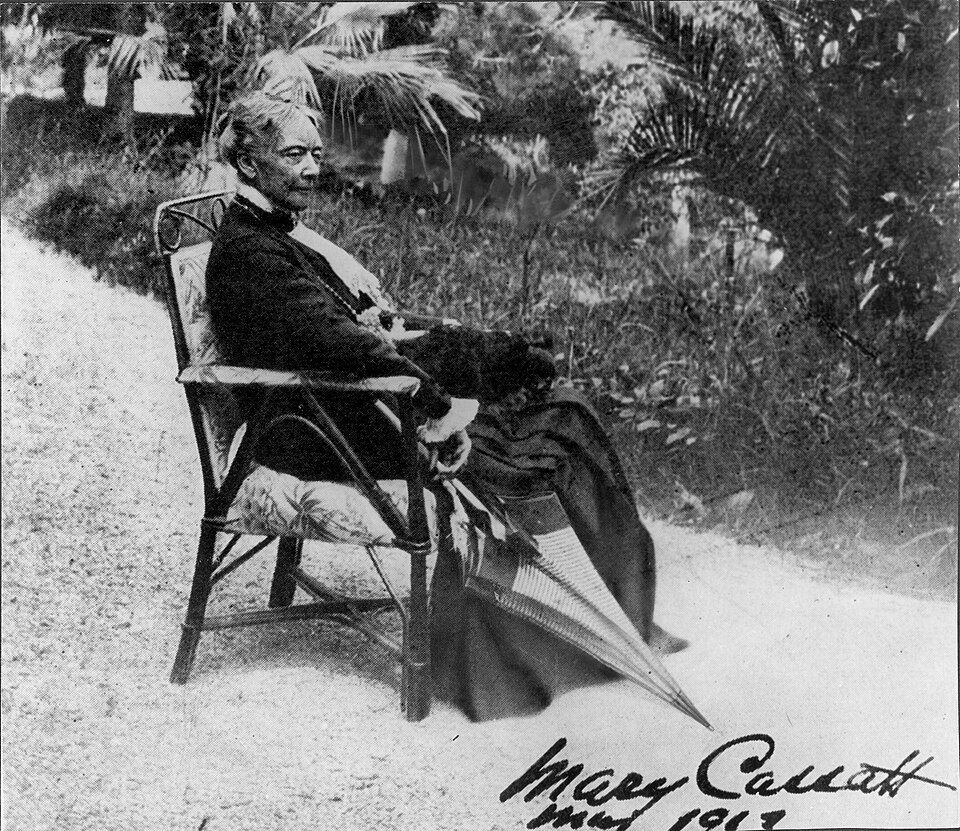
An American who painted the interior world of women in Impressionist Paris with a directness no European male of her generation could have managed.
Mary Cassatt was the only American to exhibit regularly with the French Impressionists, and one of the few women to do so at all. Working in Paris alongside Edgar Degas — who invited her into the group in 1877 — she forged a body of work that brought a genuinely female perspective to the intimate scenes Impressionism favoured: not the cafés and racecourses of her male contemporaries, but the nursery, the dressing table, the theatre box, the afternoon call.
From Pennsylvania to Paris
Cassatt was born in Allegheny, Pennsylvania, in 1844 into a prosperous family that took her to Europe as a child. Against her father's resistance she enrolled at the Pennsylvania Academy of the Fine Arts in Philadelphia, then left for Paris to study the old masters directly. The academic Salon accepted her work through the early 1870s, but she grew impatient with its conservatism.
When Degas saw her work in a Salon window around 1875 he is reported to have admired it without yet knowing her. Two years later he invited her to join the Impressionist circle, and from the fourth Impressionist exhibition of 1879 she showed with them consistently.
The intimate scale
Cassatt's subjects were the women and children of the comfortable bourgeoisie — the world she herself inhabited. She painted mothers nursing, women reading, figures at the opera glimpsed through a lorgnette. What distinguished her from sentimentality was a quality of attention: her figures are present, absorbed, not posed for approval. She frequently worked from life rather than convention, and her compositions show a Degas-like willingness to crop and tilt.
Her draftsmanship was exceptional, trained on Correggio and Rubens during repeated study trips to Spain and Italy. Line was never decorative filler but the structure on which colour was laid.
The Japanese influence and printmaking
In 1890 Cassatt visited an exhibition of Japanese woodblock prints at the École des Beaux-Arts and responded with a suite of ten coloured aquatints — among the most admired prints of the era. The flat areas of colour, decisive outlines, and compressed spatial depth of the Japanese ukiyo-e tradition found a direct echo in her work, producing images that are at once resolutely Western in subject and Oriental in construction.
Her printmaking output is as significant as her painting: she understood the medium's capacity for intimate, repeatable images and exploited it with technical precision.
I am independent! I can live alone and I love to work.
Legacy
Cassatt's influence operated through personal relationships as much as institutional ones. She persuaded a circle of American collectors — including her friends Louisine and Henry Havemeyer — to acquire French Impressionist paintings at a time when American taste ran to academic work. The Havemeyer collection, now largely in the Metropolitan Museum of Art, was shaped substantially by her advice.
Her own reputation dimmed after her death in 1926 and recovered dramatically in the feminist scholarship of the 1970s, which recognised her work as a sustained, rigorous engagement with the female gaze.