Max Bill
The Swiss polymath who treated art, design, and architecture as a single discipline governed by mathematical rigour and moral clarity.
Max Bill approached every medium — paint, concrete, typography, furniture, buildings — as a field in which mathematical ideas could be made visible, tactile, and useful. Over six decades he refused the boundaries separating fine art from applied design, insisting instead that rigour and beauty were the same thing expressed at different scales.
Bauhaus formation
Bill grew up in Winterthur and enrolled at the Bauhaus in Dessau in 1927, studying under Paul Klee, Wassily Kandinsky, and László Moholy-Nagy until 1929. The school's synthesis of craft, technology, and visual theory shaped everything he would do afterward. Returning to Zurich, he established himself as a graphic designer and architect while continuing to paint and sculpt — a breadth of practice that was unusual even by Bauhaus standards. He became closely associated with Concrete Art, the movement around Theo van Doesburg and later Max Huber and Richard Paul Lohse, which held that visual art should be constructed from purely non-representational, often geometric, elements derived from logical principles rather than observation or emotion.
Concrete Art and visual mathematics
Bill's paintings and sculptures explored how mathematical sequences — infinite series, Möbius forms, modular progressions — could generate aesthetic experience without recourse to symbol or narrative. His "Endless Ribbon" sculptures of the 1930s and 1940s treated the Möbius strip as a formal problem with spatial consequences: a surface that is continuous, paradoxical, and immediately perceptible. He was awarded the Grand Prix for sculpture at the Milan Triennale in 1951, one of the highest recognitions the postwar design world offered, and had received a prize at the same event in 1936. These works were not illustrations of mathematics; they were arguments, in material form, that mathematics and art shared a common ground.
HfG Ulm and the reform of design education
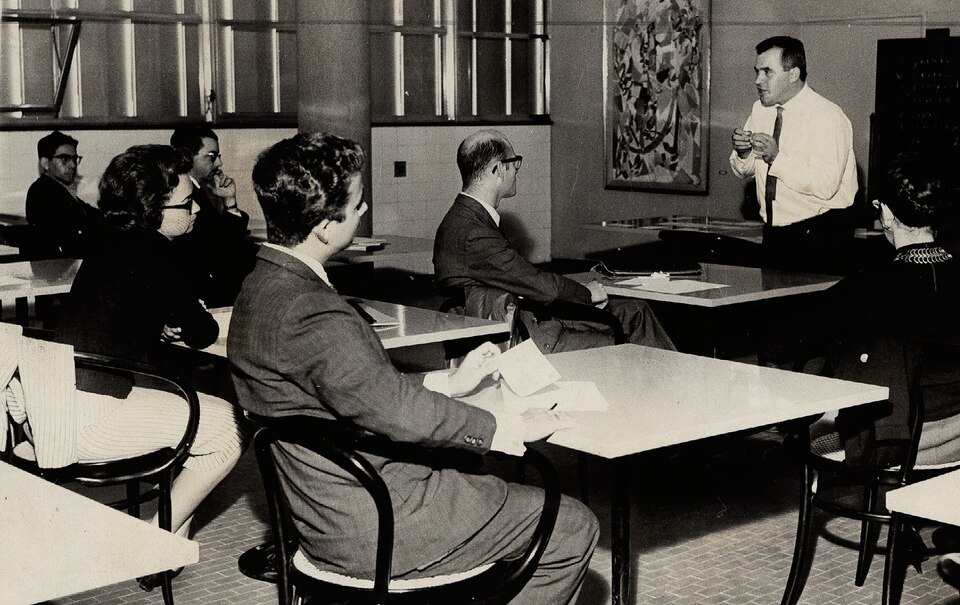
Bill's most consequential institutional act was co-founding the Hochschule für Gestaltung (HfG) in Ulm in 1953, where he served as rector and director until 1956. The school was conceived as a rigorous successor to the Bauhaus — not a revival but a reinvention suited to postwar industrial conditions, with a curriculum grounded in science, semiotics, and systematic method alongside traditional studio disciplines. Its graduates and faculty shaped corporate design programmes, information design, and industrial product development across Europe and beyond. The HfG's influence on how visual communication was taught and practised in the second half of the 20th century is difficult to overstate.
The Ulm stool and functional economy
Among Bill's most widely reproduced objects is the Ulmer Hocker (Ulm stool), designed in 1955 with Hans Gugelot and Paul Hildinger for the HfG. Three planks joined without fasteners: seat, back, or side-table depending on orientation. The stool embodied everything Bill argued design should be — reversible, teachable, manufacturable without waste, and honest about its own construction. It has remained in continuous production and is now read as one of the clearest expressions of mid-century functional design thinking.
Good design is a language, not a style.