Paul Cézanne
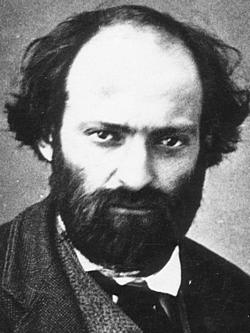
The Provençal painter who dismantled single-point perspective and gave Cubism, and through it most of twentieth-century art, its structural grammar.
Paul Cézanne spent thirty years in relative obscurity painting the landscape and still lifes of Provence with a method so at odds with the conventions of his time that it was largely rejected by the institutions that mattered. By the time younger painters understood what he had achieved — the construction of pictorial space through colour relationships rather than drawn line and shadow — he was old and near death. He was called, by Matisse and Picasso alike, the father of them all.
Formation and early rejection
Cézanne was born in Aix-en-Provence on 19 January 1839, the son of a banker. He studied law briefly under his father's pressure, pursued painting in Aix, and moved to Paris to work — where his early submissions to the Salon were rejected so consistently that they became a running joke among artists. He was a genuine friend and contemporary of the Impressionists, particularly Pissarro, who urged him toward more disciplined observation of nature and lighter palette. But Cézanne was after something the Impressionists were not.
Method and its departure from Impressionism
Where Impressionism sought to capture the transient appearance of light on surfaces, Cézanne wanted to render the underlying structure of things — the weight and solidity of objects, their relationships in space — while retaining the vibrancy that plein-air painting had recovered. He worked slowly, making small brushstrokes of colour that built up form through adjacency rather than through shadow or modelling.
The departure from single-point perspective was gradual but radical. Cézanne often showed multiple viewpoints on a single canvas simultaneously — a tabletop tilted toward the viewer while an object on it is seen from the side. The distortion was not incompetence but method: he was showing things as they are known rather than as they appear from a fixed point. Picasso and Braque recognised the implications and made Cubism from them.
His great subjects were the Mont Sainte-Victoire massif visible from Aix, which he painted more than sixty times; the Card Players — a sequence of five paintings of Provençal peasants at cards; and his Bathers series, large-format works developing the composition of nude figures in a landscape that occupied him for decades.
I want to make of Impressionism something solid and durable, like the art of the museums.
Recognition and late period
Cézanne spent most of his mature life in Aix, working in isolation from Parisian critical discourse and largely ignored by it. The young painters who came to understand his work — through reproductions, through the small number of dealers who showed it, and through his 1895 solo show at Ambroise Vollard's gallery — treated his canvases as a programme rather than a personal statement.
He was included in the 1904 Salon d'Automne and given a major retrospective room there in 1907, the year after his death. He died in Aix on 22 October 1906.