Paul Klee
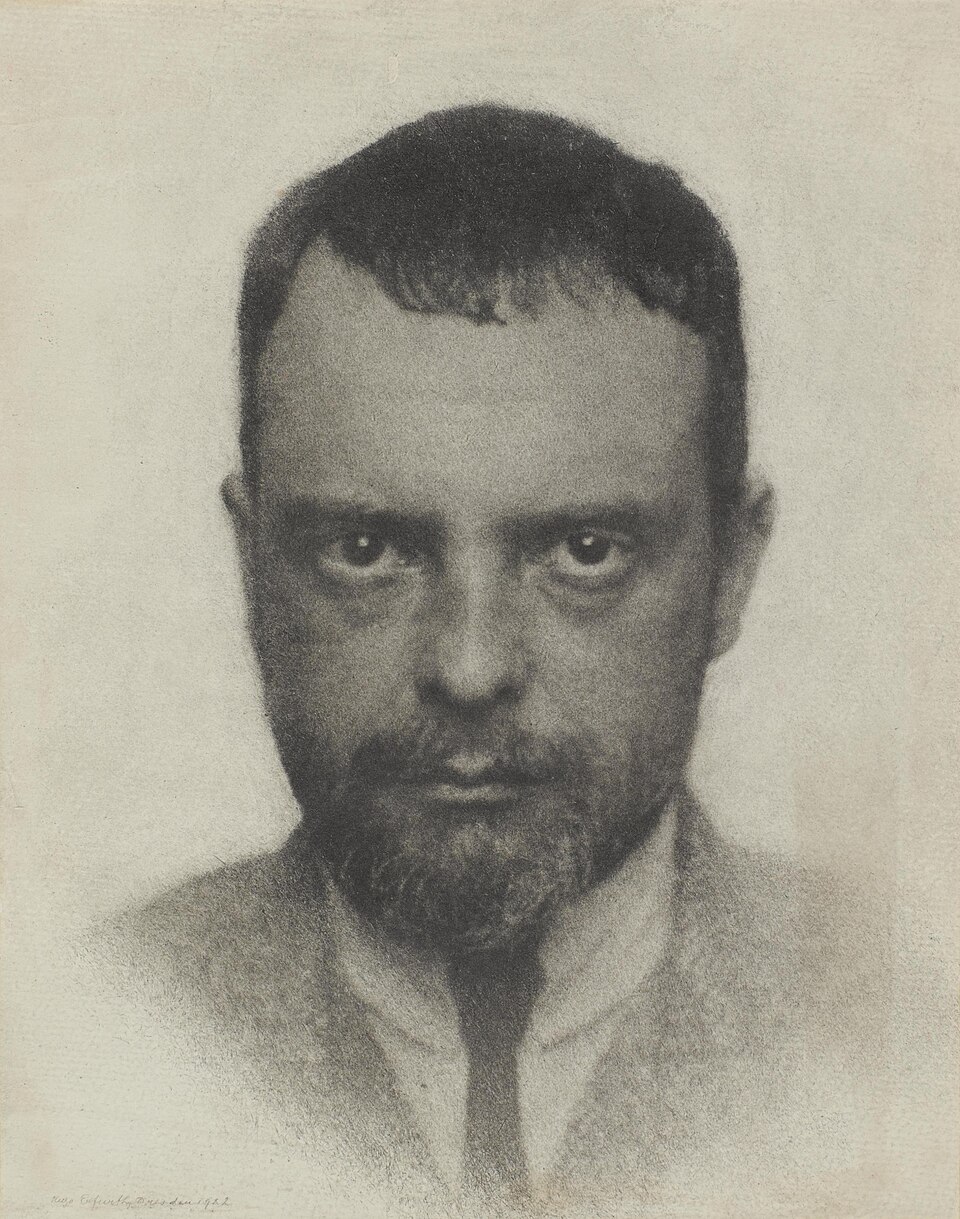
A Swiss-German painter whose singular visual language drew from expressionism, cubism, and surrealism to produce work that remained resolutely, untranslatably his own.
Paul Klee produced more than nine thousand works across painting, drawing, and watercolour, each one the product of a visual intelligence that refused to settle into any single movement or manner. Born near Bern to a German father and Swiss mother, he spent his career moving between Munich, Weimar, Dessau, and Düsseldorf before disease and political exile pushed him home to Switzerland for his final years.
Early formation and the question of colour
Klee studied at the Academy of Fine Arts in Munich under Franz von Stuck, graduating in 1901. A formative trip to Italy in 1901–02 sharpened his eye for classical form without converting him to it. For years he struggled to reconcile his confident draftsmanship with an uncertain relationship to colour. That changed in 1914, when a ten-day visit to Tunisia with August Macke and Louis Moilliet produced an immediate and lasting revelation: "Colour possesses me," he wrote in his diary. "I don't have to pursue it. It will possess me always, I know it." From that point, colour became the structural logic of his work rather than its surface.
Bauhaus years
In 1920 Klee was invited to join the Bauhaus in Weimar by Walter Gropius. He taught there until 1931 — first in Weimar, then in Dessau after the school moved in 1925 — developing a rigorous pedagogy of visual form that he published as the Pedagogical Sketchbook (1925) and expanded in his lecture notes, later compiled as The Thinking Eye. His teaching addressed line, tone, colour, and pictorial movement as interrelated forces, not decorative options. Colleagues during these years included Wassily Kandinsky, with whom he shared a house in Dessau. The Bauhaus period produced some of his most technically assured and theoretically grounded work, even as his imagery remained playful, cryptic, and charged with private symbolism.
Personal language and the limits of classification
Klee's work resists period labels because he used the vocabulary of every major movement of his era — the flat planes of cubism, the inner urgency of expressionism, the dream logic of surrealism — without belonging to any of them. His figures are schematic but never cold; his colour chords are precise but never predictable. Works such as Twittering Machine (1922) and Ad Parnassum (1932) demonstrate the range: the first, a sardonic mechanism for making bird-noise; the second, a mosaic-like meditation on light and aspiration. The Swiss art historian Will Grohmann, who wrote the standard monograph on Klee, described his position as one of radical singularity within the modern tradition.
Exile and final years
After the Bauhaus closed, Klee took a professorship at the Düsseldorf Academy in 1931. Two years later, following the Nazi seizure of power, he was dismissed; his work was subsequently included in the regime's Entartete Kunst (Degenerate Art) exhibition of 1937, where seventeen of his pieces were displayed as examples of cultural corruption. He returned to Bern in 1933. In 1935 he was diagnosed with scleroderma, a progressive autoimmune disease that steadily restricted the movement of his hands. Despite this, his output in his final years remained extraordinary in volume and grew stranger and more monumental in scale — large, heavy forms replacing the earlier delicacy. He applied for Swiss citizenship in 1939; it was granted on 7 July 1940, eight days after his death.
Colour possesses me. I don't have to pursue it. It will possess me always, I know it. That is the meaning of this happy hour: colour and I are one. I am a painter.