Peter Paul Rubens
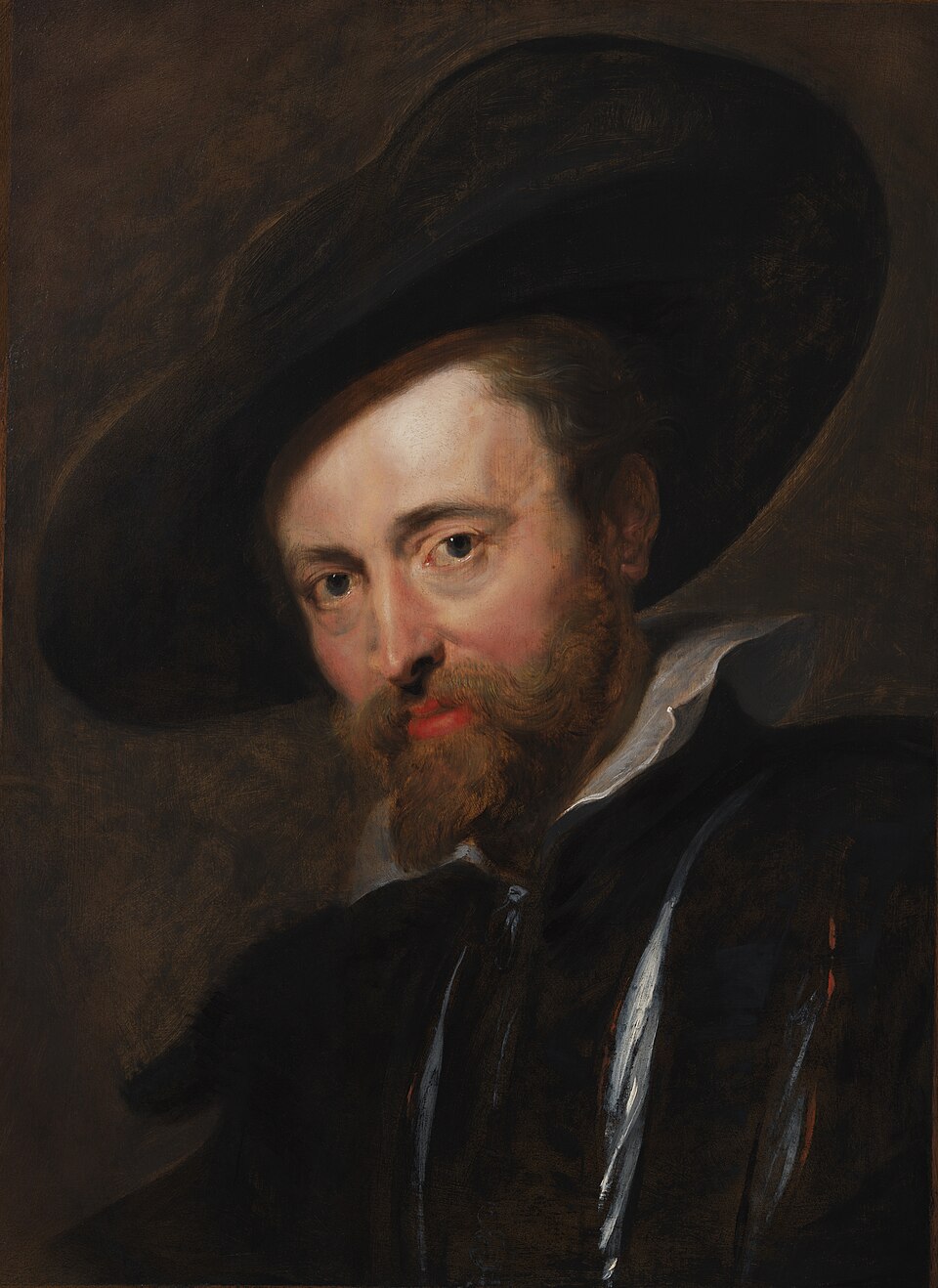
The Flemish master who made the Baroque its most operatic — filling canvases with bodies in motion, flesh in light, and a conviction that painting could hold everything the world contained.
Peter Paul Rubens was the most productive, most widely employed, and arguably most influential painter of the seventeenth century. His studio in Antwerp was the largest and most organised in Europe; his commissions came from every Catholic court and church on the continent; and his style — powerful bodies, radiant flesh, saturated colour, and a sense of everything being simultaneously in motion — defined the Baroque for the generation that followed him.
Formation and Italy
Rubens was born in Siegen, in the County of Nassau, on 28 June 1577, the son of a Flemish Protestant lawyer who had fled Antwerp. After his father's death the family converted back to Catholicism and returned to Antwerp, where Rubens trained successively under three Flemish painters before departing for Italy in 1600. He spent eight years in Italy — working at the court of the Duke of Mantua, studying the Venetians above all, and copying antiquities in Rome — and returned to Antwerp in 1608 a fully formed master.
The Italian sojourn gave him command of the entire tradition: Michelangelo's muscular forms, Titian's colour and handling, the antique's sculptural weight. He synthesised all three and pushed them further than any of his sources.
The Antwerp studio and major cycles
Back in Antwerp, Rubens established a studio of exceptional efficiency, training assistants — among them Anthony van Dyck and Jacob Jordaens — to work from his designs at scale. He developed a method of making small oil sketches (modelli) from which assistants would execute large canvases, with Rubens finishing the critical passages — faces, hands, highlights — himself. This allowed him to accept commissions of a scale and frequency impossible for an individual painter.
The largest of these was the Marie de' Medici cycle (1622–1625), twenty-four enormous canvases for the Luxembourg Palace in Paris depicting the life of the French queen mother. The cycle is part history, part allegory, part mythological spectacle; it remains the most ambitious decorative programme in the history of Northern European painting.
For the Jesuit church in Antwerp — now destroyed by fire — he painted thirty-nine ceiling panels. For the Torre de la Parada, Philip IV's hunting lodge outside Madrid, he and his studio produced over sixty paintings of mythological subjects.
Diplomacy and later career
Rubens was also a diplomat. Between 1626 and 1630 he served as a secret agent in the negotiations between Spain and England, spending time at both courts and being knighted by both Charles I of England and Philip IV of Spain. He used these diplomatic journeys to study collections, acquire works, and make contacts that brought further commissions.
His final decade was concentrated largely on the landscapes of his Château de Steen estate near Mechelen — loosely painted, atmospheric works that influenced Constable and the English landscape tradition.
My talents are such that I have never lacked courage to undertake any design, however vast in size or diversified in subject.
Legacy
Rubens's influence on European painting was immediate and comprehensive. Van Dyck, his greatest pupil, carried the Rubensian portrait tradition to England. Watteau absorbed his handling of outdoor light and delicate flesh. Delacroix studied him obsessively and took his approach to colour into the nineteenth century. Renoir, who also spent extended time with the Medici cycle in the Louvre, found in Rubens a model for the joyful depiction of the human body that underwrites his own mature work.