Pieter Bruegel the Elder
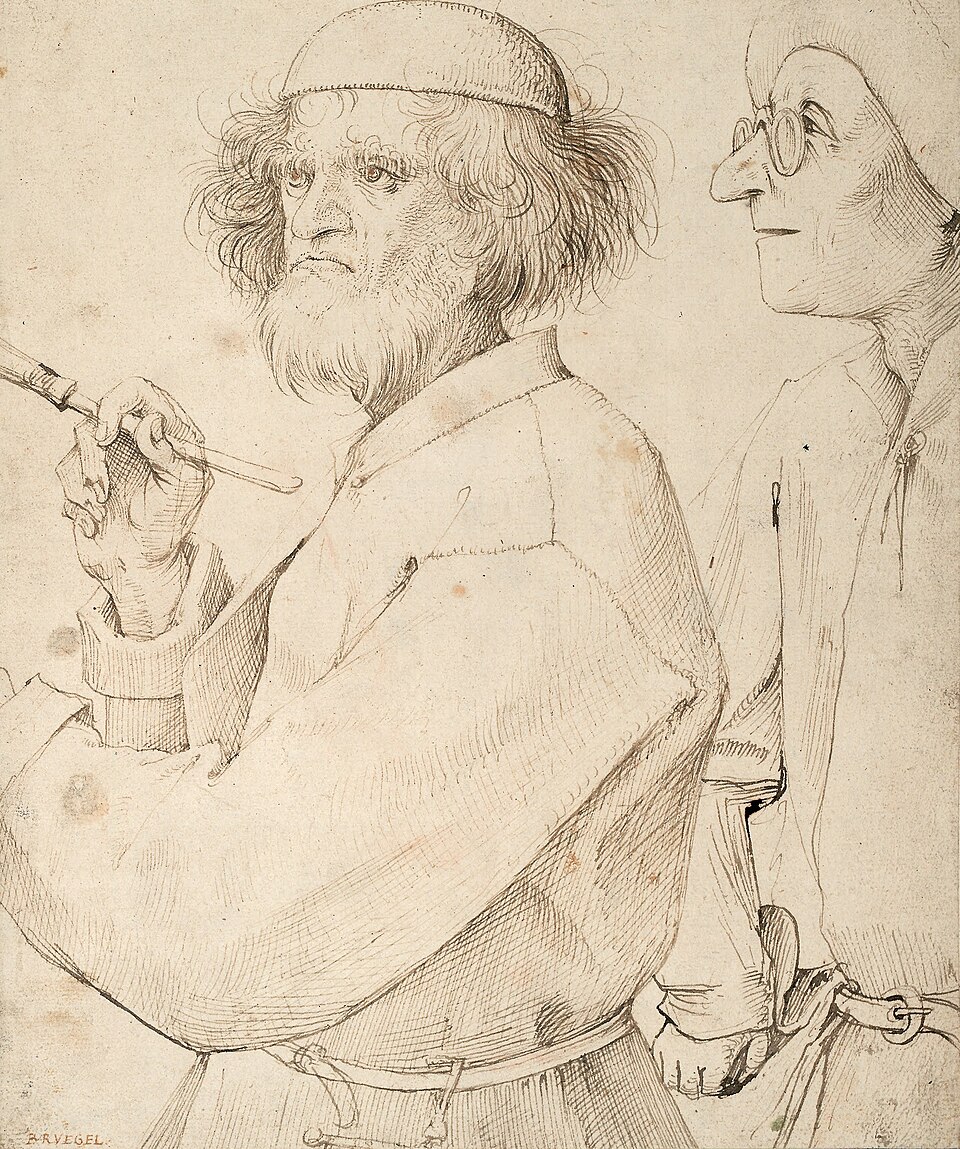
The Flemish painter who made peasant life and the rhythm of the seasons the true subject of large-scale painting — and in doing so produced some of the most enduringly observed pictures in Western art.
Pieter Bruegel the Elder is the most original Flemish painter of the sixteenth century and one of the most original in the entire tradition. Working in a period dominated by the influence of Italian art and the prestige of mythological and religious subject matter, he chose peasants, proverbs, and the Flemish countryside — and painted them at a scale and with a compositional ambition that transformed the genre landscape into one of the most intellectually demanding in Western art.
Antwerp and the Italian journey
Bruegel was born around 1525–1530, probably in Breda in the Duchy of Brabant. He trained in Antwerp under Pieter Coecke van Aelst and was admitted to the Antwerp Guild of Saint Luke as a master in 1551. Between 1552 and 1554 he travelled to Italy — visiting Rome and possibly Naples — and returned via the Alps. Unlike most Northern painters who made the Italian journey, he showed little direct interest in Italian Renaissance figural style. What the Alps gave him was a landscape vision: the first serious treatment of mountain scenery in Northern painting came directly from his Alpine drawings.
Back in Antwerp he worked for a decade as a designer of prints for the publisher Hieronymus Cock, producing allegorical compositions that drew on Bosch's example but with a more systematic moralising intent. In 1563 he moved to Brussels, apparently for personal reasons.
Peasant scenes and the landscape series
Bruegel's mature paintings fall into two groups. The peasant scenes — of which the most celebrated are the Peasant Wedding and the Peasant Dance — depict village life with an anthropological patience: the movements of bodies in a crowd, the social hierarchy of a feast, the particular gestures of people who work with their hands. They are not satirical, not condescending; they take their subjects as seriously as any history painting.
The Months series (1565), commissioned by the Antwerp merchant Nicolaas Jonghelinck, consists of six (possibly twelve) large panels depicting the activities and landscape of the year's calendar. Five survive. Hunters in the Snow (January) — peasants returning through a village, their dogs thin, the landscape emptied by cold — is among the most reproduced images in Western art and one of the most economical evocations of winter ever painted.
Morality and Flemish proverbs
Several of Bruegel's paintings take Flemish proverbs as their programme. Netherlandish Proverbs (1559) packs more than a hundred illustrated sayings into a single Flemish village scene. The Tower of Babel — painted twice — uses the ancient narrative as a reflection on human ambition, depicting the tower as a massive, spiralling structure already beginning to crumble from within.
He showed that painters who drew their subjects from court life and classical fable had not yet looked at where most people spent most of their time.
Legacy
Bruegel was admired in his own time and collected by the Emperor Rudolf II, who acquired several of his major works. He died in Brussels on 9 September 1569, leaving two sons — Pieter Brueghel the Younger and Jan Brueghel the Elder — who continued his manner into the next generation. His landscape vision fed directly into the Dutch Golden Age: Rembrandt owned prints after his work, and the tradition of painted seasons and peasant life that he established continued through the seventeenth century. His influence on twentieth-century painting — Beckmann, Ensor — was acknowledged and substantive.