Raphael
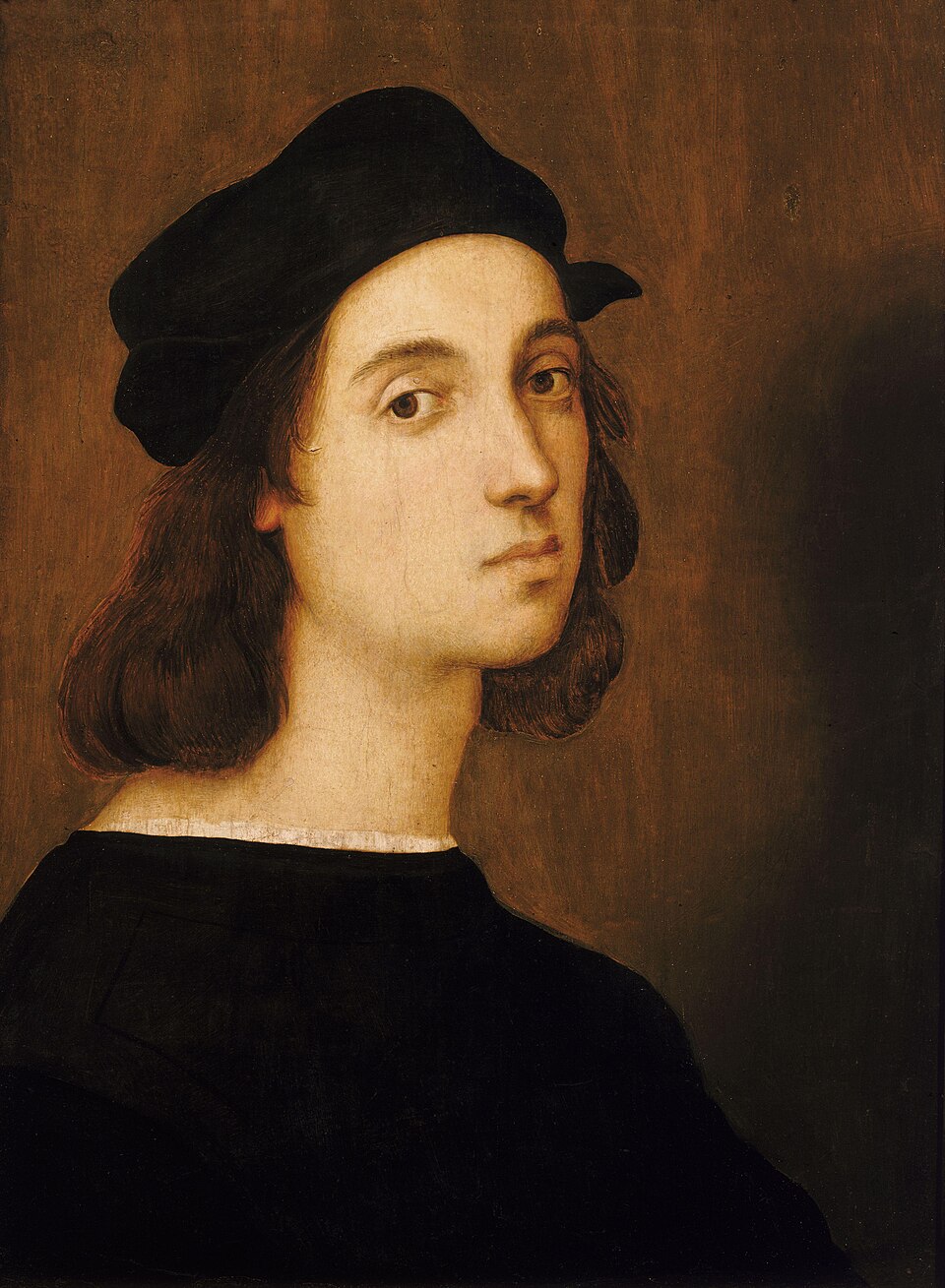
The painter of Urbino who made harmony a technique — composing figures with such clarity and grace that his rooms in the Vatican became the measuring-rod of European ambition.
Raphael died on his thirty-seventh birthday, having produced a body of work so formally complete and so widely reproduced that it defined academic painting for three hundred years. He was the youngest of the three great masters of the High Renaissance and the one who most fully achieved what the period proposed: the lucid organisation of form, narrative, and human feeling into a single, effortless-seeming whole.
Urbino and early training
Raffaello Sanzio was born in Urbino on 6 April 1483, the son of the court painter Giovanni Santi. Urbino under Federico da Montefeltro was one of the most cultivated courts in Italy, and Raphael grew up surrounded by humanist scholarship and exemplary craftsmanship. After his father's death in 1494, he entered the workshop of Pietro Perugino in Perugia, absorbing the older master's characteristic sweetness of expression and skill in spatial organisation.
By the early 1500s he had outgrown Perugino. A journey to Florence brought him into contact with Leonardo da Vinci's compositional experiments — the pyramidal grouping of figures, the use of gesture to articulate internal states — and with Michelangelo's heroic figural style. He synthesised both without appearing to strain.
The Vatican Stanze
In 1508 Pope Julius II summoned Raphael to Rome to decorate a suite of apartments in the Vatican. The result — the Stanze di Raffaello — is the greatest ensemble of Renaissance fresco painting and the work on which his reputation rests. In the Stanza della Segnatura, painted between 1509 and 1511, the School of Athens depicts the philosophers of antiquity gathered beneath a great barrel vault, with Plato and Aristotle at the centre, their gestures indicating their contrasting philosophies. Michelangelo sits apart, sketching. The composition handles fifty-odd figures with a spaciousness that makes the wall appear to open.
The companion fresco, the Disputa, places theologians in a curved arrangement mirroring the semicircle of heaven above them — a compositional device so elegant that it looks inevitable.
Portraiture and later work
Beyond the Stanze, Raphael produced portraits of exceptional psychological directness — including a series of papal portraits and a celebrated image of Baldassare Castiglione — as well as large altarpieces and tapestry cartoons for the Sistine Chapel. From 1514 he succeeded Bramante as chief architect of St Peter's, taking on additional responsibilities in the preservation of ancient Rome.
He died on 6 April 1520, his thirty-seventh birthday, reportedly of a fever. Rome went into mourning. His unfinished Transfiguration was placed at the head of his bier.
In Raphael's work there is nothing that could be amended; it is all good, all beautiful, all divine.
Legacy
Raphael became the supreme model for academic painting. The French Academy, the Royal Academy in London, and their counterparts across Europe all held him up as the exemplar of correct composition, noble subject matter, and graceful execution. The Pre-Raphaelites named themselves against him, intending by their rejection of his influence a restoration of the sincerity they claimed had preceded him — which is a measure of how thoroughly he had defined the mainstream.