Rembrandt
The Dutch master who used darkness as a medium — making light fall on the human face like a moral judgement.
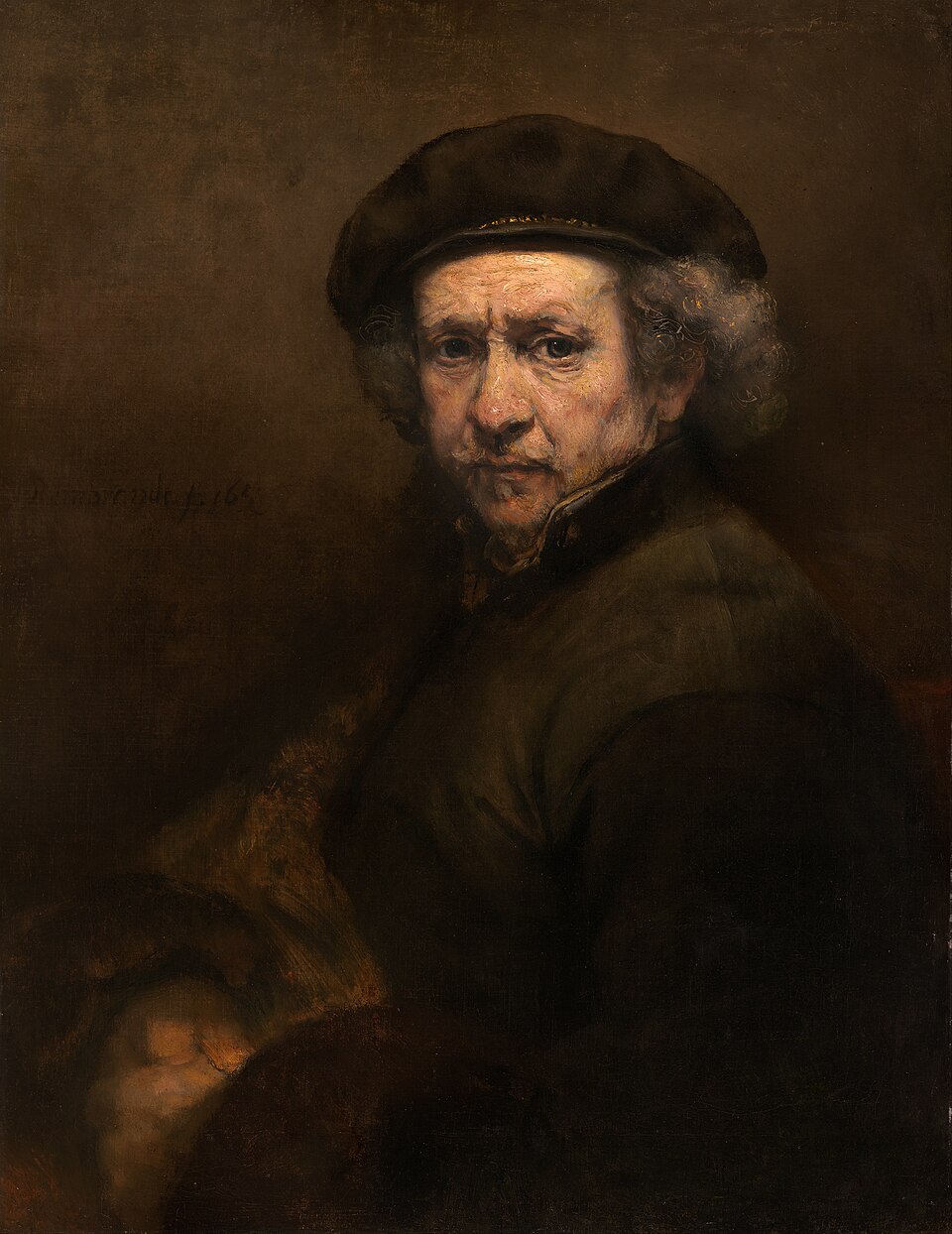
Rembrandt van Rijn is the pre-eminent figure of the Dutch Golden Age and one of the indisputable masters of Western painting. His power rests on two things: an unmatched ability to make paint render the texture of skin, fabric, and shadow, and a quality of attention to the human face — in his own face above all, studied across forty self-portraits — that goes beyond likeness into something closer to moral investigation.
Leiden and early success in Amsterdam
Rembrandt Harmenszoon van Rijn was born on 15 July 1606 in Leiden, the son of a prosperous miller. He studied Latin school before abandoning an academic career for painting; he trained briefly in Leiden and then in Amsterdam under the history painter Pieter Lastman, from whom he absorbed the technique of dramatic lighting and expressive gesture. Returning to Leiden he established a studio and quickly attracted notice. By 1631 he had moved permanently to Amsterdam, where he found an eager market among the prosperous merchant class for portraits, biblical paintings, and etchings.
His group portrait The Anatomy Lesson of Dr Nicolaes Tulp (1632) established his reputation immediately. The painting was not the first group portrait in Amsterdam — the form had a long tradition — but Rembrandt organised it around an action rather than a row of faces, creating a composition with the tension of a history painting.
The Night Watch and reversal of fortune
In 1642 Rembrandt completed the Night Watch (formally, Militia Company of District II under the Command of Captain Frans Banninck Cocq), a monumental group portrait of a civic militia company. It is now the most famous painting in the Rijksmuseum, but its immediate reception is uncertain; the story that the patrons were displeased because Rembrandt showed some figures in shadow is not well supported. What is clear is that in the 1640s and 1650s the fashion in Amsterdam shifted toward smoother, lighter, more elegant portraiture — a mode Rembrandt refused to follow. Commissions declined, his spending outpaced his income, and in 1656 he was declared insolvent. His house and collection were sold.
Late work
The last two decades of his life, impoverished and largely out of fashion, produced his most searching paintings. Portraits and self-portraits of the 1650s and 1660s are built up with impasted, layered paint — surfaces that catch the light differently from any angle — and depict their subjects with an unflinching attention to age, fatigue, and dignity. His late Jewish Bride (c. 1665–1669), whatever its actual subject, renders the tenderness between two figures through the weight and texture of paint on their touching hands.
Choose only one master — Nature.
Legacy
Rembrandt's influence spread immediately across the Netherlands and more slowly through European painting as a whole. His etchings — printmakers from his own time to the present have studied them — placed him among the supreme masters of the medium. Vermeer, though he never met Rembrandt, absorbed his method of using directed light to structure interior space. Reynolds, Delacroix, and Van Gogh all cited him as essential. The forty-odd self-portraits, taken together, constitute the most sustained autobiographical project in the history of painting.