René Magritte
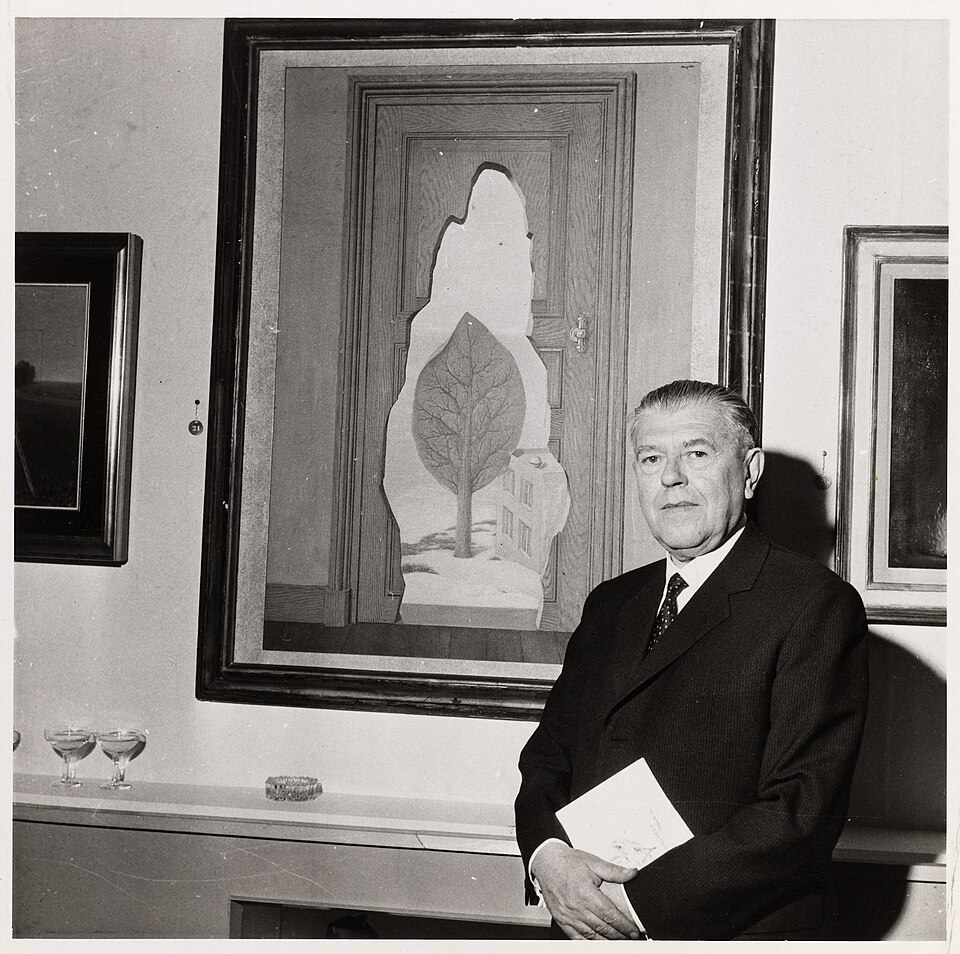
A Belgian painter who made the ordinary strange and the strange ordinary, using photographic precision to undermine every certainty about what we see and what things mean.
René Magritte painted in a flat, almost commercial style that reproduced the world with unnerving fidelity — then placed objects in impossible relations, inscribed words that contradicted images, and turned the familiar into a site of philosophical unease. His canvases look like illustration but operate like puzzles with no solution.
Formation and early influences
Magritte was born in Lessines, Belgium, on 21 November 1898. His mother died by suicide when he was thirteen — a biographical fact sometimes over-deployed in critical accounts of his imagery of concealed faces and water. He studied at the Académie Royale des Beaux-Arts in Brussels intermittently from 1916 to 1918, then worked in advertising and wallpaper design for several years before turning fully to painting. His early work showed the influence of Futurism and Cubism before an encounter with a reproduction of Giorgio de Chirico's The Song of Love in 1922 redirected him toward the dreamlike juxtaposition of objects that would define his mature style.
In 1927 Magritte moved to Paris and associated with the Surrealist group centred on André Breton. He returned to Brussels in 1930 and spent most of the rest of his life there, working in a bourgeois domestic setting that contrasted sharply with the ambitions of his paintings.
The painted image and its treachery
Magritte's most discussed single work, La Trahison des images (The Treachery of Images, 1929), depicts a pipe with the inscription Ceci n'est pas une pipe (This is not a pipe). The statement is literally correct — the painting is not a pipe — but its confrontational plainness forced viewers to confront the gap between image and object that representation normally papers over. The painting has since become a touchstone of semiotics and philosophy of language.
His imagery drew from a small but endlessly recombined vocabulary: bowler-hatted men, clouds, curtains, rocks suspended in mid-air, mirrors that reflect what is behind rather than in front of the viewer, and windows that open onto paintings of the view rather than the view itself. Each canvas resists allegorical reading: Magritte consistently denied that his works had hidden meanings, insisting they depicted mystery rather than symbolised it.
Everything we see hides another thing; we always want to see what is hidden by what we see.
Influence on later movements
Magritte's influence on Pop Art, conceptual art, and advertising is substantial and documented. His visual method — familiar objects rendered precisely in impossible contexts — was adapted by artists including Jasper Johns and Ed Ruscha, and absorbed wholesale into the visual culture of advertising, where the surrealist juxtaposition became a standard technique for drawing attention.