Richard Serra
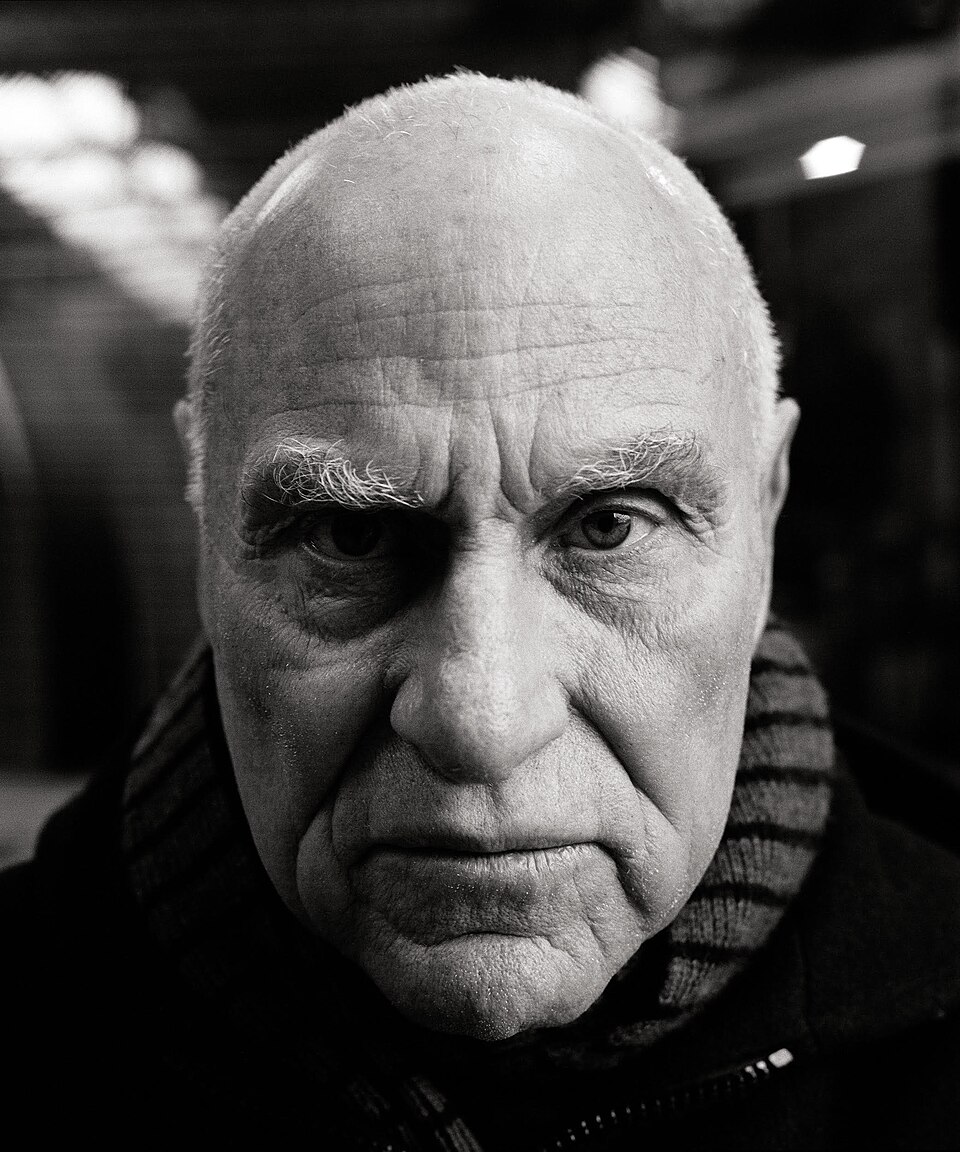
An American sculptor who made weight, scale, and the moving body of the viewer the raw material of his art, turning industrial steel into charged encounters with space.
Richard Serra treated sculpture not as an object to be looked at but as a condition to be walked through. Across six decades he pushed material — first molten lead, then vast sheets of weathering steel — to the point where mass, balance, and the viewer's own path through space became the subject of the work itself.
Formation and the Verb List
Serra studied at the University of California, Berkeley and UCLA before completing an MFA at Yale, where he was exposed to the milieu that would shape the postminimalist turn. In 1967–68 he compiled his "Verb List," a written inventory of actions — to roll, to crease, to fold, to store, to bend, to shorten, to twist, to splash — that reframed sculpture as a set of processes performed on material rather than a repertoire of fixed forms. The list became a foundational document of process art, and its logic runs through everything he made afterward: the object is the trace of an action carried out on matter under the pressure of gravity.
Early works enacted this directly. Serra flung molten lead into the junctions between floor and wall, letting the cooling metal record the gesture that made it — the "splash" pieces that made process visible and permanent in a single act.
Steel, weight, and the viewer's body
Serra soon moved from lead to Cor-Ten weathering steel, the industrial alloy whose surface oxidizes into a stable rust-brown skin. In his hands, single plates and leaning slabs of enormous weight were balanced against one another so that their stability depended on the precise distribution of load — sculpture held up by physics rather than joinery. The result confronted viewers with sheer mass and scale, and made the experience of the work inseparable from the act of moving around and through it.
This concern with the site — the specific place a work occupied and the bodily experience it produced there — became central. Serra insisted that his sculptures were not decorations dropped into a location but were made for, and altered by, the particular space they inhabited.
Tilted Arc and the question of public space
That principle collided with public opinion in the case of "Tilted Arc" (1981), a 120-foot curving wall of steel installed across Federal Plaza in New York City. Commissioned as a permanent, site-specific work, the piece divided the plaza and its users, provoking complaints and eventually a series of public hearings. In 1989, after prolonged controversy, the sculpture was removed — a decision Serra regarded as the destruction of the work, since a site-specific piece could not, by his definition, be relocated intact. "Tilted Arc" became a landmark episode in the history of public art, framing lasting debates about artistic intent, community consent, and who controls shared space.
Torqued forms and late recognition
In later decades Serra developed his "Torqued Ellipses" and related series of torqued-steel forms — towering, leaning walls whose curves twist as they rise, so that the interior volume shifts continuously as one walks their length. Major installations of this work include the permanent presentation at Dia:Beacon and "The Matter of Time" at the Guggenheim Bilbao. His standing was consolidated by the retrospective "Richard Serra Sculpture: Forty Years" at the Museum of Modern Art in 2007. Serra died in New York in March 2024.
Sculpture is not about the object; it is about the way you move through space, and the way space moves through you.