Robert Rauschenberg
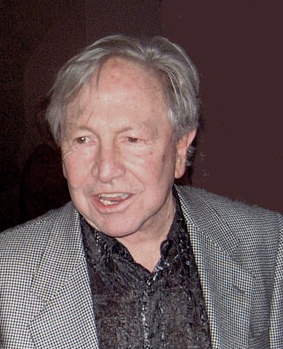
The American artist who dissolved the boundary between painting and the world by dragging everyday life — tyres, radios, stuffed goats — directly into the work.
Robert Rauschenberg spent a career making art that refused to stay put. His Combines jammed newspaper, paint, found objects, and real light bulbs into single works that were neither paintings nor sculptures — only themselves. In doing so he opened the gap between Abstract Expressionism and Pop Art and let nearly everything else pour through.
From Port Arthur to Black Mountain
Rauschenberg was born in Port Arthur, Texas, in 1925 and drafted into the US Navy during World War II, where he worked as a neuropsychiatric technician. After the war he studied at the Kansas City Art Institute, the Académie Julian in Paris, and then crucially at Black Mountain College in North Carolina — the experimental school where John Cage, Merce Cunningham, and Willem de Kooning also worked. The environment was transdisciplinary by design, and it suited him exactly.
At Black Mountain he met painter Cy Twombly and studied with Josef Albers, whose rigorous formalism he absorbed and immediately subverted. Two early gestures announced his thinking: the White Paintings (1951) — monochrome canvases that registered only shadow and ambient light — and Erased de Kooning Drawing (1953), in which he laboriously rubbed out a gifted work by de Kooning to make a new one from the act of erasure.
The Combines
Between 1954 and 1964 Rauschenberg produced the works that define him: the Combines, hybrid objects that combined painting with found material — a stuffed Angora goat girdled by a tyre (Monogram, 1955–59), a quilt and a pillow smeared with paint (Bed, 1955), a radio embedded in a canvas. He described his practice as working "in the gap between art and life." The Combines were indifferent to categorical tidiness; they insisted that the newspaper, the shirt, and the paint were equivalent materials — all surfaces to be acted upon.
The influence was immediate. Jasper Johns, his close collaborator in the mid-1950s, was working parallel territory with flags and targets. Together they constitute the hinge between the gestural painting of the New York School and the mass-culture imagery of Pop.
Method and surface
Rauschenberg was promiscuously medium-conscious. He worked in photography, silk-screen printing, performance, papermaking, and what he called Combines throughout his life, not just in that canonical decade. In the early 1960s he began transferring photographic imagery — sports photographs, space-race images, reproductions of Old Masters — directly onto canvas using a solvent transfer method. These works merged the archive of mass media with gestural painting marks in a way that preceded and helped define Pop Art's engagement with reproduction.
He was also concerned with collaboration and chance. A long association with Merce Cunningham's dance company kept him alert to duration, light, and the body in space.
Legacy
Rauschenberg received the Venice Biennale Grand Prize in 1964 — a controversial award at the time, seen by some European critics as American cultural aggression. He later co-founded Rauschenberg Overseas Culture Interchange (ROCI), a personal diplomacy project in which he produced and exhibited work in countries including Cuba, China, Tibet, and the Soviet Union, trading art for access across geopolitical barriers.
He died in Captiva, Florida, in May 2008. His influence runs through installation art, conceptual practice, and the whole culture of mixed media — the assumption that any material is available to any artist is, in large part, his legacy.
I work in the gap between art and life.