Roy Lichtenstein
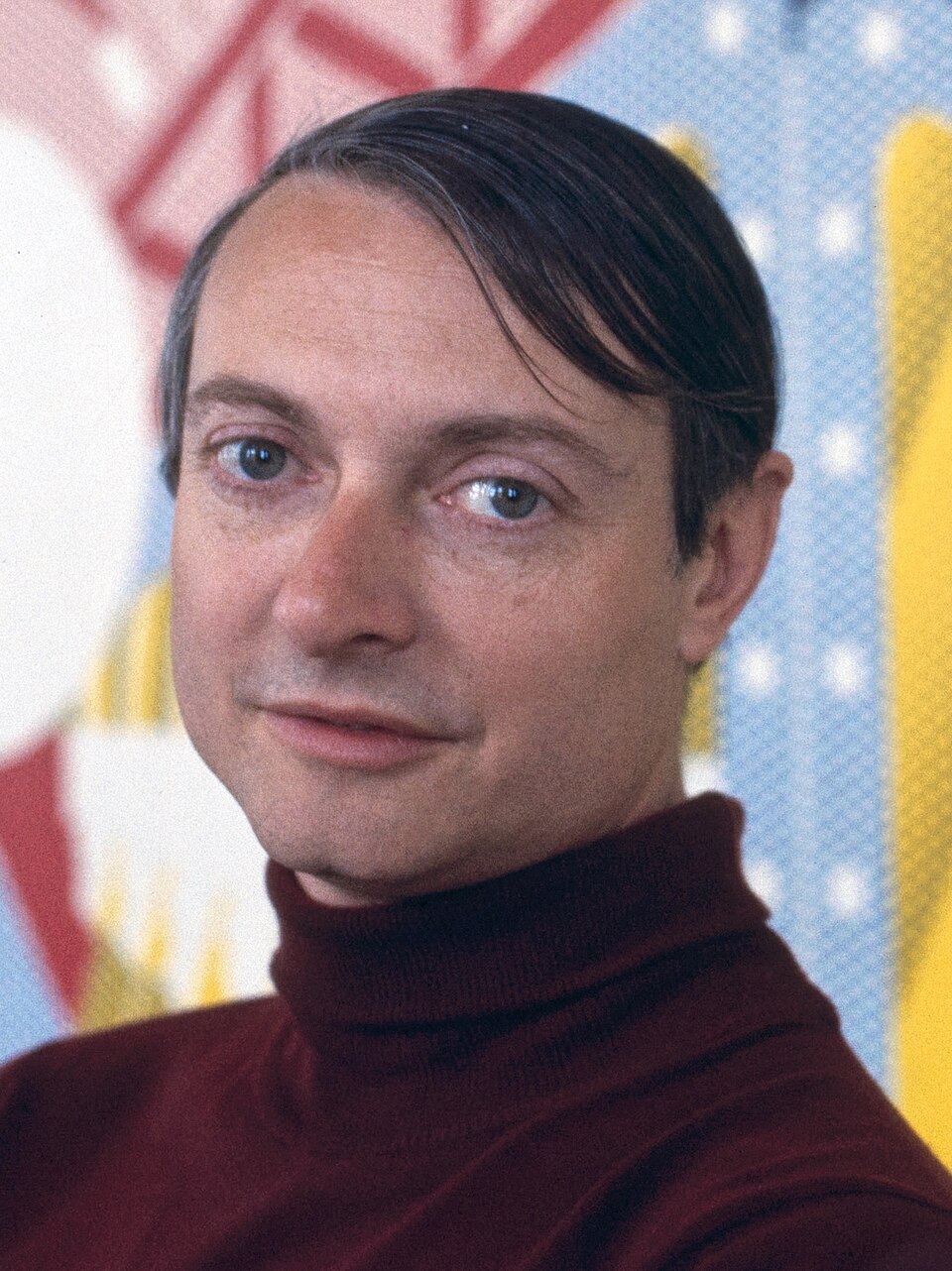
The Pop artist who painted comic-book panels at monumental scale and made the gap between high art and mass-produced imagery impossible to ignore.
Roy Lichtenstein took the cheapest, most disposable images in American visual culture — the war comic, the romance panel, the department-store advertisement — and rendered them at museum scale with mechanical exactitude, forcing art institutions and their audiences to confront what they had agreed to call culture and what they had agreed to ignore.
Formation in New York and Ohio
Lichtenstein was born in Manhattan in 1923. He studied briefly under Reginald Marsh at the Art Students League before Ohio State University, interrupted by three years of military service in Europe. He completed his MFA at Ohio State in 1949 and began teaching there, working through Abstract Expressionism, Cubism, and American history painting before arriving at the imagery that would define him.
The shift happened around 1961. Teaching at Rutgers University in New Jersey, where Allan Kaprow and Lucas Samaras were also on the faculty, Lichtenstein began incorporating cartoon imagery — from bubblegum wrappers and comic books — into paintings that copied the style of mass printing with hand-applied paint. The subject matter was provocatively banal; the execution was precise and deliberate.
The Pop breakthrough
In 1961 and 1962 Lichtenstein produced works like Look Mickey and Blam that replicated the visual language of American comics — bold black outlines, primary colours, speech bubbles, onomatopoeic lettering, and most distinctively the Ben-Day dot, the mechanical halftone pattern used in cheap print reproduction. Painted by hand at large scale, these dots exposed the printing process that normally remained invisible.
Leo Castelli gave him his first solo show in 1962. Andy Warhol, hearing that Castelli had taken on an artist making comic paintings, reportedly abandoned his own comic-strip works rather than compete. Within a year Lichtenstein was central to Pop Art alongside Warhol, Jasper Johns, and James Rosenquist.
Method and subjects
Lichtenstein never simply copied his sources. He selected, cropped, simplified, and rescaled. The Ben-Day dot, black outlines, and flat colour — applied with stencils and rollers — were a constructed style that simulated mechanical reproduction while remaining unmistakably handmade.
Over the following decades he applied this method to subjects beyond comics: brushstrokes (paintings of the gestural Abstract Expressionist mark, rendered in the flat style of his commercial imagery), Art Deco, Chinese painting, still life, interiors. Each series interrogated a different visual convention by running it through his reductive machine.
I think my work is different from comic strips — but I wouldn't call it transformation; I don't think that whatever is meant by it is important to art.
Legacy
Lichtenstein continued to work and exhibit until his death. He produced prints, sculpture, murals — including large-scale public commissions — and continued exploring the tension between high and low, original and reproduction, throughout his career. He died in New York in September 1997 from pneumonia.
His influence is visible in graphic design, advertising, and contemporary painting wherever bold outline and flat colour are used self-consciously. The technical innovation — systematising a mechanical appearance through handcraft — remains his particular contribution to the history of printmaking and painting.