Salvador Dalí
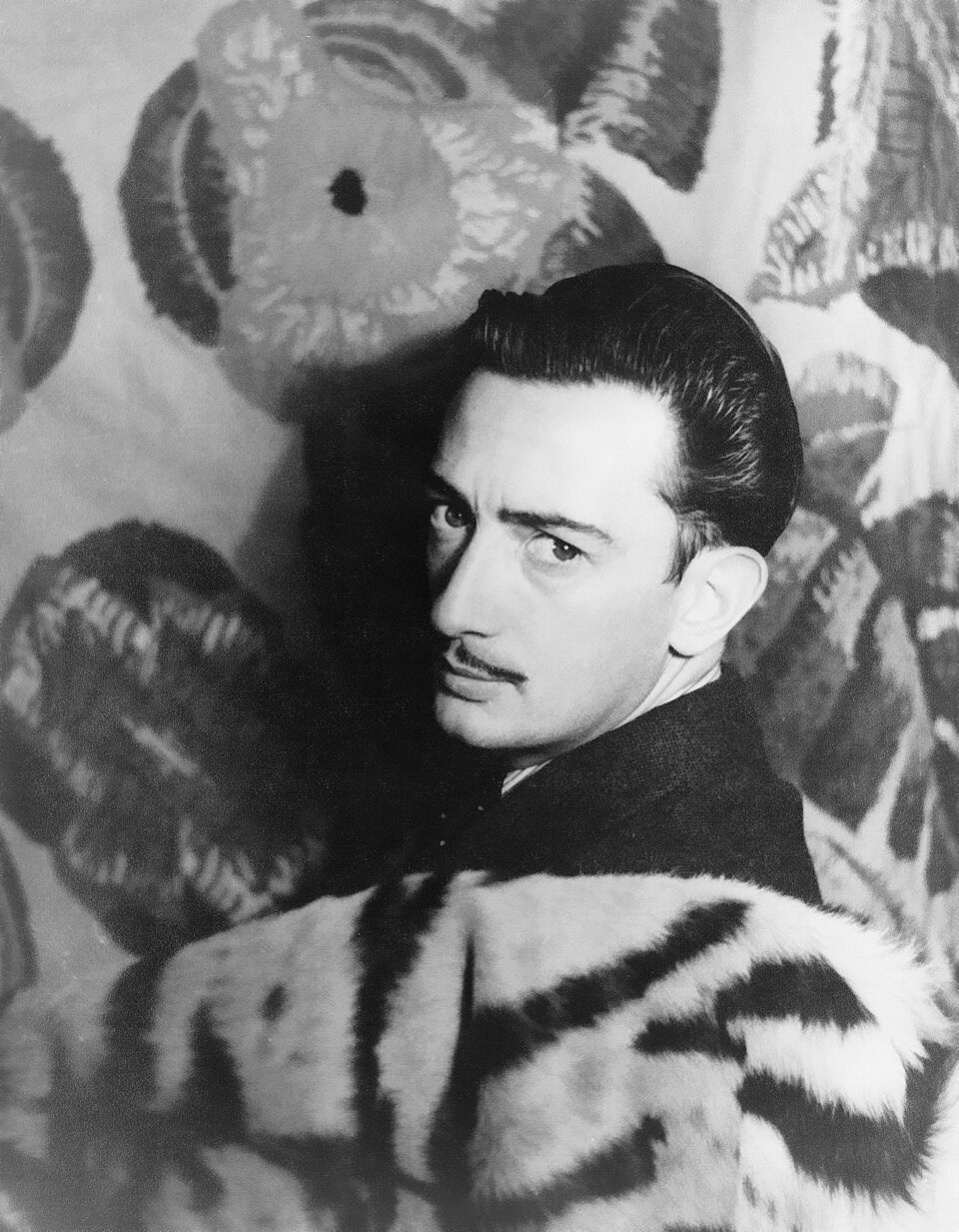
The Spanish painter whose hallucinatory precision gave Surrealism its most technically accomplished and publicly recognisable face.
Salvador Dalí painted dreams as if they required the accuracy of a botanist's drawing — the melting watch, the burning giraffe, the dessicated plains of the Empordà — rendered with old-master draftsmanship in service of imagery generated by deliberate psychological extremity. No other Surrealist was so technically rigorous or so strategically visible.
Catalonia and early formation
Dalí was born in Figueres, in the Catalan region of Spain, in 1904. He showed precocious drawing ability and enrolled at the School of Fine Arts in Madrid in 1922, where he encountered Federico García Lorca and Luis Buñuel and absorbed Impressionism, Pointillism, and Cubism in rapid succession. He was expelled in 1926 before sitting his final examinations — reportedly declaring that the examiners were not competent to judge him.
A first visit to Paris in 1926 introduced him to Picasso, and in 1929 he joined the Surrealist movement centred on André Breton. That same year he made Un Chien Andalou with Buñuel — the short film whose opening eyeball-slicing image remains one of cinema's most disturbing sequences.
The Surrealist decade
Between 1929 and the late 1930s Dalí produced the paintings that have defined Surrealism in the popular imagination. The Persistence of Memory (1931), with its drooping watches draped over a dreamscape derived from the coastal landscape near Cadaqués, is among the most reproduced works in twentieth-century art.
His method he called the Paranoiac-Critical method: a self-induced hallucinatory state in which the mind produced irrational imagery that the hand then transcribed with meticulous academic precision. The contradiction between the irrationality of the subject and the hyperrealist execution of the paint was intentional and central.
In 1934 André Breton expelled him from the Surrealist group over political disagreements — Dalí refused to denounce Hitler, and his courtship of commercial celebrity sat badly with Surrealism's declared hostility to bourgeois culture. Dalí was indifferent. He continued to use the Surrealist label and continued to develop his own imagery independently.
America and the Theatre-Museum
From 1940 to 1948 Dalí and his wife Gala lived primarily in the United States, where he produced paintings, designed the Mae West Lips Sofa, worked briefly for Alfred Hitchcock on dream sequences for Spellbound (1945), and achieved the commercial fame that confirmed his standing as the most recognisable living artist in the world.
After returning to Europe he began the project that became his lasting monument: the Dalí Theatre-Museum in Figueres, which opened in 1974. He designed it as a total environment — a Gesamtkunstwerk of rooms, optical illusions, and site-specific works within the shell of the old municipal theatre. He is buried beneath it.
Late in life he moved to the castle of Púbol, which he had given to Gala. After her death in 1982 he retreated there, then to the Tower of Galatea adjacent to the Figueres museum. He died in Figueres in January 1989.
The only difference between me and a madman is that I am not mad.