Titian
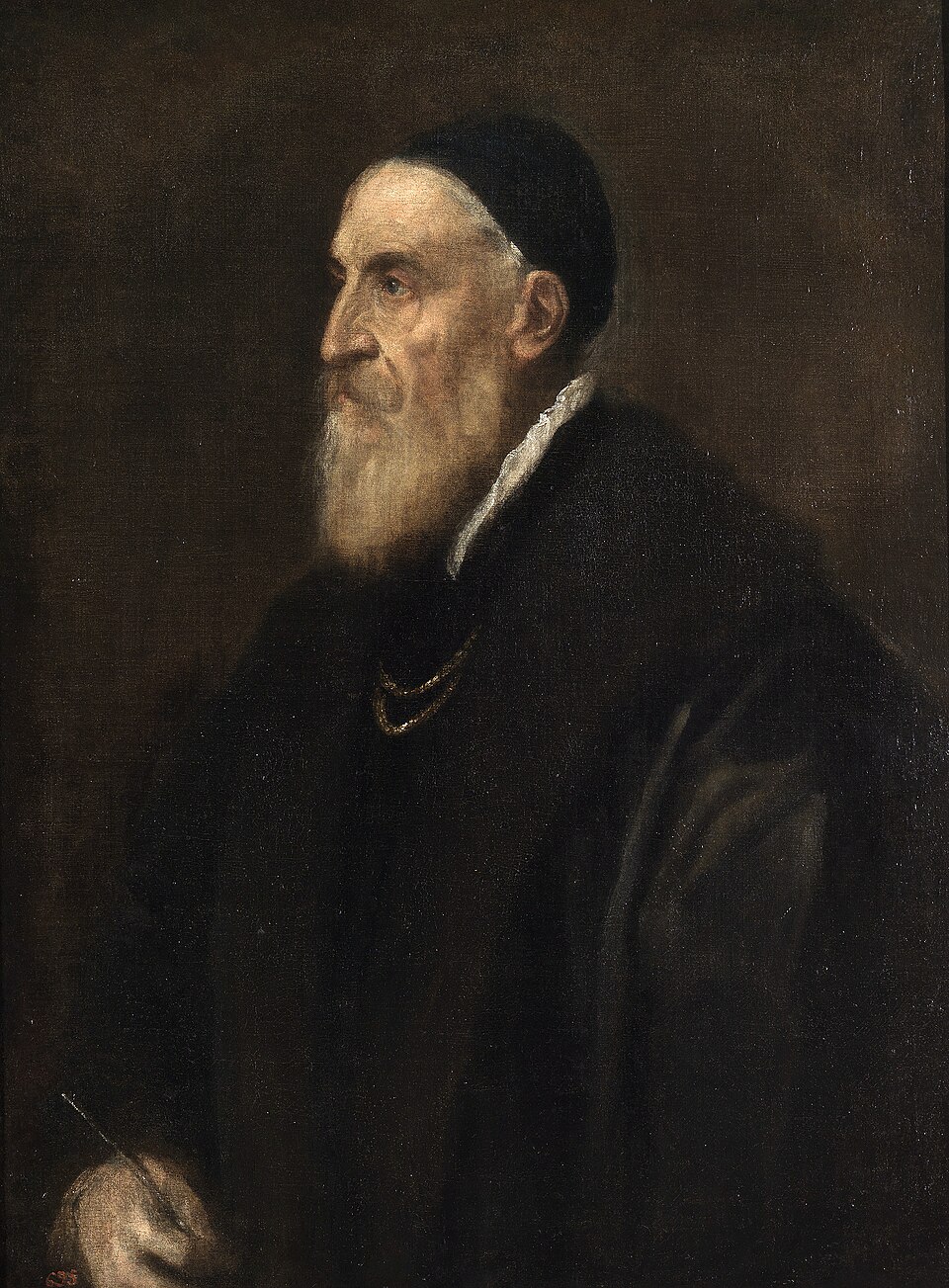
The master of the Venetian school who showed that colour, not line, could bear the whole weight of form — and who painted emperors and gods with equal command across eight decades.
Titian dominated Venetian painting for over sixty years and left an inheritance that determined the direction of European painting for two centuries. He proved that colour applied with a loaded brush — not the careful drawing that Florentine theory placed at the centre of art — could model form, convey atmosphere, and produce works of psychological depth that no line-based method could match.
Cadore and Venice
Tiziano Vecellio was born in Pieve di Cadore, in the Dolomites, at a date that remains uncertain — probably between 1488 and 1490. He came to Venice as a boy and entered the workshop of Giovanni Bellini, the master of the Venetian tradition, before transferring to that of Giorgione. From Giorgione he absorbed the technique of tonalism — building form through gradations of colour and tone rather than drawn contour — and after Giorgione's death in 1510 he completed several of the older painter's unfinished works.
By 1516, when Bellini died, Titian was the dominant painter in Venice. His altarpiece the Assunta (Assumption of the Virgin), installed in the Frari church in 1518, was unlike anything the city had seen: figures of heroic scale, bold reds and golds, and a sense of upward physical force that owed more to Michelangelo's Sistine ceiling than to the quiet harmonies of Bellini.
Court painter to emperors
Titian's reputation extended well beyond Venice. Holy Roman Emperor Charles V appointed him court painter and ennobled him in 1533 — the first time a German emperor had so honoured an Italian artist. He painted Charles V on horseback at Mühlberg (1548), a work that invented the genre of the equestrian state portrait as it would be practised for the next three centuries. His relationship with Charles V's son, Philip II of Spain, was equally productive: a series of large mythological paintings, the poesie, occupied him through the 1550s and 1560s.
Late manner
In his final decades Titian developed a style of extraordinary freedom. Brushwork became loose and layered; forms dissolved at their edges into pools of paint applied with a rag or his fingers as much as a brush. The Pietà he painted for his own tomb — unfinished at his death and completed by Palma il Giovane — stands as the most personal of his works and as a statement about what painting at the limit of a long life can look like.
In his last works the brushstrokes are broad and swift, laid on in great blobs, so that from nearby nothing can be seen, but from a distance everything appears perfect.
Legacy
Titian's influence passed directly into every tradition that followed him. Rubens copied his works in the Spanish royal collection; Velázquez studied them at the same source. Rembrandt, though he never visited Italy, was formed in part by engravings after Titian. Reynolds held him up as the model for portraiture. His late painterly freedom — the idea that the mark of the brush could be visible and expressive rather than effaced — is the foundation of the entire tradition of painterly handling that runs through Rubens, Hals, and Velázquez to Manet and beyond.