Vincent van Gogh
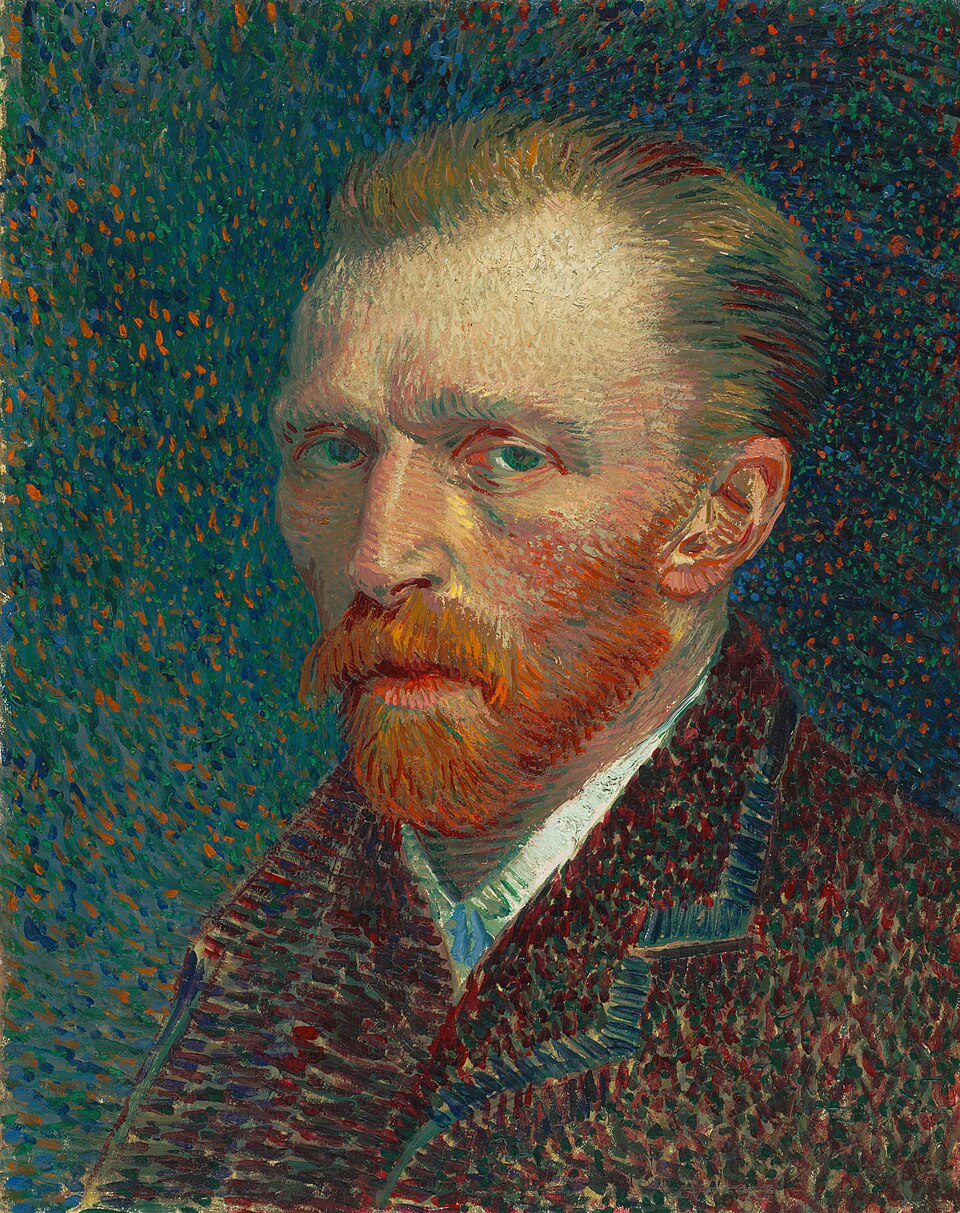
The Dutch Post-Impressionist who compressed a decade of painting into explosive colour and charged brushwork that shaped virtually every expressive tendency in Western art that followed.
Vincent van Gogh worked as a painter for roughly a decade and produced approximately 2,100 artworks — about 860 of them oil paintings — most of them in the final two years of his life. The compression of that output, and the intensity of the colour and mark-making within it, gave the twentieth century several of its most foundational visual models: the idea that paint could carry emotion directly, that colour could be used structurally rather than descriptively, that the artist's psychological state could be made visible as formal quality.
Early life and the path to painting
Vincent Willem van Gogh was born on 30 March 1853 in Zundert, a village in the Dutch province of North Brabant, the eldest surviving child of a Dutch Reformed minister. He worked first as an art dealer for Goupil & Cie, with postings in The Hague, London, and Paris, before a deepening religious crisis led him toward missionary work in the Belgian mining district of Borinage. He was dismissed from the mission for excessive zeal in sharing the poverty of his congregation.
He began drawing seriously around 1880 and committed to painting as a vocation. He was almost entirely self-taught, studying anatomy, perspective, and technique through books and correspondence, and by copying works he admired. His older brother Theo, an art dealer in Paris, provided financial support that sustained him throughout his painting career.
The Dutch and Parisian periods
Van Gogh's early Dutch work — dark, tonal, concerned with peasant labour and interiors — culminated in The Potato Eaters (1885), a deliberately ungainly composition that he considered a serious statement about the dignity of agricultural work. He moved to Paris in 1886 to live with Theo, and the exposure to Impressionism, Neo-Impressionism, and Japanese woodblock prints transformed his palette within months. The dark tones gave way to colour as structural principle; the brushwork became more active and directional.
Arles and Saint-Rémy
In February 1888 van Gogh moved to Arles in Provence, seeking southern light and a community of artists he hoped to establish. The period produced an extraordinary concentration of work: the Sunflowers series, the Bedroom in Arles, portraits of postman Roulin and his family, and, at the end of the year, the crisis that resulted in him severing part of his own ear during a severe mental episode. Paul Gauguin had come to Arles at van Gogh's invitation; the episode ended the collaboration and the Arles period.
He entered the Saint-Paul-de-Mausole asylum in Saint-Rémy in May 1889. The year there produced The Starry Night, the Irises series, and a body of work defined by the swirling, rhythmic brushwork that became his most recognisable formal signature.
Instead of trying to reproduce exactly what I see before me, I make more arbitrary use of colour to express myself forcibly.
Final months and legacy
Van Gogh moved to Auvers-sur-Oise in May 1890 to be near his physician Dr Paul Gachet and Theo. He worked prolifically until late July, producing landscapes and portraits including the turbulent Wheatfield with Crows. He shot himself on 27 July 1890 and died two days later. He was thirty-seven.
He sold one painting during his lifetime. His reputation was established posthumously through Theo's efforts and, after Theo's death, through the advocacy of Theo's wife Jo van Gogh-Bonger.