Azzedine Alaïa
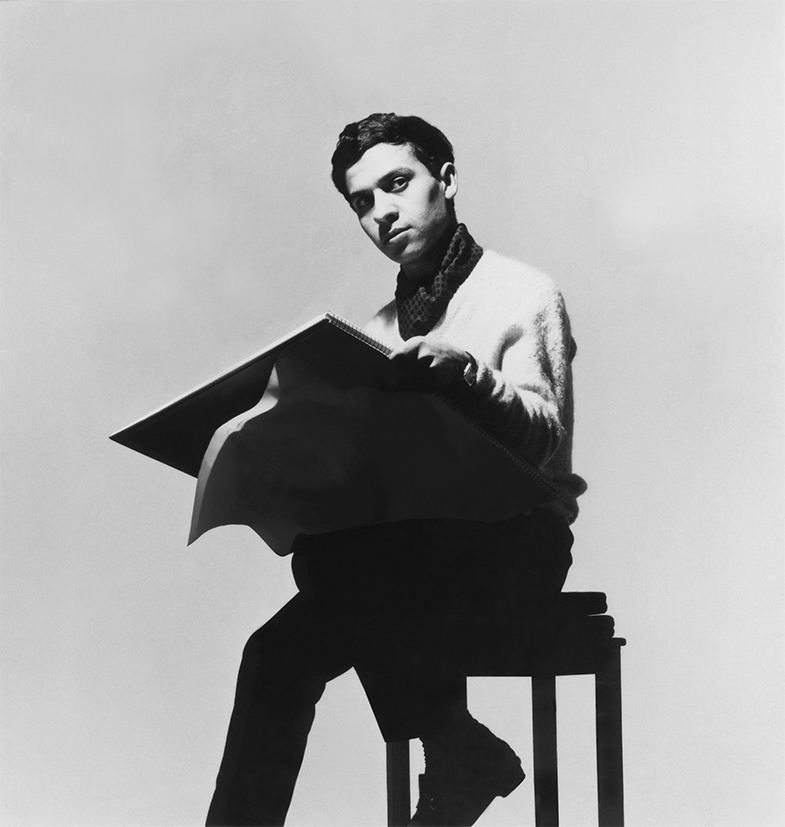
The Tunisian-born couturier who dressed on his own schedule, built garments from the body outward, and earned the name le roi du cling for silhouettes that refused to apologise for the figure beneath them.
Azzedine Alaïa worked outside the fashion calendar, dressed women from his apartment before he had a showroom, and built each piece through sustained hand-fitting rather than modelling on a stand. The result was clothing that fitted with a precision the industry recognised as exceptional and that women who wore it described in terms closer to armour than dress.
Tunis and Paris
Alaïa was born in Tunis in 1935 and studied sculpture at the École des Beaux-Arts de Tunis. The sculptural sensibility never left: his approach to a garment was structural, concerned with how fabric could follow, compress, or extend a form. He arrived in Paris in 1957, working briefly at Dior, then as an assistant at Guy Laroche. For several years he worked as housekeeper for the Countess Blégiers de Brantes, which gave him access to a social world — and a client list — before he had any formal platform. He began dressing private clients from his apartment on the Rue de Bellechasse, building a reputation through word of mouth rather than institutional presentation.
The body as blueprint
Alaïa's working method was unusual in its tactility. He fitted directly on the body, adjusting in multiple sessions, and was known to spend hours on a single seam. His fabrics — stretch jersey, leather, bandage knit — were chosen for how they responded to movement, not how they read in a photograph. The silhouette this produced was body-conscious in an era that often favoured volume: seamed, structured, shaped. Paris gave him the epithet le roi du cling — the King of Cling — which he accepted without comment and which accurately described the fit without capturing the precision that achieved it.
Refusal of the calendar
He showed when he was ready. Alaïa's decision to work outside the official fashion-week schedule was consistent rather than occasional: he presented collections when they were complete, sometimes months after the commercial season had passed, and declined the pressure to produce at the industry's pace. Buyers and editors attended anyway. His clients across four decades included Naomi Campbell, Grace Jones, Tina Turner, and Michelle Obama. Campbell, who modelled for him without fee throughout the early part of her career, lived in his building for a period.
Fondation and late recognition
Alaïa opened the Fondation Azzedine Alaïa in the Marais — a gallery and archive space adjacent to his studio and atelier — as both an exhibition venue and a repository for his work and the work of others he admired. He curated shows there of photographers and designers whose rigour matched his own. Institutional recognition followed the same arc as his commercial one: substantial but on a delay. He received the CFDA International Award in 1998, the Légion d'honneur in 2008. He died in Paris in November 2017.
"My work is about the body. I want women to feel free in their clothes — free and protected at the same time."