Willem de Kooning
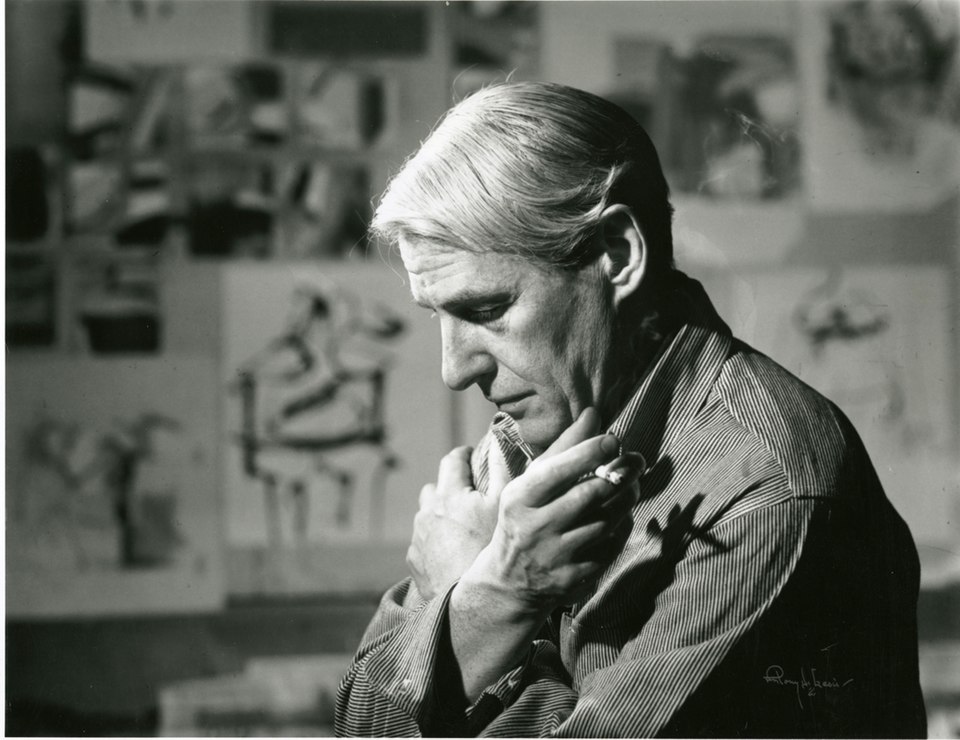
A Dutch-American painter who refused to give up the human figure even as abstraction became the dominant orthodoxy, keeping it alive as the most turbulent and charged presence in his canvases.
Willem de Kooning arrived in New York as an illegal immigrant in 1926 and became, within three decades, one of the most consequential painters in the city's history — a figure who held Abstract Expressionism together with the human body it was supposedly leaving behind, and who refused to resolve the tension.
Arrival and formation
De Kooning was born in Rotterdam in 1904 and trained in applied arts and decorating before stowing away on a freighter bound for North America. He settled in New York, worked as a house painter and commercial artist, and gradually entered the circle of artists forming around the Federal Art Project in the 1930s. His friendship with Arshile Gorky was formative: both were European-trained painters trying to find what painting could still do after Cubism, Surrealism, and the long American tradition had all made their claims.
He married the painter Elaine Fried in 1943. She remained a central figure in his life and, after their separation and reconciliation, in his final years.
The Women and the figure
De Kooning's fame rested initially on his black-and-white abstractions of the late 1940s — paintings that demonstrated his command of gesture and surface without resolving into any legible image. But what made him controversial was his return to the figure: the Women series, begun around 1950, presented female figures rendered in slashing, brutal strokes, the forms half-dissolved, the paint thick and re-worked. Woman I (1950–52), now in the Museum of Modern Art, took two years to complete. Critical reaction was divided: some saw misogyny, others the residue of ancient fertility imagery, others simply a refusal to abandon the most fraught subject in Western art.
He continued to move between abstraction and figuration for the rest of his career. His landscapes of the late 1950s and the lush, unresolved paintings of the 1960s drew on both. In his East Hampton studio, established from the 1960s onward, he developed a late style — open, fluid forms in lighter colours — that some critics considered a separate achievement from the dense earlier work.
I have to change to stay the same.
Surface and process
De Kooning worked and reworked his canvases to a degree unusual even among his peers. Paint was scraped away, added again, revised. He used newspaper to slow the drying of oil paint, creating textures that preserved the history of the hand's movement across the canvas. The surface of his paintings is a record of decisions made and unmade; nothing is hidden.
This commitment to visible process placed him in a different relationship to the gestural tradition than Jackson Pollock, whose drip paintings effaced the individual stroke. De Kooning's mark is always present as a mark — heavy, considered, muscular.
Legacy
De Kooning became a United States citizen in 1962 and received the Presidential Medal of Freedom in 1964. In his final decade, he lived with a diagnosis now believed to have been Alzheimer's disease, yet continued to paint. Late works, made with assistants' help, are still contested in attribution terms but remain exhibited and discussed. He died on Long Island in 1997.