William Blake
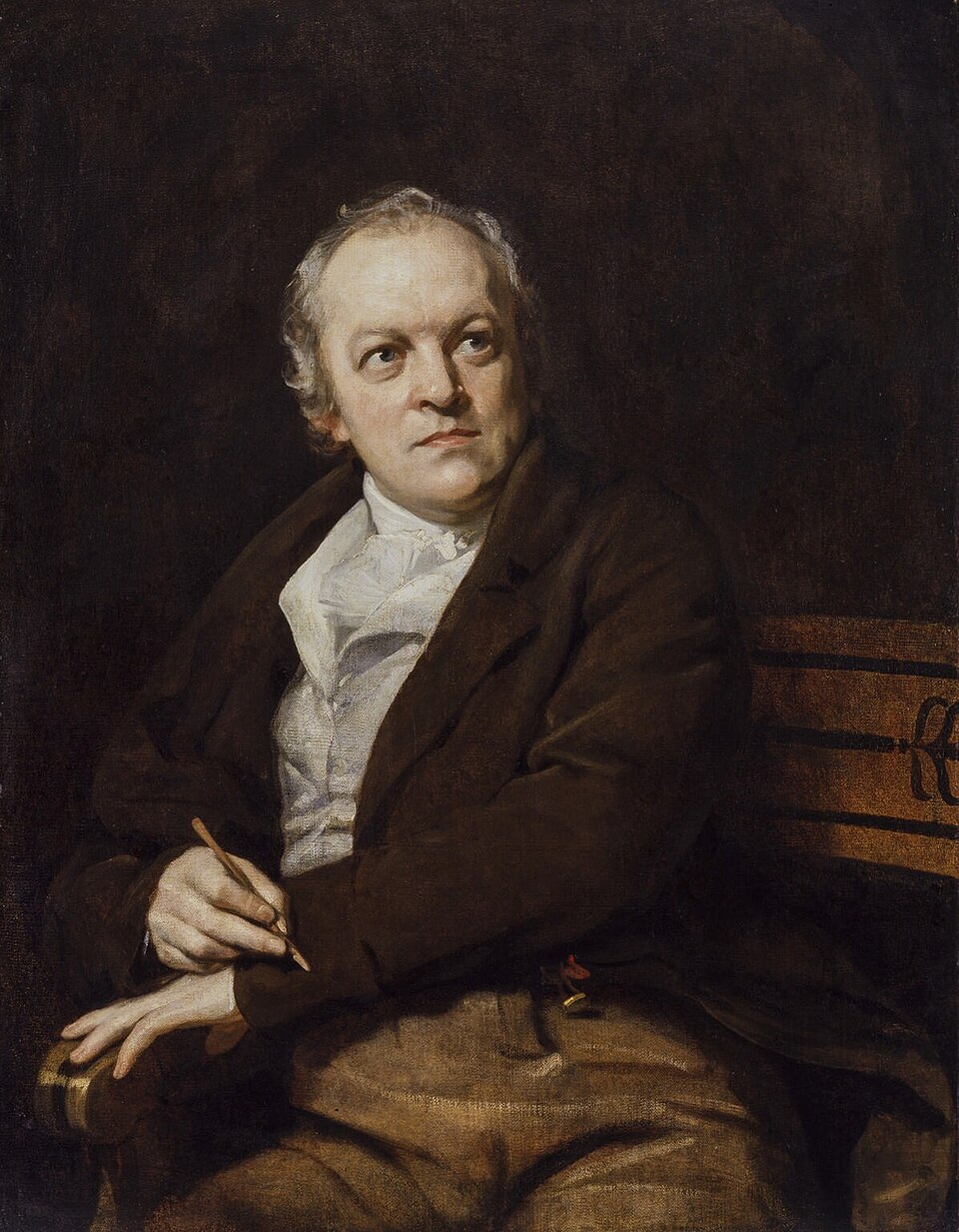
The English poet and printmaker who forged myth from copper plates — unrecognised in his lifetime, foundational to every age since.
William Blake spent his life in London, made copper plates sing, and built a private mythology that no contemporary understood. The recognition came a century late — but it came complete.
Illuminated printing
Blake trained as an engraver and used the trade's tools to circumvent every literary middleman. His method — relief etching — allowed him to write, illustrate, and print each page as a single unified object. Words and images were never separated. The result was a body of work that existed in no more than a handful of hand-coloured copies, each slightly different, each irreproducible.1
Songs of Innocence (1789) established the technique. Songs of Experience (1794) completed the dialectic — innocent vision answered by bitter knowledge, lamb by tiger, pastoral by city.
Tyger Tyger, burning bright, In the forests of the night; What immortal hand or eye, Could frame thy fearful symmetry?
Prophecy and mythology
Beyond the Songs, Blake constructed an elaborate private cosmology across his prophetic books. The Marriage of Heaven and Hell (c. 1790–1793) inverted orthodox morality with systematic ferocity. Milton: A Poem (1804–1811) and Jerusalem: The Emanation of the Giant Albion (1804–1820) expanded the mythology into epic scale. Critic Northrop Frye described these works as forming what is, in proportion to its merits, the least read body of poetry in the English language.
The prophetic books were almost entirely unknown in Blake's lifetime. He sold almost nothing.
London and isolation
Blake never left England except for three years at Felpham, Sussex (1800–1803), where he worked under the patronage of William Hayley. The arrangement ended badly. He returned to London and remained there, producing illuminated books in near-complete obscurity, sustained by commercial engraving commissions and the conviction of his visions.
His reputation was rehabilitated only in the 1860s by Alexander Gilchrist's biography, published two years after Gilchrist's own death.
Footnotes
- Blake's relief etching reversed the conventional intaglio process — he painted the design in acid-resistant material and etched away the background, so the raised surface could be inked directly. ↩