Yayoi Kusama
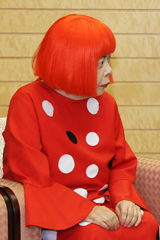
A Japanese artist who turned obsessive repetition — the dot, the net, the mirror — into one of the most immediately recognisable visual languages of the twentieth and twenty-first centuries.
Yayoi Kusama has been covering surfaces — canvas, walls, furniture, her own body, museum floors — with polka dots and obsessive net patterns since the 1950s. What began as a response to childhood hallucinations became one of the most sustained and publicly beloved artistic practices of the past century. Still working from a psychiatric facility in Tokyo that she entered voluntarily in 1977, she is by most market measures the world's most successful living female artist.
Origins and early hallucinations
Kusama was born in 1929 in Matsumoto, a city in the Nagano Prefecture of Japan, to a family of seed merchants. Her childhood was marked by an emotionally difficult home environment and by visual hallucinations she has described as flowers that spoke to her and auras dissolving into dots. She began drawing compulsively from a young age, covering her notebooks with nets and dots as a means of capturing and stabilising what she saw — a practice she has characterised as "obliteration," the absorption of self and surroundings into pattern. She studied traditional Nihonga painting in Kyoto before concluding that the conservative Japanese art world offered no space for her ambitions.
New York and international emergence
On the advice of Georgia O'Keeffe, whose work she had admired from afar, Kusama moved to New York in 1957. Her Infinity Net paintings — vast, monochromatic canvases covered edge to edge with obsessively painted loops — attracted the attention of critics and artists. She knew Donald Judd, who admired her work, and was contemporaneous with Andy Warhol and Claes Oldenburg, both of whom were working with repetition and mass-produced imagery; scholars have discussed mutual influence without resolving lines of priority.1
Her performances and happenings in the 1960s — nude body-painting events in public spaces, anti-war "Anatomic Explosions" on Wall Street — pushed her beyond the gallery and into the cultural mainstream. She launched a fashion line, wrote experimental novels, and produced film work, all while maintaining an extraordinarily productive studio practice.
The Infinity Rooms and global reach
The Infinity Mirror Rooms — mirrored chambers containing lights or objects that multiply to apparent infinity — have their roots in her 1960s installations but achieved mass visibility from the 1990s onward. Works such as Infinity Mirror Room — Phalli's Field (1965, reconstructed) and Infinity Mirrored Room — The Souls of Millions of Light Years Away (2013) have been among the most widely photographed artworks in museum history, generating queues of hours and reshaping museum programming around immersive experience. The phenomenon raises genuine questions about depth versus spectacle, which Kusama has always answered by producing work of evident consistency and seriousness alongside the crowd-pleasing rooms.
| Category | Characteristic works |
|---|---|
| Infinity Net paintings | Monochromatic looping nets, 1958–present |
| Soft sculptures | Accumulation series; fabric-covered furniture |
| Infinity Mirror Rooms | Mirrored immersive installations, 1965–present |
| Pumpkin works | Polka-dotted pumpkin sculptures, 1990s–present |
Voluntary confinement and continued production
In 1977 Kusama moved into a psychiatric facility in Shinjuku, Tokyo, on a voluntary basis, citing the need for structured support. She has lived there since, walking to her nearby studio each day. The arrangement has not curtailed output; if anything, her production has accelerated in her seventies, eighties, and nineties. She has published novels, poetry, and memoir. Major retrospectives — at the Whitney Museum, the Tate Modern, and the Reina Sofía — have confirmed her art-historical standing alongside market valuations that rank her among the most commercially significant artists alive.
My art originates from hallucinations only I can see. I translated the hallucinations and the fear of them into paintings.
Footnotes
- Kusama showed her Infinity Net paintings at the Brata Gallery in 1959, before Warhol's serial silkscreens; some historians have argued for her priority in establishing repetition as a primary artistic strategy in New York. ↩