Agnès Varda
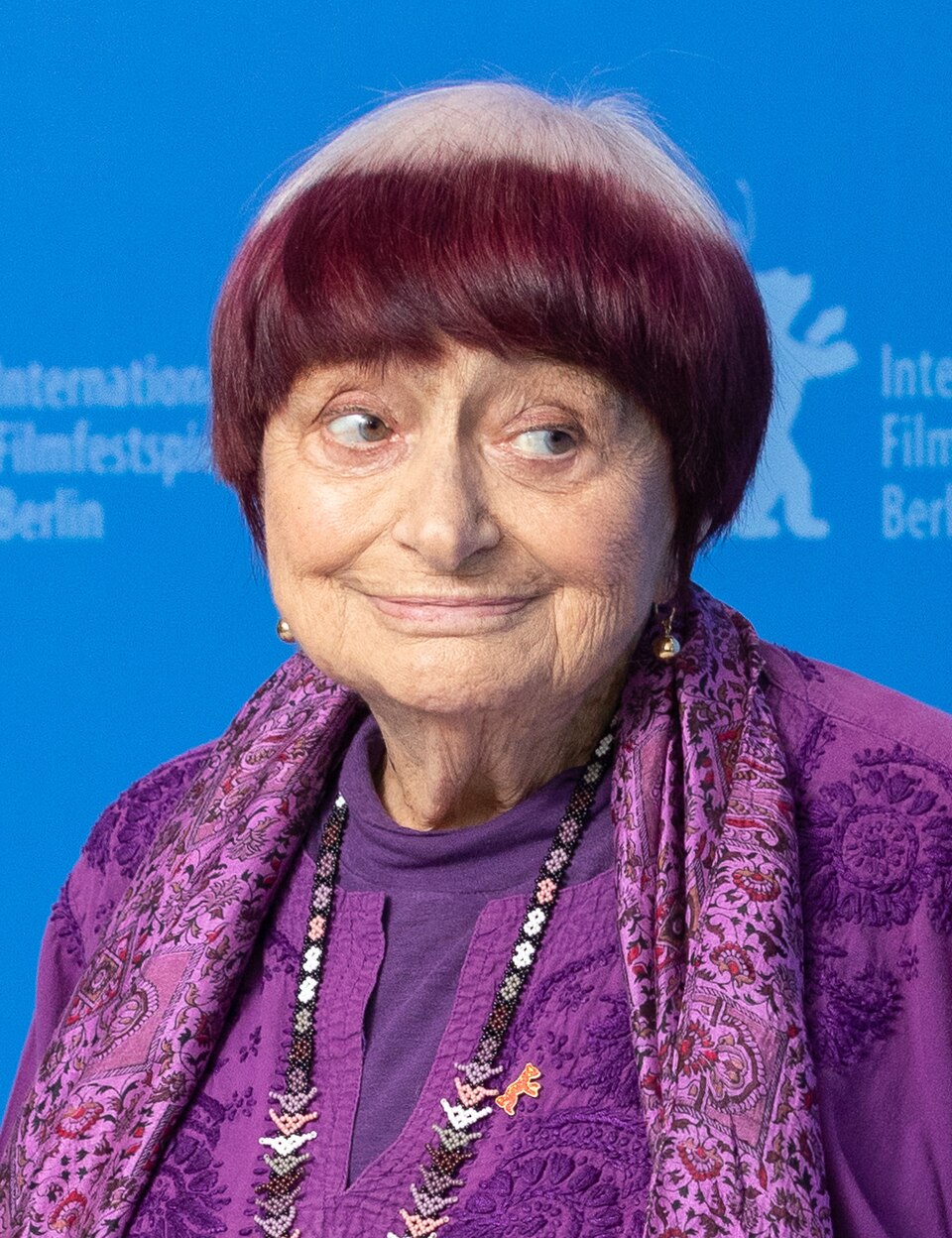
A filmmaker who began with a camera she barely knew how to operate and spent sixty years inventing a cinema that thought about itself while looking at the world.
Agnès Varda made her first feature, La Pointe Courte, in 1955 — four years before the films usually cited as launching the French New Wave — with no formal film training, a borrowed camera, and a fishing village as her subject. She continued making films for another six decades, and the work never settled into a style so much as a method: curiosity, formal experiment, and the conviction that looking carefully at small lives is as serious a project as looking at large ones.
Origins and first films
Varda was born in Ixelles, Belgium, and grew up in France. She trained as a photographer and worked as the official photographer of the Théâtre National Populaire in Paris before turning to film. La Pointe Courte (1955), shot in the fishing village of Sète, intercut a fictional drama between a couple with documentary observation of village life — a structural idea that anticipated the concerns of an entire generation of filmmakers. Alain Resnais edited the film, and it circulated among the filmmakers who would become the New Wave. Varda remained peripheral to the canonical grouping — she was not a critic at Cahiers du Cinéma — which may be why her centrality took decades to be fully acknowledged.1
The defining work
Cléo de 5 à 7 (1962) follows a singer through Paris in near-real time during the two hours she waits for biopsy results. The film thinks in time as explicitly as any fiction feature of the period, and it thinks about women looking and being looked at — a preoccupation that runs through Varda's entire career. Vagabond (Sans toit ni loi, 1985), which won the Golden Lion at Venice, began with a young woman's frozen body discovered in a ditch and reconstructed her final weeks through a fragmented series of testimonies. The film is simultaneously a social document and a formal argument about what cinema can and cannot retrieve.
| Film | Year | Context |
|---|---|---|
| La Pointe Courte | 1955 | Debut feature; fishing village, documentary-fiction hybrid |
| Cléo de 5 à 7 | 1962 | Near-real-time; the female gaze examined |
| Vagabond (Sans toit ni loi) | 1985 | Golden Lion, Venice; fragmented testimony |
| The Gleaners and I | 2000 | Digital essay-film; gleaning as metaphor |
| Faces Places (Visages Villages) | 2017 | Collaboration with JR; Academy Award nomination |
Method and late career
In 2000, Varda used a small digital camera to make The Gleaners and I (Les glaneurs et la glaneuse), a film that followed people who gather leftover food from fields and markets. The film turned a sociological observation into an autobiography — Varda herself became a gleaner, collecting images. It marked her full transition into the essay-film mode she had always been approaching. Her 2017 collaboration with the street artist JR, Faces Places (Visages Villages), earned an Academy Award nomination for Best Documentary Feature and introduced her work to a new generation. She received an Honorary Academy Award in 2017 and a Palme d'Or at Cannes in 2015.
Legacy
Varda's influence is both formal — the essay-film owes her a large debt — and ethical. She demonstrated that cinema could be made outside institutional structures without losing intellectual seriousness, and that subjects deemed marginal (gleaners, beach vendors, island communities) were fully adequate to the demands of art. She died in Paris on 29 March 2019.
Chance is the greatest director of all.
Footnotes
- Varda's position outside the core Cahiers group long affected how her work was received and canonised; feminist film scholars from the 1980s onward have argued for her centrality more strongly than earlier histories allowed. ↩