Michelangelo Antonioni
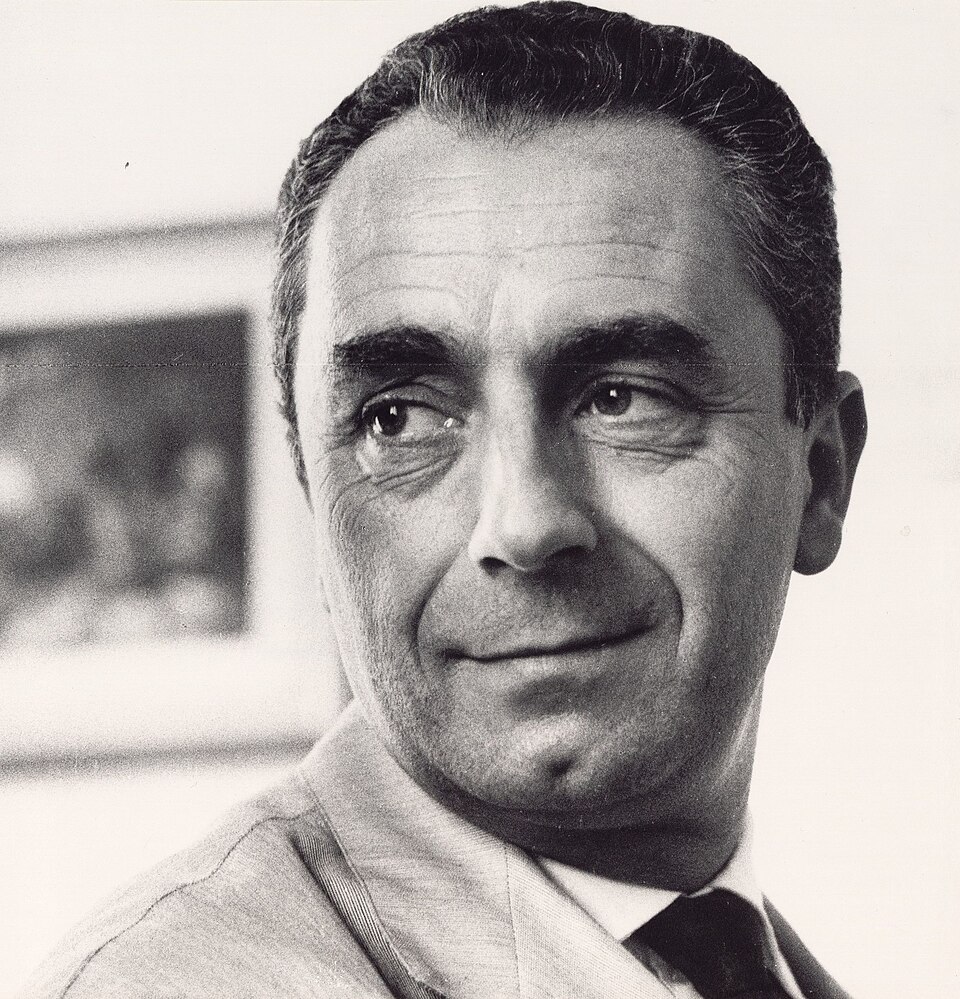
The Italian director who replaced plot with atmosphere and built a cinema of interior estrangement from the ruins of narrative.
Michelangelo Antonioni made films in which people drift rather than decide, and landscapes swallow the characters who stand in them. His rejection of causal narrative and his concentration on visual texture and emotional vacancy produced some of the twentieth century's most formally rigorous art cinema.
Formation in Ferrara and Rome
Antonioni was born in Ferrara in 1912 and studied economics before turning to film criticism and, in 1942, directing. Early short documentaries and work as a screenwriter trained his eye before he committed fully to feature filmmaking. His first features in the early 1950s showed an interest in social dislocation, but it was the shift toward an almost plotless structure at the close of the decade that defined his mature voice.
The alienation trilogy
Between 1960 and 1962 Antonioni made three consecutive films — L'Avventura, La Notte, and L'Eclisse — that together constitute what critics have called the alienation trilogy. A woman vanishes in L'Avventura; the investigation of her disappearance is gradually abandoned as the survivors begin their own entanglement. In La Notte a marriage exhausts itself across a single day and night in Milan. L'Eclisse ends with a series of shots of an empty street corner, no characters in frame — cinema's most sustained meditation on absence. The trilogy was shot in black and white by cinematographer Aldo Scavarda and Gianni Di Venanzo, and its compositions treat buildings and vacant lots as presences equal to the actors.
Eros is sick; man is not adjusted to the modern world.
The English-language films
In 1966 Antonioni directed Blowup, a co-production set in swinging London. A fashion photographer, enlarging his images, believes he has recorded a murder — but the evidence dissolves under scrutiny. The film addressed the gap between photographic representation and reality, and its surface glamour masked a rigorous scepticism about what images can prove. The Passenger (1975), starring Jack Nicholson, pushed further into identity and self-erasure: a journalist assumes a dead man's papers and life, moving toward an ending that refuses resolution with a single long, slow camera movement through a window grille — technically audacious and philosophically precise.
Visual method and legacy
Antonioni's formal signature was the long take with slow lateral movement, allowing his camera to linger after characters exit frame, recording the space they left rather than following them. Colour, used from Red Desert (1964) onward, became expressive rather than realistic — the industrial landscape of that film was reportedly repainted to suit the film's palette. He collaborated closely with production designers and was precise about locations, selecting them for their psychological charge. His influence on the slow cinema movement — filmmakers such as Béla Tarr, Chantal Akerman, and Hou Hsiao-hsien — is consistently cited. He received an honorary Academy Award in 1995.