Wes Anderson
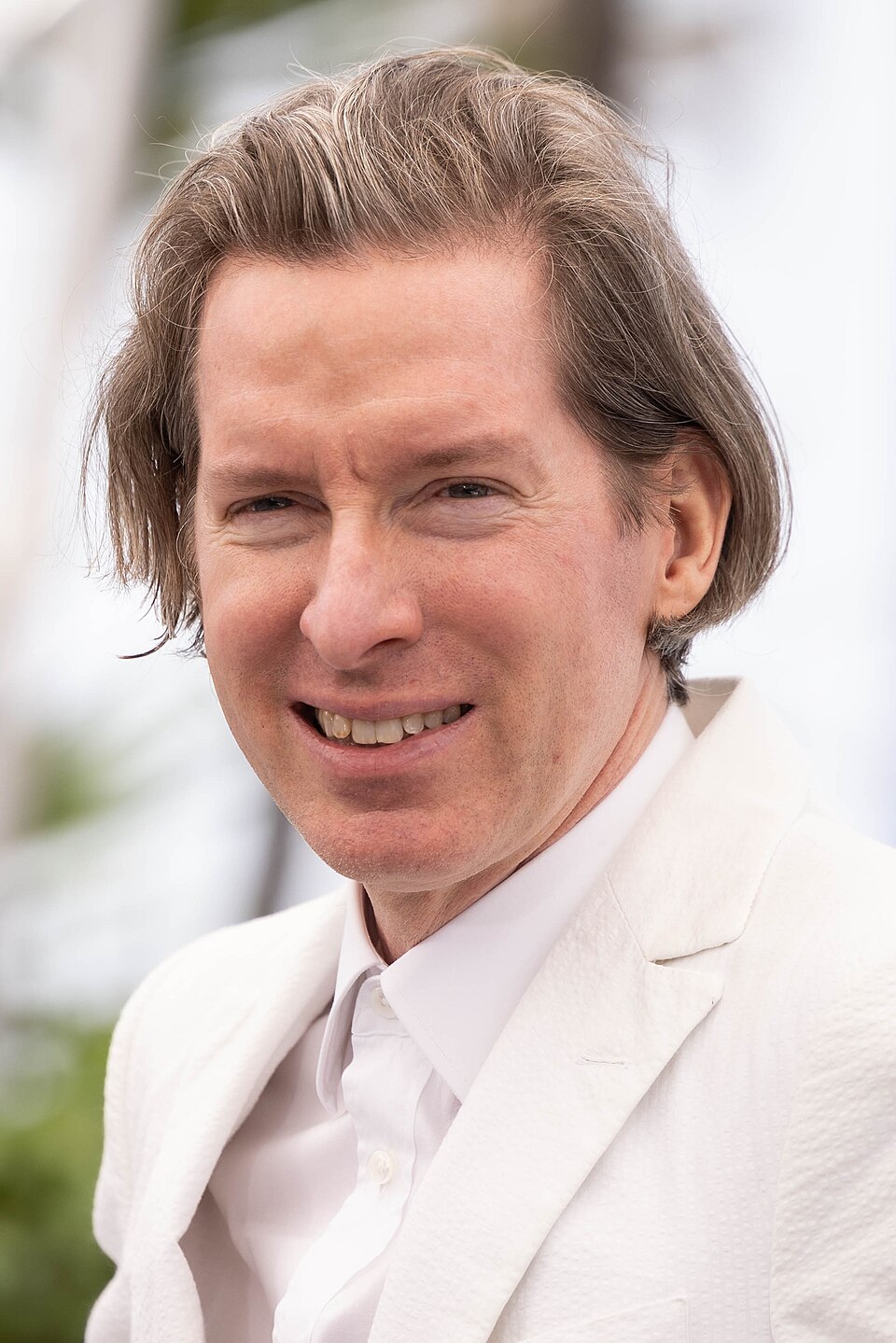
The filmmaker who turned every frame into a dollhouse and every film into a controlled elegy for innocence.
Wes Anderson is an American filmmaker whose work is immediately, unmistakably his own — every shot centred, every palette scripted, every family broken and straining toward repair. Across three decades he has refined a cinema of deadpan grief, building dollhouse worlds precise enough to hold genuine feeling.
Houston to Austin: origins of a style
Anderson grew up in Houston, Texas, the middle of three sons whose parents divorced when he was eight — a biographical rupture that would echo across his entire body of work. At the University of Texas at Austin he studied philosophy and met Owen Wilson, a fellow student with whom he began writing. Their short film Bottle Rocket (1994), shot on a shoestring in Texas, caught the attention of producer James L. Brooks and was expanded into a feature released in 1996. It introduced the template: offbeat ensemble, meticulous production design, and a heist story that was really a story about belonging.
Rushmore (1998) sharpened everything. Max Fischer — overcommitted, delusional, lovable — became the prototype Anderson protagonist: a child-adult whose elaborate defence mechanisms cannot quite conceal his longing. Bill Murray appeared for the first time in what would become a recurring partnership, deadpan anchor to Anderson's ornate world.
The Royal Tenenbaums and the ensemble family
The Royal Tenenbaums (2001) is the film that established Anderson as a major voice. Narrated like a novel, scored with Nico and Elliot Smith, built around a disgraced patriarch's return to a family of failed prodigies, it located the emotional engine beneath the stylisation — grief, self-invention, and the damage parents inflict. Anderson received his first Academy Award nomination for Best Original Screenplay.
The films that followed — The Life Aquatic with Steve Zissou (2004), The Darjeeling Limited (2007), Moonrise Kingdom (2012) — extended the obsessions: fathers and sons, expeditions that go sideways, children who understand the world better than the adults around them. Fantastic Mr. Fox (2009) moved into stop-motion animation, earning a Best Animated Feature nomination and proving that the style translated perfectly to puppets — perhaps inevitably, given its always-already-artificial quality.1
Method: the symmetrical machine
Anderson's visual grammar is by now as codified as any director's in the history of the medium.
| Element | Description |
|---|---|
| Planimetric staging | Camera perpendicular to the scene; actors aligned in a single plane |
| Centred symmetry | Every significant composition bisected by a vertical axis |
| Whip pan | Rapid lateral cut between symmetrical spaces |
| Chapter cards | Title cards divide films like novels |
| Ensemble casts | Recurring company: Murray, Owen Wilson, Anjelica Huston, Adrien Brody, Tilda Swinton |
| Colour scripting | Each film has a rigorously pre-designed palette; pastel primaries dominate |
| Miniatures | Scale models deployed alongside live action and stop-motion |
The effect is not coldness but a precise emotional temperature — melancholy held at arm's length long enough to be examined. Anderson constructs grief the way a watchmaker constructs a mechanism: every part visible, every part necessary.
I always want to make a movie that feels like something you haven't quite seen before — but also like a memory of something.
The Grand Budapest Hotel and the peak of ambition
The Grand Budapest Hotel (2014) is Anderson's most awarded and most architecturally ambitious film. A nested Russian-doll narrative set in a fictional Central European republic between the wars, it won four Academy Awards — Best Costume Design, Best Production Design, Best Original Score, and Best Film Editing — and earned Anderson his first directing nomination. Ralph Fiennes as the legendary concierge M. Gustave H. gave the film its emotional centre: a man performing civilisation against oncoming barbarism. Anderson also won the BAFTA for Best Original Screenplay.
Isle of Dogs (2018), a second stop-motion feature, won the Silver Bear for Best Director at Berlin. The French Dispatch (2021) and Asteroid City (2023) continued to elaborate the system — the latter almost Brechtian in its layering of fiction within fiction.
In 2024, Anderson won the Academy Award for Best Live Action Short Film for The Wonderful Story of Henry Sugar, an adaptation of Roald Dahl's story. Rushmore and The Grand Budapest Hotel have been inducted into the United States National Film Registry.
Footnotes
- Anderson has cited the influence of animators Ray Harryhausen and Henry Selick; the stop-motion aesthetic was a natural extension of the handcrafted quality already present in his live-action miniatures and diorama-like set design. ↩