Pedro Almodóvar
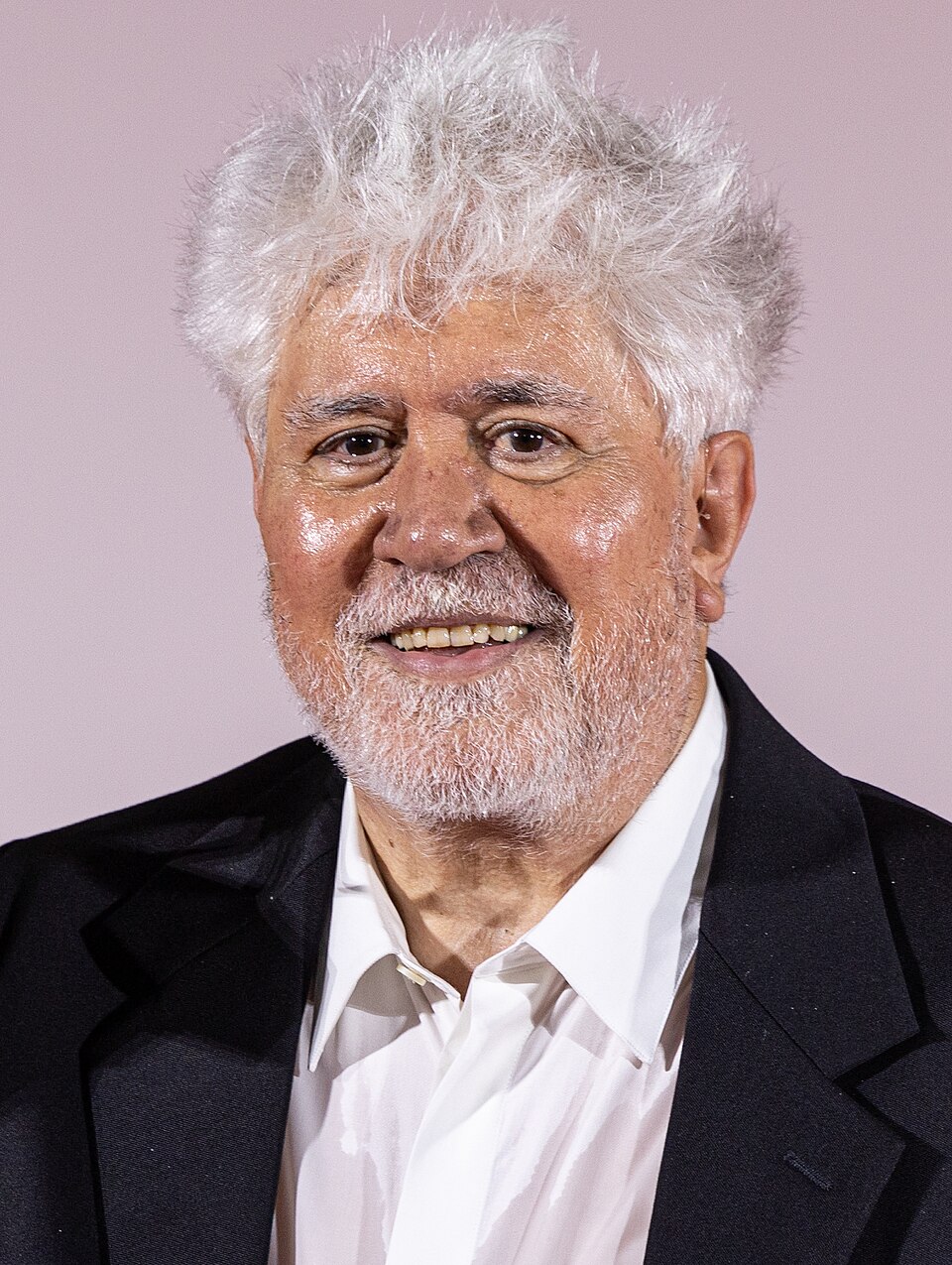
A director who built an entire cinema out of melodrama and bright colour, turning Spain's post-Franco liberation into a body of work recognised everywhere.
Pedro Almodóvar grew up in La Mancha and arrived in Madrid with no money and no film training. He became the most internationally recognised Spanish filmmaker of his generation by making pictures that were loud, emotional, and formally controlled — melodramas about women, desire, grief, and identity, shot in colours sharp enough to read as argument.
Formation and the Movida
Almodóvar was born in Calzada de Calatrava in 1949 and moved to Madrid as a teenager. He found work at the national telephone company Telefónica, where he stayed for twelve years while making Super-8 films in his spare time and performing with a theatre group. His early career coincided with the Movida Madrileña — the cultural explosion that followed Francisco Franco's death in 1975 — and his sensibility is inseparable from that moment: transgressive, campy, openly queer, and impatient with the Spain that had existed before.1
His debut feature, Pepi, Luci, Bom (1980), was shot over eighteen months on weekends with a borrowed camera and a largely non-professional cast. It was rough, deliberately offensive, and immediately identified as something new. A sequence of low-budget features followed through the early 1980s, each refining his vocabulary of heightened emotion, pop-cultural quotation, and outrageous narrative turns.
International breakthrough
Women on the Verge of a Nervous Breakdown (1988) was the film that carried Almodóvar beyond the Spanish market. A screwball farce built on precise formal control — colour, set design, and comic timing working together — it received an Academy Award nomination for Best Foreign Language Film and established him as a figure of international attention. The films that followed, among them Tie Me Up! Tie Me Down! (1989) and High Heels (1991), maintained his profile while extending his range toward darker emotional territory.
All About My Mother (1999) marked a decisive consolidation of his reputation. The film follows a woman who travels to Barcelona after her son is killed, and it gathers around her a group of characters — transsexual, HIV-positive, a nun, a fading actress — whose lives compose a meditation on loss, identity, and performance. It won the Academy Award for Best Foreign Language Film and Best Director at the Cannes Film Festival.2
Mature work
Talk to Her (2002) won the Academy Award for Best Original Screenplay — the first time Almodóvar received an Oscar for his writing. The film's construction, in which two men care for two women in comas and a film-within-a-film carries the narrative's most extreme material, demonstrated how far he had developed the melodramatic form as a vehicle for formal complexity.
Volver (2006), starring Penélope Cruz, returned to La Mancha and to questions of motherhood and female solidarity. Pain and Glory (2019), a self-portrait in fictional form starring Antonio Banderas, won Best Director at Cannes and was widely read as a reckoning with ageing, addiction, and artistic identity.
The Room Next Door (2024), his first English-language feature, starred Tilda Swinton and Julianne Moore in a film about a terminally ill journalist and her friend. It won the Golden Lion at the Venice Film Festival.
Advocacy and production
Almodóvar is openly gay and has been a consistent public advocate for LGBTQ+ rights in Spain across four decades of shifting political conditions. In 1986 he founded El Deseo with his brother Agustín Almodóvar, a production company that has produced all of his features since Law of Desire (1987) and has supported work by other Spanish filmmakers.
Melodrama is a genre that refuses to pretend that feelings are small.
Footnotes
- Almodóvar's early Super-8 work circulated in bars and clubs in Madrid before he had access to proper film equipment; his connection to the Movida was participatory, not merely atmospheric. ↩
- All About My Mother won Best Director at Cannes 1999 and the Academy Award for Best Foreign Language Film — a rare double recognition for a single film. ↩