Alexey Brodovitch
The art director who remade American fashion publishing as a discipline of movement, tension, and surprise, and trained a generation of photographers to see the same way.
Alexey Brodovitch held the position of art director at Harper's Bazaar for twenty-four years and in that time transformed the visual language of the American fashion magazine — introducing cinematic sequencing, radical white space, and a photographic sensibility that treated the editorial spread as a unified composition rather than a container for images. Outside the magazine office he ran the Design Laboratory, a workshop whose alumni included Richard Avedon and Irving Penn, and whose single standing demand was that students astonish him.
Origins and formation
Brodovitch was born in 1898 in Aholičy, a village in what is now Belarus, and grew up in Russia. He served in the First World War and fought in the White Army during the Russian Civil War before leaving Russia after the Revolution. He settled in Paris in the early 1920s, where he worked as a poster designer and painter, absorbing the formal energy of the Ballets Russes — Diaghilev's company, for which he admired the set and costume work of Picasso, Matisse, and Braque — and the broader dynamism of the Parisian avant-garde.
In 1930 he moved to the United States, initially teaching at the Philadelphia Museum College of Art. His reputation as a designer and teacher grew quickly, and in 1934 he was appointed art director of Harper's Bazaar, then under the editorship of Carmel Snow.
Harper's Bazaar
Brodovitch's twenty-four years at Harper's Bazaar (1934–1958) are the central fact of his career. He treated each issue as a designed object rather than an assembled publication. Photographs were cropped, scaled, and sequenced to create rhythm across pages; text was set to work with image rather than alongside it; white space was used not as absence but as active element. He brought in photographers whose work aligned with his visual instincts — Martin Munkácsi, Man Ray, Brassaï, Henri Cartier-Bresson — and later shaped the careers of photographers who would define the postwar period.
His relationship with Richard Avedon was particularly formative: Brodovitch recognised Avedon's talent early, provided him with the editorial context in which to develop it, and maintained a close professional collaboration for years. Irving Penn was another whose work developed in the environment Brodovitch cultivated, though Penn was more closely associated with Vogue.
The magazine under Brodovitch became a reference point for graphic designers across disciplines, not merely fashion editors.
Ballet and the Design Laboratory
In 1945, Brodovitch published Ballet — a book of his own photographs taken at ballet performances over several years, printed with motion blur and dramatic cropping deliberately retained. The book is a sustained argument about photography as a medium for capturing duration rather than freezing instants. Its design — asymmetric layouts, high contrast, extensive use of black — was as considered as any of his magazine work.
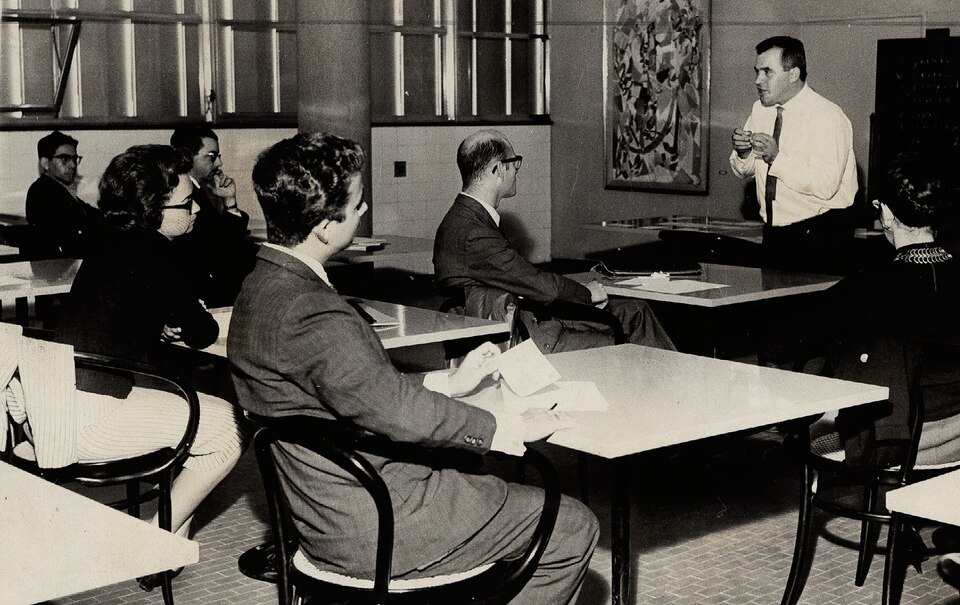
His Design Laboratory workshops, held in New York and Philadelphia, were teaching events of a different character from conventional art school instruction. Brodovitch brought in practitioners, critiqued work with intensity, and operated under a principle he stated plainly to students: that their job was to produce something he had not seen before. The phrase attributed to him — "Astonish me" — was not a loose aspiration but a standing condition.
Legacy
Brodovitch left Harper's Bazaar in 1958 and spent his final years in deteriorating health, living in Le Thor, France, where he died in 1971. His influence on American graphic design and editorial photography is difficult to overstate: the visual conventions he established at Bazaar — dynamic layout, the cinematic spread, the photographer as visual author — became the grammar of serious magazine design for the rest of the twentieth century. The photographers he trained and encouraged carried his sensibility into advertising, portraiture, and fine art photography.
Astonish me.