Ansel Adams
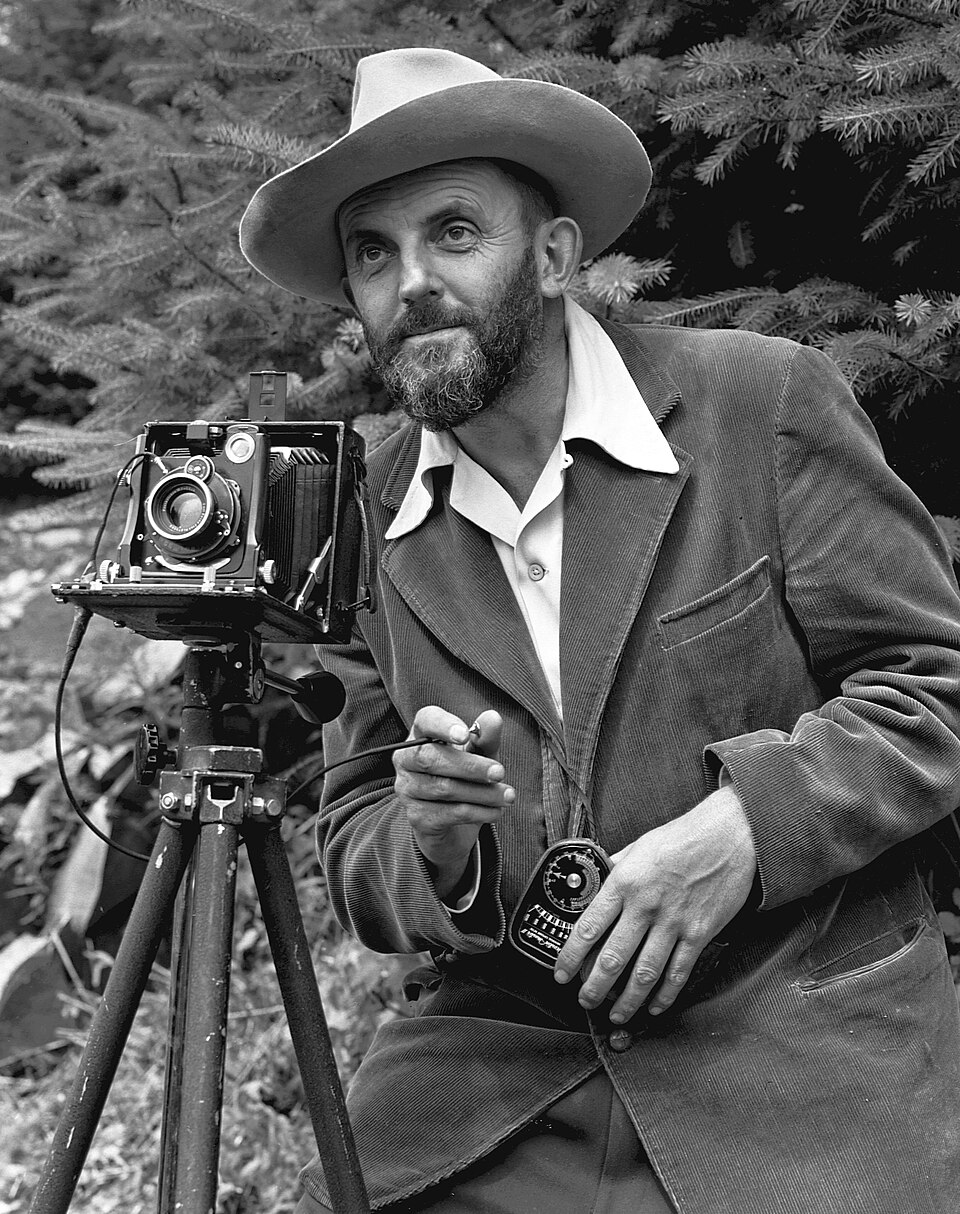
The photographer who proved that a landscape could be both a precise technical document and an act of moral witness.
Ansel Adams spent a lifetime making black-and-white photographs of the American West so precisely calibrated — from exposure through darkroom — that they could carry the full weight of the wilderness they depicted. He was simultaneously a master technician and an impassioned conservationist, and he refused to separate those roles.
Formation in Yosemite
Adams was fourteen when his family visited Yosemite National Park in 1916 and gave him his first camera, a Kodak Box Brownie. The valley became a lifelong subject and spiritual home. He joined the Sierra Club in 1919, guiding summer outings while deepening his photographic practice. His early work — still soft-edged and Pictorialist in approach — sharpened steadily as he came under the influence of the sharp-focus, full-tonal-range aesthetic championed by photographer Paul Strand, whose prints he encountered in 1930.1
By the early 1930s Adams was committed to what he and his peers would call "straight" photography: unmanipulated, unretouched, technically exacting — the antithesis of the painterly soft-focus Pictorialism that had dominated fine-art photography for decades.
Group f/64 and the Straight Photography Manifesto
In 1932, Adams co-founded Group f/64 with Edward Weston, Imogen Cunningham, and four other photographers working in the San Francisco Bay Area. The group took its name from the smallest aperture setting on a large-format camera — the stop that yields the greatest depth of field and sharpest rendering across an entire scene. Their inaugural exhibition at the M. H. de Young Memorial Museum in San Francisco announced that photography had its own aesthetic logic, distinct from painting, and that this logic demanded clarity, precision, and an honest rendering of the world.
The negative is the score, the print is the performance.
The Zone System
Adams's most lasting technical contribution was the Zone System, developed with photographer and teacher Fred Archer around 1939–1940 at the Art Center School in Los Angeles. The system divides the tonal range of a photographic image into eleven numbered zones — from pure black (Zone 0) to pure white (Zone X) — and gives the photographer a vocabulary for pre-visualising the finished print before the shutter is released. By adjusting exposure and development time in tandem, a photographer could place any tone in the scene at any chosen zone in the print.
| Zone | Tone | Example |
|---|---|---|
| 0 | Maximum black | No detail |
| III | Dark shadows | Shadow detail in dark rock |
| V | Middle grey | Average skin tone, grey card |
| VIII | Bright highlights | Snow with texture |
| X | Maximum white | Specular reflections |
Adams codified the system across his Basic Photo series of five books published between 1948 and 1956, which became standard texts in photographic education for decades.
Conservation and Legacy
Adams understood his photographs as arguments. His advocacy and a portfolio shown to Secretary of the Interior Harold Ickes contributed to the establishment of Kings Canyon National Park in 1940.2 Contracted by the United States Department of the Interior to document national parks, he produced images circulated in Washington as evidence for the parks' worth. His decades of correspondence with politicians and testimony before Congress helped expand and protect the national park system. In 1980, President Jimmy Carter awarded him the Presidential Medal of Freedom — the nation's highest civilian honour — citing both his art and his environmental work.
Beyond conservation, Adams was central to photography's institutional legitimacy. He was a key advisor in the founding of the photography department at the Museum of Modern Art in New York, helped found the photography magazine Aperture in 1952, and co-founded the Center for Creative Photography at the University of Arizona in 1975. His 1941 image Moonrise, Hernandez, New Mexico — made in fading evening light, the exposure calculated from memory — became one of the most reproduced photographs in the history of the medium.
Footnotes
- Adams later credited seeing Paul Strand's sharp, contact-printed negatives in 1930 as a decisive influence on his shift away from Pictorialism. ↩
- Kings Canyon National Park was designated in 1940 following sustained lobbying by Adams, the Sierra Club, and others who resisted proposals to dam the Kings River canyon. ↩