Alfred Stieglitz
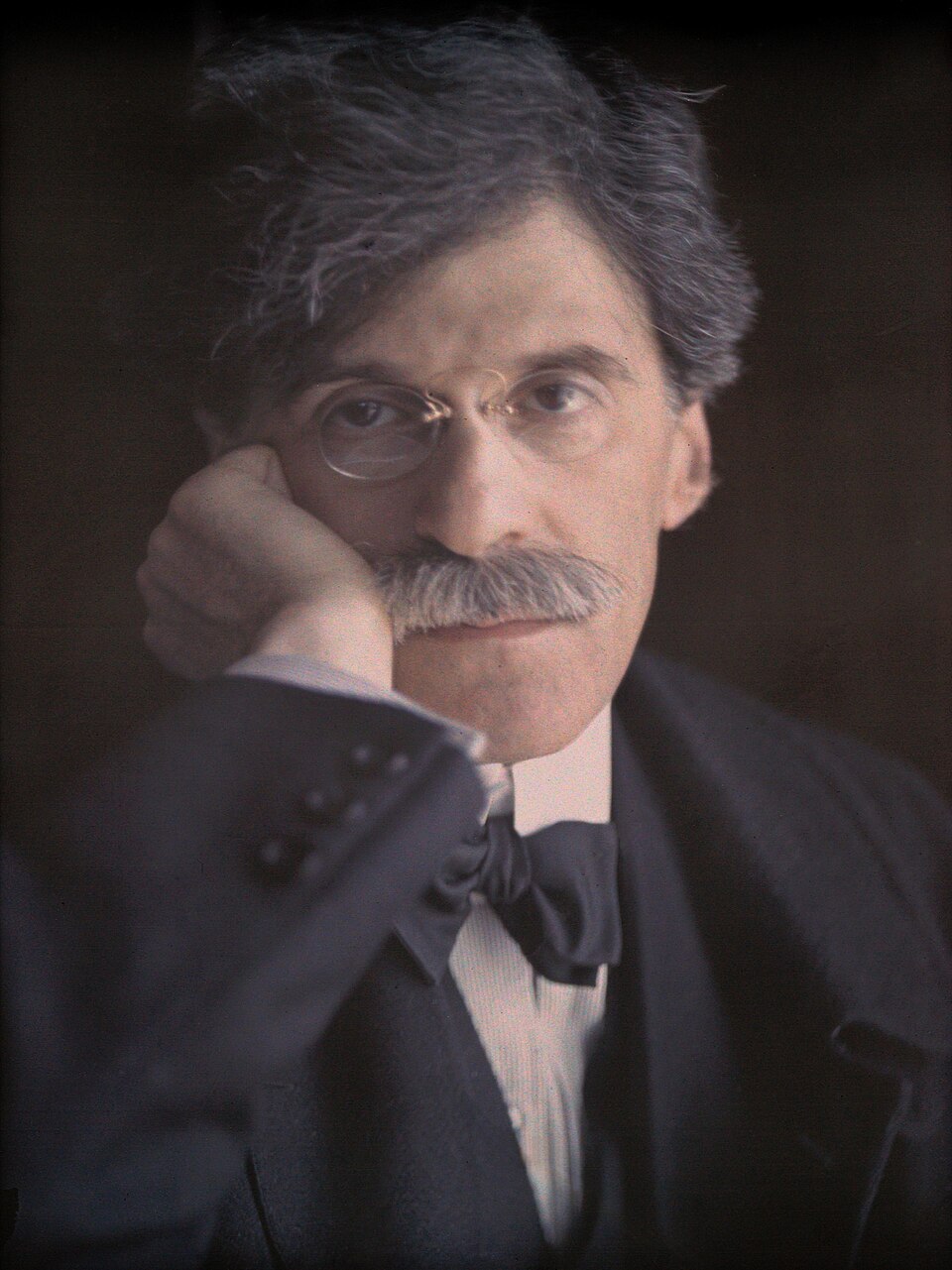
The photographer who turned a small New York gallery into the threshold through which modern art entered America.
Alfred Stieglitz spent fifty years fighting on two fronts simultaneously: for photography's standing as a fine art and for the American public's exposure to European modernism. He won on both counts, and the institutions he built — a journal, two galleries, a community of artists — outlasted every argument he was forced to make.
Formation and the Pictorialist campaign
Stieglitz was born in Hoboken, New Jersey in 1864, the son of a prosperous German-Jewish merchant family. His father sent him to study mechanical engineering in Berlin in 1882; he promptly switched to photochemistry and began photographing in earnest. He returned to New York in 1890 with prizes from European camera clubs and a clear agenda: to prove that the photograph was not merely a record but an image made with intention, craft, and expressive purpose.
That campaign took its first institutional form in 1897, when Stieglitz became editor of Camera Notes, the journal of the Camera Club of New York. He used the platform to publish rigorously reproduced photographs alongside critical essays, setting a standard for photographic printing that no American publication had previously attempted. When he found Camera Club's ambitions too modest, he broke away. In 1902 he founded the Photo-Secession, a loose association of pictorialist photographers — Edward Steichen, Clarence White, Gertrude Käsebier among them — committed to photography as art rather than documentation.
Gallery 291 and Camera Work
The decisive phase of Stieglitz's career opened in 1905 when he and Steichen established a small exhibition space at 291 Fifth Avenue. The "Little Galleries of the Photo-Secession" — soon known simply as 291 — was initially a venue for photography. But Stieglitz's eye ranged further. Between 1908 and 1913, 291 introduced American audiences to work by Rodin, Matisse, Cézanne, Picasso, Brancusi, and Picabia before the Armory Show had attempted anything comparable. The gallery closed in 1917 but the twelve years of its operation established New York as a live participant in the conversation of international modernism rather than a passive consumer of it.
Camera Work, the quarterly he edited and published from 1903 to 1917, ran in parallel. Each issue was typeset with care, illustrated with photogravure reproductions of exceptional quality, and designed as an argument in print form. Fifty numbers appeared; the final issue was devoted entirely to the work of Paul Strand.
I wanted to find out what America was, and what was in it that could justify itself as art.
The Steerage and the Equivalents
His own photography broke from Pictorialism's soft-focus, atmospheric style. The Steerage (1907), made aboard a transatlantic liner on a crossing to Europe, is a composition of extraordinary structural rigour: gangway, chains, funnel, ramp, and the crowded lower deck arranged in a geometry that prefigured the formal concerns of modernism rather than the sentiment of social documentation. Stieglitz later described it as the photograph he cared about most.
In the 1920s and 1930s he turned his camera to the sky, producing the Equivalents series — close-cropped images of clouds, made from the late 1920s onward, that he proposed as direct expressions of psychological states without symbolic content. They remain among the earliest deliberate attempts to make abstract photographs.
Stieglitz married painter Georgia O'Keeffe in 1924, having championed her work at 291 and at subsequent venues. He made hundreds of photographs of O'Keeffe over the following two decades — portraits, hands, details — constituting one of the most sustained photographic studies of a single subject in the history of the medium.
Legacy
After 291 closed, Stieglitz continued gallery work: the Intimate Gallery (1925–1929) and An American Place (1929–1946) were successors in spirit, showing O'Keeffe and a small circle of American modernists. He died in New York in 1946.
His editorial work established the template for the art photography journal; his gallery practice seeded American institutions' taste for European modernism; and his own photographs gave the medium two of its canonical images — The Steerage and the Equivalents — at opposite ends of its expressive range.