Margaret Bourke-White
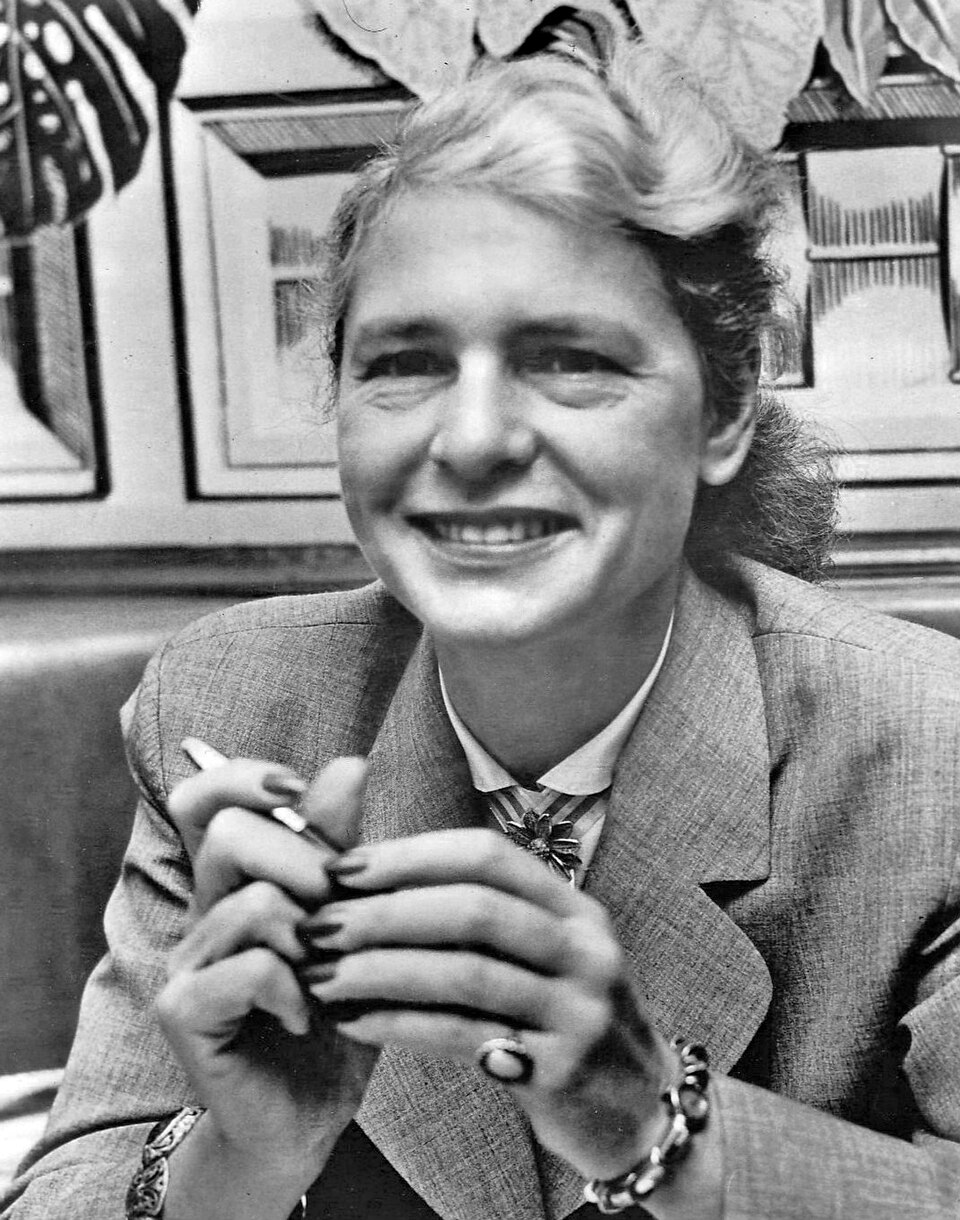
The American photographer who put industrial America on magazine covers, became the first female war correspondent accredited to the US Army, and documented the twentieth century's worst moments without flinching.
Margaret Bourke-White arrived at photojournalism before the profession had fully named itself, and she extended its reach further than almost anyone of her generation. She photographed Soviet steel mills when no foreign camera had been allowed inside them, put a dam on the cover of a magazine that would define the form, documented the liberation of a Nazi concentration camp, and photographed Gandhi the week before his assassination. Her career is the record of a century in its most violent and transformative decades.
Industrial photography and early career
Bourke-White studied at Cornell University after earlier enrolment at Clarence White's photography school and other institutions. She began her professional life photographing steel mills and industrial architecture in Cleveland, Ohio — subjects that most photographers of the late 1920s treated as documentary background rather than pictorial opportunity. Bourke-White saw them differently: the geometry of furnaces, the scale of factory floors, the drama of molten metal as formal material for images that were both rigorous and visually commanding.
This industrial practice brought her to the attention of Henry Luce, who recruited her as a staff photographer for Fortune magazine in 1929. She was the first staff photographer hired by Fortune, and the commission gave her access to the corporate and industrial landscape of Depression-era America on terms that no photographic assignment had previously offered.
Life magazine and Fort Peck
In 1936, Luce launched a new magazine: Life. Bourke-White photographed the Fort Peck Dam under construction in Montana — a massive New Deal infrastructure project — and the resulting image appeared on the cover of Life's first issue on 23 November 1936. The photograph showed the dam's massive concrete buttresses looming over tiny human figures, a composition that made both the ambition of the project and the scale of American industrial capacity immediately legible.
Her place at Life gave her the platform and the resources to pursue the assignments that defined the next two decades of her career.
I think photographers are born, not made. I think there is a vision that comes with birth.
War correspondent
In 1941 Bourke-White was in Moscow when Germany invaded the Soviet Union — she was present to photograph the German air raids on the city, producing images that no other Western photographer had access to. In 1942 she became the first female photographer accredited to the US Army, and covered the North African and Italian campaigns.
In April 1945, she accompanied General Patton's forces to the Buchenwald concentration camp shortly after its liberation. Her photographs of the survivors — methodical, unsparing, made without sentimentality — are among the most important documents of the Holocaust's immediate aftermath, and among the first images of the camps' interior conditions seen by general audiences. Bourke-White described the experience as the most difficult of her career.
In 1948 she photographed Mahatma Gandhi at his spinning wheel in what would be one of the last portraits made before his assassination the following January. The image — Gandhi at work, self-sufficient, unposed — became one of the defining photographs of the independence movement.
Korean War and late years
Bourke-White covered the Korean War in the early 1950s. In 1952 she was diagnosed with Parkinson's disease, which progressively limited her physical capacity but did not immediately end her work. She underwent experimental surgical treatments and continued writing about her experience of the disease. Her autobiography, Portrait of Myself, was published in 1963 — a clear-eyed account of a career conducted at the edge of what was physically and institutionally possible for a woman in her profession.
She died on 27 August 1971 in Darien, Connecticut, aged 67.