Archimedes
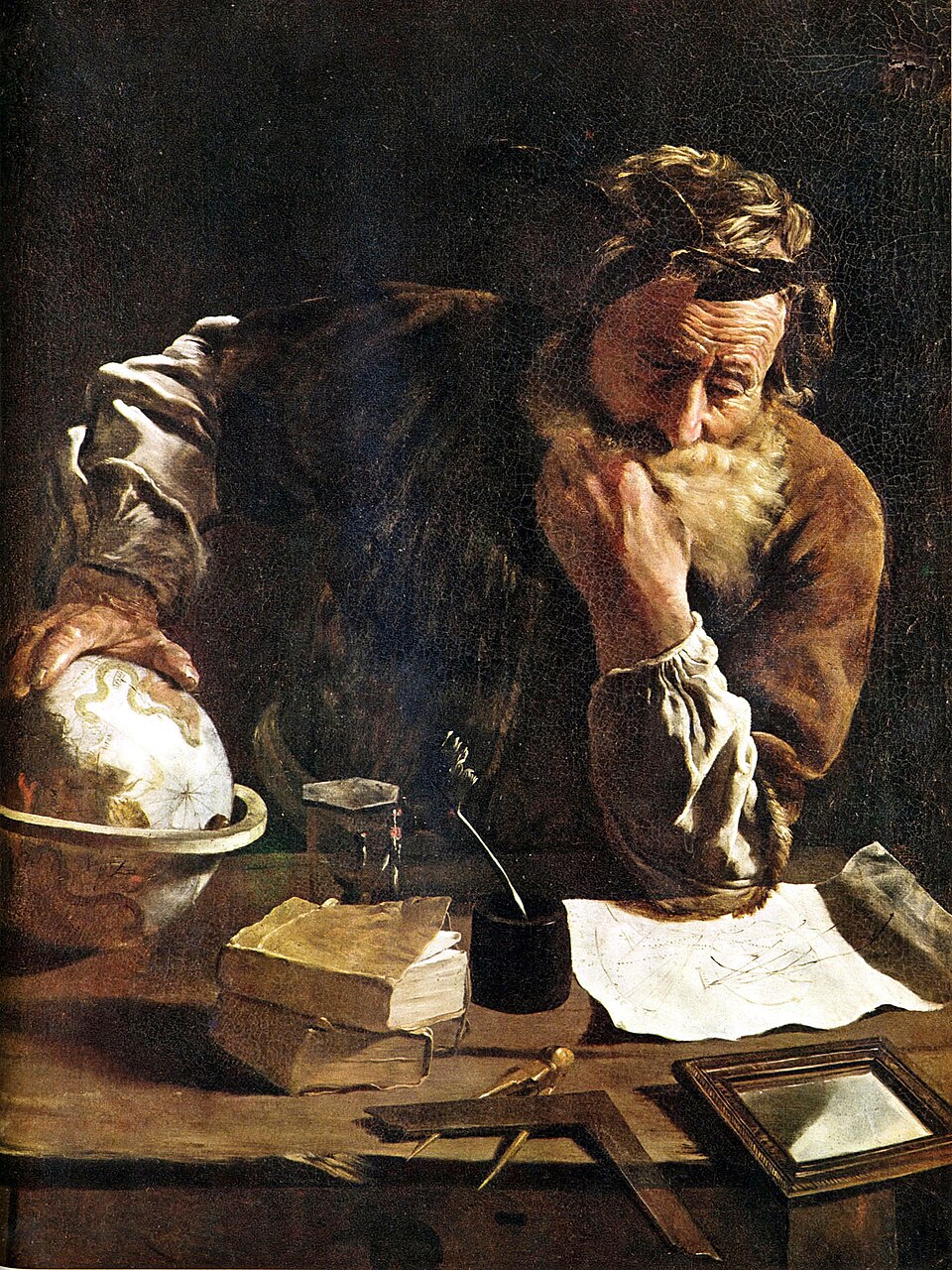
The mathematician of Syracuse who calculated the infinite using only geometry and sand.
Archimedes of Syracuse was the greatest mathematician of antiquity — a figure who anticipated integral calculus by nearly two millennia, derived precise formulas for curved surfaces and volumes, and applied rigorous proof where others offered only approximation. Working in third-century BC Sicily, he extended the reach of Greek mathematics further than any predecessor.
Origins in Syracuse
Archimedes was born around 287 BC in the Greek city-state of Syracuse on the island of Sicily. Ancient sources suggest he may have studied in Alexandria, the intellectual capital of the Hellenistic world, where he likely encountered the work of Euclid. He returned to Syracuse and spent the rest of his life there, working under the patronage of King Hiero II. Few biographical details survive with certainty; what remains is the body of his written work, transmitted in Greek manuscripts.
The mathematical works
His surviving treatises reveal a mathematician of extraordinary range. In On the Measurement of a Circle he bounded π between 223/71 and 22/7 using inscribed and circumscribed polygons with 96 sides. In On the Sphere and Cylinder he proved that a sphere inscribed in a cylinder has two-thirds the volume and two-thirds the surface area of that cylinder — a result he considered his finest. In The Method (rediscovered in 1906 on the so-called Archimedes Palimpsest), he revealed a mechanical technique of thought experiment used to discover results before proving them rigorously — an anticipation of the conceptual framework later formalised as integral calculus.
He also determined the area under a parabolic segment, found the areas of spirals, and computed volumes of segments of paraboloids and hyperboloids. Each proof proceeds by the method of exhaustion — a limiting process in which a sequence of approximations is shown to converge — applied with a logical precision that remained unsurpassed for centuries.
Mechanics and invention
Archimedes made equally consequential contributions to physics and engineering. He formulated the law of the lever precisely: equal weights at equal distances balance; unequal weights balance in inverse proportion to their distances from the fulcrum. He established the principle of buoyancy — that a body immersed in fluid displaces its weight in fluid — the basis of hydrostatics. He designed compound pulleys, war machines used in the defense of Syracuse against Roman forces, and the Archimedean screw, a helical device for raising water still in use today.
Give me a place to stand, and I shall move the earth.
Legacy
Archimedes died around 212 BC when Roman forces under Marcellus captured Syracuse. He is said to have been killed by a Roman soldier despite orders that he be spared. His works were preserved in Arabic translation during the medieval period before returning to Latin Europe; they became foundational reading for Galileo, Newton, and Leibniz. The method of exhaustion he perfected is the direct ancestor of the integral, and his derivations of sphere and cylinder volumes are taught in every university calculus course.
Stories
All stories →